
Web Design Blog
When to Move from a Template to a Bespoke Website: The Professional’s Guide to Scaling
Your off-the-shelf website template isn’t just a bargain; it might actually be the most expensive thing you own. Whilst it served you well during the early days, there comes a point where those rigid layouts and generic vibes start to actively repel the very clients you’re trying to attract. Knowing exactly when to move from a template to a bespoke website is the secret to shifting from a business that looks “fine” to one that commands genuine professional authority.
We’ve all been there, staring at a screen and wondering why a simple layout change feels like pulling teeth. It’s incredibly frustrating when your digital presence doesn’t reflect the premium service you provide or the hard work you’ve put into your brand. This guide reveals the specific tipping points where your template starts costing you more in lost leads than it saves in monthly fees. You’ll discover how to reclaim full ownership of your digital assets, boost your SEO performance, and finally build a platform that earns instant trust from high-end clients.
Key Takeaways
- Spot the red flags of a “rigidity wall” where your template’s limitations prevent you from organising your site exactly how your growing business needs it.
- Discover the exact criteria for when to move from a template to a bespoke website to ensure your online presence reflects your premium service rather than a generic starter kit.
- Learn why a “good enough” layout is a silent lead-killer and how custom code improves both your Google rankings and the instant trust you build with high-value clients.
- Get a clear, jargon-free plan for auditing your current assets and defining the must-have features for your new, high-performance digital headquarters.
The Template Starting Point: Why ‘Off-the-Shelf’ Eventually Hits a Ceiling
Let’s be completely honest: templates are brilliant. When you’re in the “proof of concept” phase of your business, a subscription-based website builder is a total lifesaver. It allows you to get your ideas online quickly without needing a massive capital investment. It’s the digital equivalent of your first flat; it’s functional, it gets the job done, and it’s a place to hang your hat whilst you figure out your next move. There is absolutely no shame in starting there.
However, there comes a point where that flat starts feeling a bit cramped. You can’t move the walls, the plumbing is a mystery, and you’re paying “rent” on a space you’ll never actually own. This is the “Invisible Ceiling.” It’s that frustrating moment when your growth is restricted by the very tool that helped you launch. Knowing when to move from a template to a bespoke website is about recognising that your business has outgrown its starter home. A bespoke build isn’t just a prettier version of what you have; it’s a site built from the ground up, specifically engineered to meet your unique commercial goals.
The Difference Between Customised Templates and Bespoke Builds
Changing the colours or swapping out a few photos on a pre-made theme isn’t the same as custom development. Most templates are built to be “universal,” meaning they include every possible feature for every possible type of user. This creates “bloated code” that slows your site down and confuses search engines. Understanding the fundamentals of web design helps clarify why a ground-up build is so different. Whilst a template forces your content into a pre-set grid, a bespoke build starts with your specific user journey. It ensures the code is lean, fast, and entirely focused on your customers’ needs.
The Financial Logic of Starting Small
Validating your business with a DIY builder in the first year is a smart move. It’s practical. But as you scale, those monthly subscription fees and the endless “workarounds” to fix layout issues start to add up. You eventually spend more time (and money) trying to make a template behave than you would investing in a permanent solution. This is the moment you shift from a cost-centre mindset to seeing your digital presence as a genuine sales asset. Transitioning to a custom site means investing in “digital real estate” that you actually own, giving you the freedom to scale without hitting another technical wall.
5 Warning Signs Your Business Has Outgrown Its Current Layout
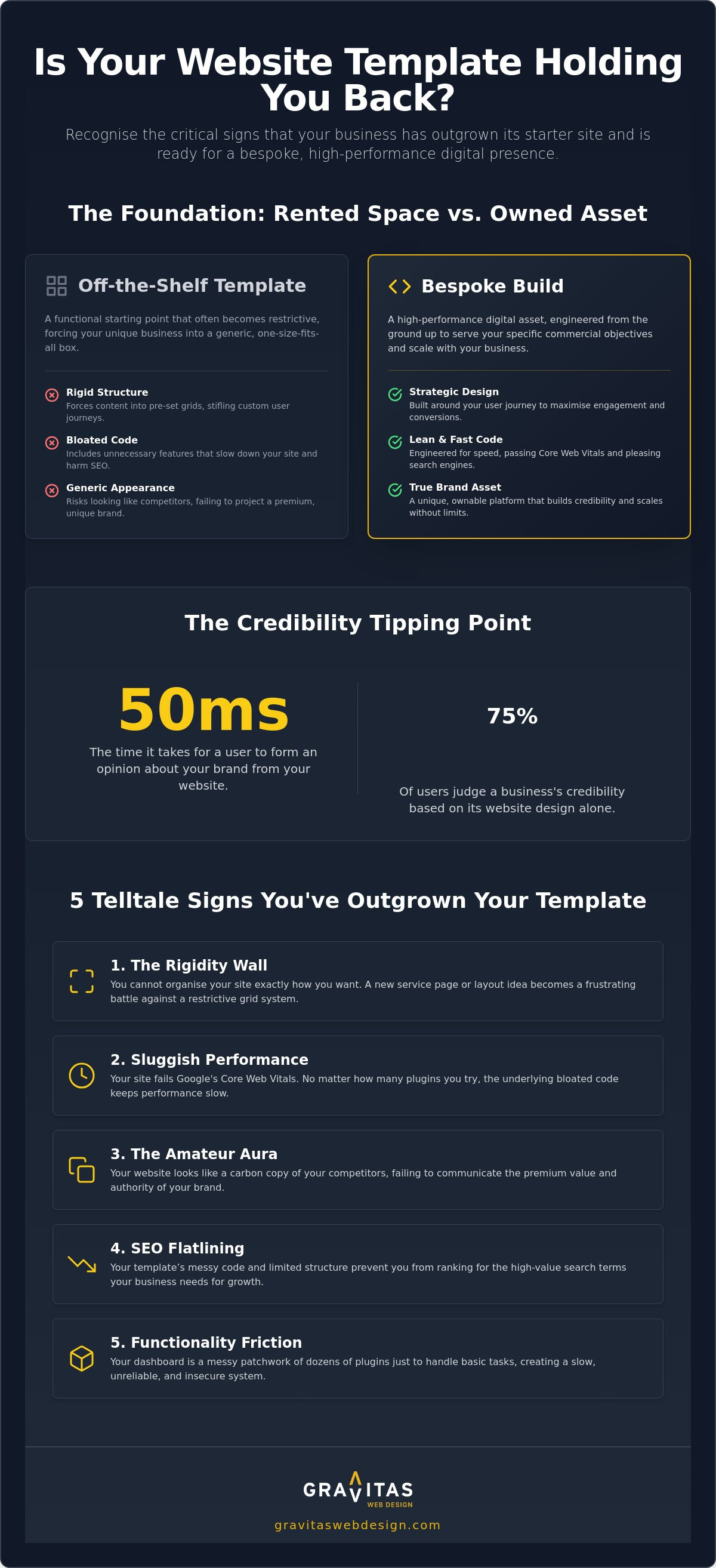
Have you ever tried to move a single “Contact” button, only to watch your entire homepage collapse into a heap of digital rubble? It’s soul-crushing. Deciding when to move from a template to a bespoke website usually happens when you realise you’re spending more time fighting your layout than actually running your business. If your site feels like a straightjacket, it’s time to look at the red flags. High-value clients are savvy; research suggests they form an opinion about your brand in just 50 milliseconds. If those first few ticks of the clock reveal a generic, clunky interface, you’re already fighting an uphill battle.
- The Rigidity Wall: You have a brilliant idea for a new service page, but your template’s grid system simply won’t budge without custom coding that feels like heart surgery.
- Sluggish Performance: You’re failing Google’s Core Web Vitals. No matter how many “speed booster” plugins you install, the underlying bloated code is dragging you down.
- The Amateur Aura: A staggering 75% of users judge a business’s credibility based on its website design. If you look like a carbon copy of your cheapest competitor, you aren’t projecting premium value.
- SEO Flatlining: Your template’s limited header structure and messy code are preventing you from ranking for the complex, high-intent search terms your business needs to grow.
- Functionality Friction: Your dashboard is a “Frankenstein” of 25 different plugins just to handle basic tasks. It’s messy, it’s slow, and it’s waiting to break.
The User Experience (UX) Gap
Rigid templates force your customers to adapt to the site, rather than the site adapting to them. This is particularly dangerous for firms in competitive hubs like London or Birmingham, where users have zero patience for awkward navigation. Mobile responsiveness is another common victim; a template might “fit” a phone screen, but that doesn’t mean it’s easy to use. A bespoke build ensures the user journey is seamless on every device, making the right choice for your business clear to every visitor who lands on your page.
Technical Debt and the Maintenance Nightmare
Think of “technical debt” like ignoring a leaky pipe in your house. Eventually, the floorboards rot. In the digital world, this rot comes from layers of unnecessary code and conflicting plugins that make your site a prime target for security breaches. This is why professional WordPress maintenance services are so vital for growing firms. You need a foundation that’s built to last, not a temporary fix that requires constant patching. If you’re tired of the DIY struggle, it might be time to see how a bespoke build could change things for you.
The Credibility Tipping Point: When Templates Start Costing You Leads
Imagine you’ve just come off a brilliant discovery call with a high-end prospect. They’re impressed. You’re clearly the expert they’ve been looking for. Then, you send them a link to your website. Suddenly, that familiar knot of anxiety tightens in your stomach. Is the site “good enough”? Does it actually look like the premium service you’re charging thousands for? This is the imposter syndrome of the digital age. It’s often the clearest signal for when to move from a template to a bespoke website. When you feel the need to apologise for your site before a client sees it, the template has already failed you.
High-value clients are a discerning bunch. They don’t just look at your prices; they look for clues that you’re an established, stable partner. As we discussed earlier, users form an opinion in about 50 milliseconds. In that tiny blink of an eye, a generic template can make a top-tier London consultancy look like a “one-man band” operating out of a spare bedroom. It isn’t just about aesthetics. It’s about authority. Bespoke design communicates a level of attention to detail that suggests you’ll bring that same precision to your client’s project.
The High-Value Lead Monologue
Put yourself in your prospect’s shoes for a moment. They land on your homepage. They see a layout they’ve already seen on five other sites this morning. Maybe they spot a “Powered by…” credit in the footer. Their internal monologue shifts from “This firm is the solution” to “Is this business actually as big as they say they are?”. For professional firms in Lichfield or Sutton Coldfield, looking established is everything. Your digital presence must match the quality of your physical service. If there’s a disconnect between your expertise and your website, you’re losing leads before the first email is even sent.
Branding Beyond the Logo
True branding isn’t just a fancy icon in the top left corner. It’s an entire experience. When weighing the pros and cons of your digital strategy, consider how a template limits your story. A bespoke build provides a custom digital canvas for strategic branding that a pre-made theme simply can’t handle.
It’s about the details. The way a page flows, the unique interactions, and the professional copywriting that builds a cohesive brand voice. Your website should feel like a natural extension of your office or storefront. It should breathe your values. When you move to a bespoke site, you aren’t just buying code; you’re investing in a platform that communicates obsession with quality. It tells the world that you don’t cut corners. If you’re serious about scaling, your website needs to stop being a “good enough” placeholder and start being your most powerful sales tool.
The Strategic ROI of Bespoke Web Design: Scaling Without Limits
Think of your website as the engine under the bonnet of your business. A template is like a standard, mass-produced motor; it gets you from A to B, but it isn’t winning any races. When you decide when to move from a template to a bespoke website, you’re effectively swapping that standard engine for a precision-engineered powerhouse. This isn’t just about looking “fancy.” It’s about the hard-nosed logic of return on investment. A site that loads in under two seconds isn’t just a vanity metric; it’s a competitive advantage that keeps users from bouncing back to Google.
Clean code is the secret sauce here. Templates are often built like Swiss Army knives, packed with hundreds of features you’ll never use but still have to “carry” in your site’s weight. Bespoke builds are lean. They only contain what you need, which makes them lightning-fast and far easier for Google’s crawlers to navigate. This structural integrity means you aren’t just building a site for today; you’re creating a digital headquarters that grows with you, rather than needing a total rebuild every two years. It’s about shifting from a “cost-centre” mindset to one where you understand how to get more enquiries from your website through tailored user journeys.
Supercharging Your SEO Capabilities
Custom architecture allows for much deeper technical optimisation. You can organise your internal linking and schema markup exactly how search engines like it, without being restricted by a template’s pre-set logic. This is particularly vital if you’re managing local SEO for multiple locations. Whether you’re targeting clients in London, Birmingham, or across the West Midlands, a bespoke site gives you the freedom to create dedicated landing pages that rank higher because they aren’t fighting against bloated, messy code.
Security and Performance Hosting
Shared, “cheap” hosting is often the digital equivalent of a crowded house share; if one person leaves the oven on, everyone is at risk. Bespoke sites, especially when paired with premium hosting environments, are inherently more secure. Because you aren’t relying on thirty different third-party plugins to make the site function, you’ve closed dozens of potential backdoors for hackers. You get dedicated technical support and the peace of mind that comes with knowing your digital assets are protected by professional-grade security protocols. Ready to stop worrying about your site and start using it as a growth engine? Let’s talk about building your bespoke headquarters today.
Navigating the Switch: How to Move to a Custom Site Without the Stress
Moving from a template to a bespoke build can feel a bit like moving house. You’re excited about the new space, but the thought of packing up all those digital boxes is enough to make anyone want to pour a stiff drink. It doesn’t have to be a nightmare, though. Once you’ve decided when to move from a template to a bespoke website, the key is a structured, logical plan that prioritises your sanity and your search rankings. You wouldn’t move into a new home without checking the plumbing; your website migration deserves that same level of care.
- Step 1: Audit your current content. Be ruthless. Identify what is actually bringing in leads and what is just digital clutter. Don’t pay to move junk into your new headquarters.
- Step 2: Define your “must-have” vs “nice-to-have” features. Do you really need that fancy animation, or is a lightning-fast checkout more important? Focus on functionality that drives profit.
- Step 3: Choose a partner who talks business. If a developer only talks about code and not your commercial goals, run. You need a partner who understands how your site fits into your wider growth strategy.
- Step 4: The technical migration. This is where the magic happens. It’s about protecting your hard-earned SEO rankings whilst moving everything to a more robust foundation.
- Step 5: Launch and aftercare. The “go-live” button isn’t the finish line. It’s the start of a new phase of growth that requires ongoing support and hosting.
Protecting Your SEO Rankings During Migration
The biggest fear for any business owner is losing the Google traffic they’ve spent years building. This is where 301 redirects come in. Think of them as a “change of address” service for the internet. You must map every old URL to its new bespoke counterpart correctly. A straight-talking partner will never launch a site without a comprehensive migration plan in place. It’s about ensuring that when Google’s crawlers come knocking, they find exactly what they’re looking for in your new, improved home.
Choosing the Right Bespoke Partner in Birmingham
When you’re looking for a partner in Birmingham, Sutton Coldfield, or Lichfield, you need to ask the tough questions. Ask to see a portfolio that reflects professional credibility, not just pretty pictures. You want to know that they aren’t just selling you another glorified template with a custom price tag. Local knowledge matters too. A partner who understands the West Midlands market will know how to position your brand to stand out amongst local competitors whilst maintaining a premium, high-end feel that attracts the right kind of attention.
Ready to Claim Your Digital Headquarters?
Your business has officially outgrown its starter home. We’ve explored the technical walls you’re likely hitting, the “amateur aura” that generic layouts can project, and the vital strategic importance of actually owning your digital real estate. Deciding when to move from a template to a bespoke website is a major milestone. It signals that you’re no longer just testing the waters; you’re building a foundation for serious, long-term growth.
You deserve a platform that works as hard as you do, free from “Frankenstein” plugins and the sluggish load times that drive away high-value clients. Trusted by firms across Birmingham and London, we provide a complete end-to-end service from branding to hosting. There is no confusing jargon here, just tangible results that help you scale without limits. It’s time to stop fighting your layout and start leading your industry with a site you’re truly proud to share.
Ready to stop renting and start owning? Let’s talk about your bespoke website.
We’re here to help you make that leap with total confidence. Let’s get started on your next chapter.
Frequently Asked Questions
How much does it cost to move from a template to a bespoke website?
The investment for a custom site depends entirely on the specific functionality and commercial goals of your business. Unlike templates with low entry costs but high long-term limitations, a bespoke build is a capital investment in a digital asset you actually own. You’re moving away from a basic subscription model towards a high-performance platform; it’s specifically engineered to convert your visitors into high-value leads.
Will I lose my Google rankings if I switch to a custom website?
Switching to a custom site should actually help your Search Engine Optimisation (SEO) rather than hinder it. By using a proper 301 redirect strategy, we ensure Google knows exactly where your pages have moved. Because bespoke sites are leaner and faster, they typically perform much better in search rankings than bloated templates. It’s about making the search engine’s job easier, not harder.
How long does the bespoke web design process typically take?
You should generally budget between 8 and 16 weeks for a full bespoke project. This allows for the deep discovery, custom design, and rigorous testing phases that pre-made templates simply skip. Knowing when to move from a template to a bespoke website means accepting that a quick DIY job no longer serves a scaling firm. This timeline ensures every line of code is written to support your growth.
Can I still update the content myself on a bespoke website?
Absolutely. We build our bespoke sites on flexible platforms like WordPress, giving you an easy-to-use dashboard that requires zero coding knowledge. You can swap photos, update blog posts, and change text whenever you like. We ensure the backend is just as clean and intuitive as the front, so you can manage your digital headquarters with total confidence and ease.
What is the difference between a custom WordPress site and a template?
A template is a pre-made “skin” where you’re forced to fit your content into someone else’s boxes. A custom WordPress site is built from a blank canvas specifically for you. This means no bloated code, faster speeds, and a layout that actually follows your customers’ preferred journey. It’s the difference between a tailored suit and one bought off the rack; one fits you perfectly, the other just “fits.”
Do I really need a bespoke site if my current template site looks okay?
If your business is scaling, “okay” might be costing you more than you think. Research shows 75% of users judge credibility based on design. Knowing when to move from a template to a bespoke website is about recognising when your current site stops being a helper and starts being a hurdle. If your template feels slow, looks generic, or limits your growth, it’s time to upgrade.
What are the ongoing costs of a bespoke website compared to a template?
Ongoing costs for a bespoke site are generally focused on high-performance hosting and professional maintenance rather than a mountain of plugin subscriptions. Whilst you should budget for expert support to keep your site secure, you avoid the “Frankenstein” technical debt that plagues DIY builders. It’s about paying for proactive care that protects your digital reputation rather than reactive fixes when a template breaks.