
Web Design Blog
Local SEO for Multiple Locations: The Ultimate Guide to Scaling Your Digital Presence
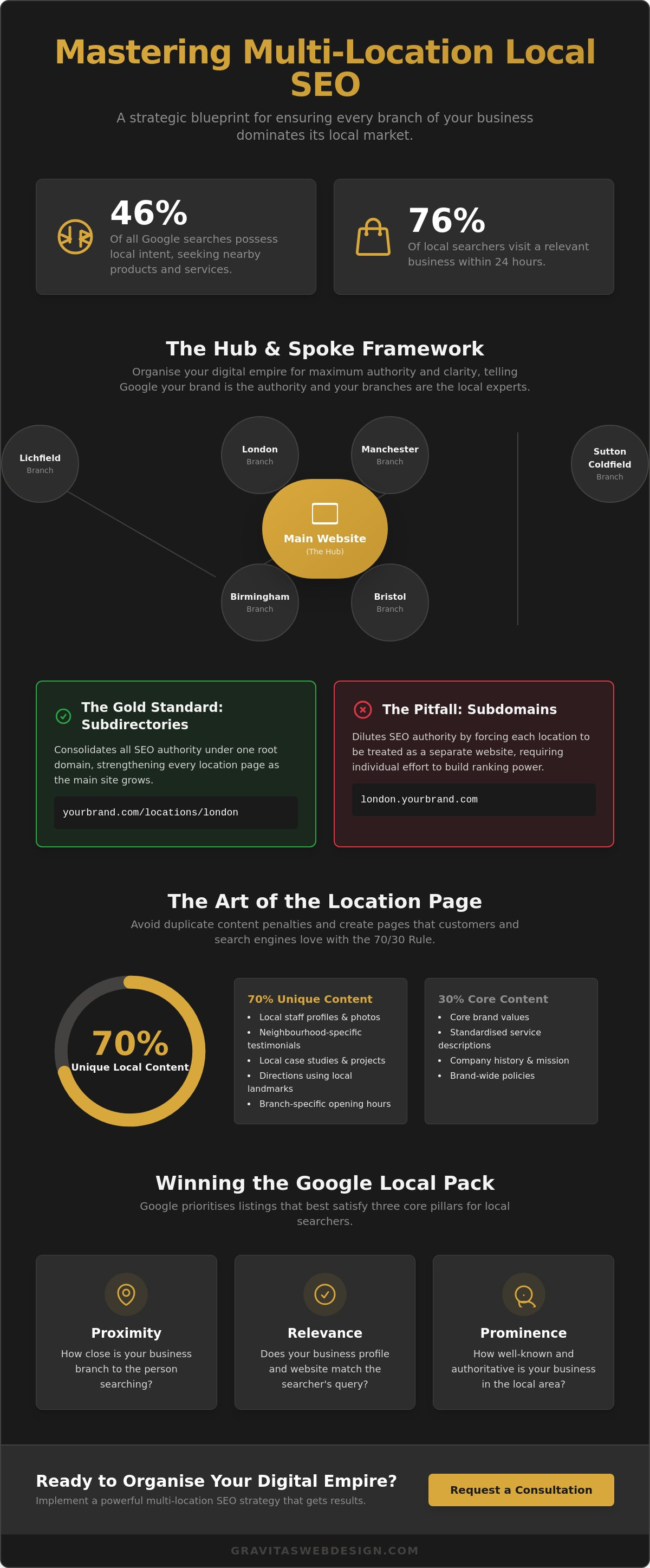
What if your digital presence felt less like a tangled web of confusion and more like a perfectly synchronised orchestra? With 46% of all Google searches having local intent, the stakes are high for businesses with several branches. It’s incredibly annoying when one location thrives whilst another remains invisible, especially when 76% of people who search for something nearby visit a business within 24 hours. Mastering local SEO for multiple locations is the secret to ensuring every single one of your shopfronts gets the attention it deserves.
We know the feeling. You’re probably tired of playing digital Whac-A-Mole, jumping between profiles and worrying that one “copy-paste” error will trigger a duplicate content penalty. You deserve a clear roadmap that doesn’t require a PhD in computer science. This guide reveals how to dominate the Local Pack across every branch without the technical headaches. We’ll walk through the ideal site structure and a manageable system for reviews and citations, giving you the tools to scale your presence with total confidence.
Key Takeaways
- Understand why Google views your Sutton Coldfield branch differently from your London office and how to tailor your strategy for each.
- Stop the subdomain madness and learn why a “Hub and Spoke” site structure is the secret to a tidy, high-ranking digital empire.
- Streamline your workload with bulk management tools for your Google Business Profiles to master local SEO for multiple locations without the burnout.
- Ditch the boring “copy-paste” habit and use our 70/30 rule to build location pages that customers and search engines actually love.
- Run a proper citation audit to scrub away dusty, outdated data and claim your rightful share of voice in every target postcode.
The Multi-Location Headache: Why One Size Does Not Fit All in Local Search
Imagine the pride of opening your third, fourth, or tenth branch, only to realise that online, half of them don’t actually exist. It’s a common frustration for growing businesses. You’ve done the hard work of securing physical premises, hiring staff, and putting up signs, but your digital shopfront is still stuck in the past. Think of local SEO for multiple locations as your digital branch network strategy. It’s the difference between being a local legend in every town and being a ghost in the machine.
Google treats a business in Sutton Coldfield very differently from one in the centre of London. Why? Because local search is built on the specific needs of a user in a specific moment. A person looking for services in a quiet suburb has different expectations than someone in a bustling capital. If your strategy doesn’t account for these nuances, you fall into the “cannibalisation” trap. This is where your own branches end up fighting each other for the same spot in search results, effectively stealing your own thunder. The emotional cost of “invisible” branches is high; it’s the anxiety of knowing you’re losing local revenue to a competitor simply because they’ve organised their digital house better than you. This challenge is just as acute for professional services firms, and businesses like law firms operating across the capital can benefit enormously from a dedicated approach to SEO for law firms in London to ensure every office location commands its fair share of search visibility.
The Difference Between National and Local Search Intent
Searching for “Web Design” is a broad, national quest for information. However, searching for “Web Design Birmingham” signals a clear intent to buy locally. Google recognises this shift and triggers the “Local Pack”, that familiar map at the top of the results. To win here, Google looks at three things: Proximity (how close are you?), Relevance (do you actually do what they asked?), and Prominence (are you a big deal in that area?). Every branch needs its own identity to satisfy these three pillars.
The Pitfalls of a “Set and Forget” Mentality
Using one generic homepage for five different locations is a recipe for disaster. It confuses Google’s crawlers and, more importantly, it confuses your customers. They want to know the specific opening times and local stories of the branch nearest to them, not a corporate “About Us” page that feels cold and distant. “Ghost” listings, which are outdated or unverified profiles, are equally dangerous. They act like broken links in your reputation. Your local SEO for multiple locations is an ongoing conversation with your community, not a one-time task you can tick off a list and forget. It requires regular check-ins to stay fresh and relevant.
Structuring Your Digital Empire: The Hub and Spoke Framework
Think of your website as a central train station, the Hub, with tracks leading out to every local stop, the Spokes. This setup is the backbone of successful local SEO for multiple locations. It keeps everything connected whilst letting each branch shine in its own light. When you organise your site this way, you’re telling Google that your brand is the authority, but your branches are the local experts. It’s a powerful combination that prevents your locations from feeling like isolated islands in a vast digital ocean.
Mapping the user journey is just as vital as the technical bits. A customer usually lands on a “spoke” page after a local search. From there, they need a friction-free path to either convert right then and there or head back to the “hub” to learn more about your core values. As you Optimize Your Local Search Engine Results, you’ll find that a logical structure is the difference between a lead and a “back button” bounce. If your site structure feels like a maze, people will simply leave. If you’re feeling a bit lost in the technical weeds, you can always chat with us about your site structure to get things back on track.
Subdirectories: The Gold Standard for Local SEO
There’s a lot of noise online about subdomains versus subdirectories. For most UK SMEs, subdirectories win every single time. Using a structure like /locations/lichfield/ is vastly superior to lichfield.yourbrand.com. Why? Because it keeps all your hard-earned domain authority under one roof. When your main site gains a backlink or a bit of “SEO juice”, it trickles down to every location page. If you use subdomains, Google often treats them as entirely separate websites, meaning you have to build authority from scratch for every single branch. That’s a lot of extra work nobody has time for.
The Spoke-to-Hub Internal Link Strategy
Internal linking is the secret sauce that passes authority from the hub to the spokes. You should link naturally from your location pages back to your core service pages. For instance, if your Birmingham branch offers custom sites, you’d link to your article on Bespoke Web Design in Birmingham: Why Custom Trumps Templates. This shows Google that the local page is backed by the expertise of the main brand. Breadcrumbs are also your best friend here. They help users navigate back to the main “Locations” overview or the homepage whilst giving search engines a clear map of your digital empire. It’s about being helpful, not looking like a robot.
Google Business Profile: Managing Multiple Listings Without Losing Your Mind
Managing twenty different Google Business Profiles can feel like shouting into a void. It’s a relentless cycle of updates, replies, and photo uploads that eats into your day. To keep your sanity, you need a structured approach to local SEO that focuses on the heavy hitters. First on the list? The golden rule of NAP consistency. If your address is listed as “Oxford Street” in London but “Oxford St” in your directory listings, Google’s algorithms start to get twitchy. Consistency isn’t just about being tidy; it’s about building trust with the bots.
If you’re managing 10 or more locations, stop doing it one by one. You’re eligible for bulk verification, which lets you organise your digital empire from a single dashboard. It saves hours of manual labour and prevents that soul-crushing “pending verification” notice from stalling your progress for weeks on end. For service-area businesses without a physical shopfront, don’t panic. You can still dominate local SEO for multiple locations by defining your service boundaries clearly, ensuring you show up where your customers actually are. It’s about being visible where it counts, even if you don’t have a front door for people to walk through.
The Art of the Local Listing
Stock photos are the enemy of authenticity. Customers can spot a generic office photo from a mile away, and it feels cold. Use real, high-quality snaps of your actual staff and premises for every branch. It builds immediate rapport. Also, be surgical with your categories. If you’re a web designer who also offers SEO, make sure those secondary categories are filled in correctly. If things still aren’t clicking, check out our guide on Why Is My Business Not Showing Up on Google Maps? Busted Myths and Practical Fixes for some practical troubleshooting.
Review Management: The Social Proof Engine
Nothing looks more dodgy than a brand with 50 glowing reviews in Lichfield and a big fat zero in Tamworth. It suggests your quality is hit-or-miss. You need a system to nudge local customers for feedback at the right moment. When the reviews do come in, please, don’t respond like a corporate PR bot. If someone leaves a stinker, reply with empathy and honesty. It shows you’re a human-to-human business that actually cares about the person on the other end of the screen. A thoughtful reply to a bad review often impresses a potential customer more than a dozen five-star ratings ever could.
The Art of the Location Page: Moving Beyond Generic Copy and Paste
Ever found yourself staring at ten different browser tabs, wondering how on earth you’re going to make a landing page for Tamworth look different from one for Lichfield? It’s a common headache. Most people panic about “duplicate content” penalties, but let’s clear that up right now. Google isn’t going to banish you to the shadow realm just because your service descriptions are similar across branches. The real danger is “unhelpful content”. If a user lands on your page and it feels like a generic, soul-less flyer, they’re gone in a heartbeat.
We use the 70/30 rule to keep things balanced. Keep 70% of the page focused on your core brand value, like your expertise in bespoke web design, and inject 30% with hyper-local flavour. This ensures your brand stays consistent whilst still feeling like a local expert in every town. It shows you aren’t just a distant corporate entity, but a neighbour who understands the local scene. This approach is the heartbeat of effective local SEO for multiple locations, making every town feel like your home turf.
Don’t forget the invisible bits that talk to the bots. Local Schema markup is like a digital business card that tells Google exactly where you are. It’s technical, yes, but vital for proving your physical presence. Before your location pages can truly perform, it’s worth running a technical SEO audit Birmingham businesses rely on to uncover hidden digital leaks that silently undermine your rankings. When you combine this with professional copywriting that speaks to your local audience, you transform a boring list of addresses into a network of thriving digital shopfronts.
Hyper-Local Storytelling
A location page should feel like a local shopfront, not a generic flyer. Mention that specific roundabout everyone hates in Sutton Coldfield or the best place for a coffee near your Lichfield office. Talk about your partnership with the local football team or that charity event you sponsored. When you use neighbourhood names and address regional pain points, you prove you’re actually there. You aren’t just “pin-dropping” on a map; you’re part of the community fabric. Of course, the visual identity you present on these pages matters just as much as the words — investing in professional logo design London businesses trust ensures your brand looks as credible and polished in every local market as the services you deliver.
Technical Essentials for Every Location Page
Every page needs the nuts and bolts done right to ensure Google and your customers can find you without a struggle. Start with an embedded Google Map set specifically to your branch coordinates. Include unique “Get Directions” buttons that open directly in the user’s map app. Use localised