
Web Design Blog
Website Maintenance UK: Protecting Your Online Credibility and Performance
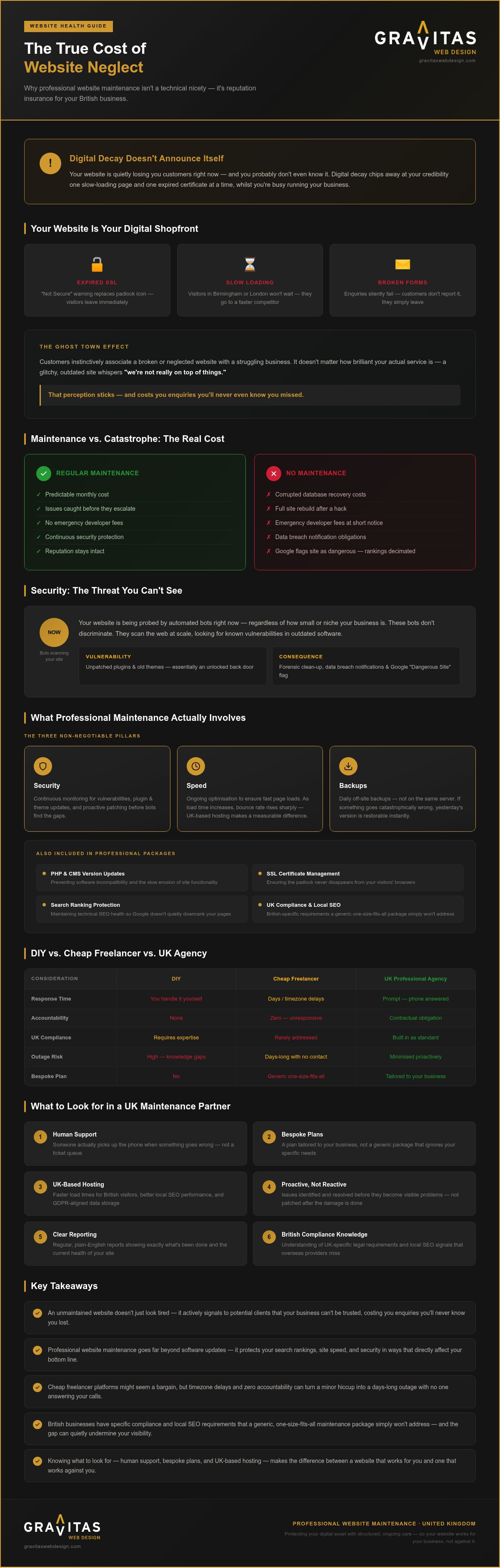
Your website is quietly losing you customers right now, and you probably don’t even know it. That’s the uncomfortable truth about digital decay: it doesn’t announce itself. It just chips away at your credibility, one slow-loading page and one expired security certificate at a time, whilst you’re busy actually running your business.
And honestly? That’s a completely fair position to be in. You built a brilliant website, you were proud of it, and now the thought of SSL certificates, PHP version conflicts, and plugin updates makes your eyes glaze over. Finding reliable website maintenance in the UK shouldn’t feel like decoding a foreign language, and it definitely shouldn’t mean chasing an unresponsive developer who takes three weeks to reply to a simple email.
This article is here to cut through all of that. We’ll show you exactly what professional website maintenance actually does for your business, why it’s far less about technical housekeeping and far more about protecting your reputation, and what to look for in a UK-based team who’ll actually pick up the phone when something goes wrong. No jargon. No fluff. Just straight answers.
Key Takeaways
- An unmaintained website doesn’t just look tired—it actively signals to potential clients that your business can’t be trusted, costing you enquiries you’ll never even know you lost.
- Professional website maintenance in the UK goes far beyond software updates; it protects your search rankings, site speed, and security in ways that directly affect your bottom line.
- Cheap freelancer platforms might seem like a bargain, but timezone delays and zero accountability can turn a minor technical hiccup into a days-long outage with no one answering your calls.
- British businesses have specific compliance and local SEO requirements that a generic, one-size-fits-all maintenance package simply won’t address—and the gap can quietly undermine your visibility.
- Knowing what to look for in a maintenance partner—human support, bespoke plans, and UK-based hosting—makes the difference between a website that works for you and one that works against you.
The Hidden Cost of Website Neglect: Why Maintenance Matters
Think of your website as your digital shopfront on a busy high street. Now imagine that shopfront has a cracked window, a door that sticks, and a sign that’s half-fallen off. You wouldn’t leave it like that for months, would you? Yet that’s precisely what happens when a website goes without proper care. Professional website maintenance in the UK isn’t just a technical nicety; it’s the ongoing work that keeps your shopfront looking sharp, trustworthy, and open for business.
The frustrating part is that digital decay rarely announces itself with a dramatic crash. It creeps in quietly. A plugin falls out of date. A PHP version becomes incompatible. A certificate expires. Digital decay is the slow erosion of site functionality caused by software incompatibility, and left unchecked, it compounds until the damage is genuinely costly to reverse.
The “Ghost Town” Effect: How Neglect Kills Credibility
Picture a potential client landing on your website for the first time. They’re ready to enquire. Then they spot the padlock icon has gone, replaced by a “Not Secure” warning in their browser. Or they fill out your contact form and hit submit, only for nothing to happen. They don’t email you to report the fault. They just leave. Quietly. And they go to a competitor whose site actually works.
This is the ghost town effect in action. Customers instinctively associate a broken or neglected website with a struggling business. It doesn’t matter how brilliant your actual service is; a glitchy, outdated site whispers “we’re not really on top of things.” That perception sticks, and it costs you enquiries you’ll never even know you missed.
The smarter way to think about maintenance is as reputation insurance. Fixing a catastrophe, whether that’s a corrupted database, a full site rebuild after a hack, or emergency developer fees at short notice, costs dramatically more than the steady, monthly care that prevents the catastrophe in the first place.
Security Risks for Unattended UK Websites
Here’s something that surprises a lot of small business owners: your website is being probed by automated bots right now, regardless of how small or niche your business is. These bots don’t discriminate. They scan the web at scale, looking for known vulnerabilities in outdated software.
WordPress powers a significant portion of the web, which makes it a frequent target when sites aren’t regularly updated. An unpatched plugin or an old theme with a known security flaw is essentially an unlocked back door. And recovering a hacked site isn’t just stressful; it involves forensic clean-up, potential data breach notifications, and the very real possibility of Google flagging your site as dangerous, which decimates your search visibility overnight.
Consistent website maintenance in the UK context means staying ahead of those vulnerabilities before they become your problem at the worst possible moment.
What Does Professional Website Maintenance in the UK Actually Involve?
Most people imagine website maintenance as someone clicking “update all” on a Tuesday afternoon and calling it a day. The reality is quite different, and honestly, quite a bit more interesting. Done properly, it’s a structured, ongoing discipline that keeps your site fast, secure, and commercially effective. Done badly, or not at all, it’s the digital equivalent of ignoring a slow puncture until you’re stranded on the M6.
Let’s break down what actually happens under the bonnet.
The Core Pillars: Security, Speed, and Backups
Think of these three as the non-negotiables. Every professional website maintenance UK package worth its salt should cover all three without compromise.
- Daily off-site backups. If your backup lives on the same server as your website, it’s not really a backup. A proper off-site backup means that if something goes catastrophically wrong, whether that’s a botched update, a server failure, or a malicious attack, you can restore your site to yesterday’s version rather than starting from scratch. It’s the ultimate safety net, and you genuinely hope you never need it.
- Speed optimisation. A visitor in Birmingham or London won’t wait for a slow site. Research from Google has consistently shown that as page load time increases, the probability of a visitor leaving rises sharply. UK-based hosting matters here: servers physically closer to your audience deliver content faster, and that speed advantage feeds directly into your Google rankings and your bounce rate.
- Proactive uptime monitoring. Automated monitoring tools check your site around the clock and flag issues before a real customer ever stumbles across them. A broken contact form or a sudden spike in error responses gets flagged immediately, not three days later when someone finally mentions it in a review.
Software and Plugin Governance
Here’s the bit that trips up a lot of DIY site owners. Clicking “update” directly on a live website is genuinely risky. Plugins are written by different developers, and they don’t always play nicely together after an update. A responsible maintenance workflow uses a staging environment, essentially a private copy of your site, where updates are applied and tested first. Only once everything checks out does the update go live. It’s the difference between a smooth Tuesday and a very stressful one.
PHP version management sits in the same category. Running an outdated PHP version leaves your site exposed to known vulnerabilities and can quietly throttle performance. Keeping it current is unglamorous work, but it matters enormously for both security and speed.
A bespoke approach to this, rather than a generic “update everything and hope” script, is what separates a proper maintenance partner from a one-size-fits-all tool. If you’d like to explore what that kind of tailored care looks like in practice, get started with a conversation about your site’s specific needs.
Regular content audits round things out. Outdated service pages, broken internal links, and stale blog posts all send quiet negative signals to search engines. Keeping your content relevant isn’t just good housekeeping; it’s an active part of maintaining your search visibility over time.
DIY vs. Cheap Alternatives vs. Professional UK Agencies
Let’s be honest about something. When you see a maintenance package advertised for a few pounds a month on a global freelancer platform, a little voice says “that’ll do.” And look, nobody’s judging you for it. Running a business means watching the pennies, and the promise of cheap website maintenance in the UK is genuinely tempting. The problem isn’t the price tag. It’s what’s quietly missing behind it.
Offshore freelancer platforms are built around volume, not care. The person managing your site might be brilliant at their job, but they’re also juggling dozens of other clients across multiple time zones. When your contact form breaks on a Monday morning and you need it fixed before a pitch meeting at noon, a six-hour response window isn’t a minor inconvenience. It’s a crisis. And “fixed cost support packages are best for everyone” sounds reassuring right up until the moment you actually need someone to answer the phone.
The Risks of the “Set and Forget” Mentality
Ignoring your website for months at a stretch doesn’t just leave you vulnerable to security threats. It quietly accumulates what developers call technical debt: a growing backlog of outdated software, incompatible plugins, and deprecated code that becomes exponentially harder and more expensive to untangle the longer it’s left. What might have been a straightforward update six months ago becomes a full forensic investigation. And if the developer who built your site has since gone quiet? You’re starting from scratch with someone who doesn’t know your setup at all. That’s a situation worth avoiding, and you can read more about how to sidestep it entirely in this guide on finding a reliable website developer.
The DIY route carries its own risks. Clicking through updates yourself, without a staging environment or a rollback plan, is a bit like rewiring a plug without turning the power off first. Possible? Yes. Advisable? Absolutely not.
Why Local UK Support Wins Every Time
There’s something genuinely underrated about being able to ring someone in Sutton Coldfield or London who understands your business, speaks your language (in every sense), and is available during the same hours you’re actually working. Shared business hours aren’t a luxury. They’re the baseline for any support relationship that’s worth having.
UK-based website maintenance also carries practical compliance advantages. GDPR isn’t abstract here; it’s a legal reality with real consequences, and a UK-based team understands that instinctively. Server location matters too: hosting your site on UK infrastructure means your data stays within appropriate legal boundaries and your pages load faster for the British audience you’re actually trying to reach.
No call centres. No ticket queues. No waiting until the other side of the world wakes up. That’s the difference a proper local partner makes.
Essential Standards for British Business Websites
There’s a baseline every credible UK business website needs to clear, and it’s higher than most people realise. Whether you’re operating in Birmingham, London, or anywhere in between, the standards Google and your visitors hold you to don’t shift based on your size or sector. They’re consistent, they’re measurable, and falling short of them has real commercial consequences.
One area that often catches multi-location businesses off guard is local SEO. If your business serves clients in several towns or cities, each location needs its own properly maintained digital presence. Stale content, inconsistent business details, or slow-loading location pages quietly undermine your visibility in local search results. There’s a thorough breakdown of how to handle this well in this guide to local SEO for multiple locations, and it’s genuinely worth a read if you’re trying to rank in more than one place.
Google’s Core Web Vitals are another non-negotiable. These are a set of measurable signals that assess how your site actually feels to use: how quickly the main content loads, how soon a visitor can interact with the page, and whether the layout shifts unexpectedly as it renders. A website maintenance UK plan that ignores these metrics isn’t really a plan at all. Google uses Core Web Vitals as a ranking factor, which means a poorly maintained site isn’t just frustrating to visit; it’s actively penalised in search results.
Accessibility is the standard that UK businesses are slowest to take seriously, and that’s starting to change. WCAG (Web Content Accessibility Guidelines) exist to ensure websites are usable by people with visual, auditory, or motor impairments. Beyond the ethical case, there’s a practical one: an inaccessible site excludes a meaningful portion of your potential audience, and legal exposure in this area is growing for UK firms.
Performance Benchmarks to Aim For
On a mobile network in the UK, a page that takes longer than three seconds to load will lose a substantial portion of visitors before they’ve read a single word. Speed isn’t just a technical metric; it’s directly tied to getting more enquiries from your website, because a fast site keeps people around long enough to actually contact you. Regular database cleaning, removing post revisions, expired transients, and redundant data, keeps your site nimble as it grows rather than gradually heavier and slower.
The Security Checklist for Peace of Mind
An SSL certificate does more than display a padlock. It encrypts the data passing between your visitor’s browser and your server, which matters enormously for any form submission or checkout process. Pair that with a Web Application Firewall (WAF), which filters and blocks malicious traffic before it ever reaches your site, and you’ve got a meaningful first line of defence. For WordPress sites in particular, the specifics of keeping that defence current are covered in detail in this resource on WordPress maintenance services.
If you’d like a bespoke assessment of where your site currently stands against these standards, get in touch and we’ll take a proper look together.
How Gravitas Web Design Protects Your Digital Asset
There’s a specific kind of frustration that comes from submitting a support ticket and receiving an automated response telling you your query has been assigned a reference number. Meanwhile, your site is down. Meanwhile, your phone isn’t ringing. Meanwhile, nobody is actually fixing anything. Gravitas Web Design was built precisely as the antidote to that experience.
Based in Sutton Coldfield and working with businesses across Birmingham and London, Gravitas operates on a simple principle: your website is a commercial asset, not a hobby project, and it deserves to be treated accordingly. That means bespoke website maintenance UK plans built around your specific setup, your traffic patterns, and your business goals rather than a generic checklist applied identically to every client regardless of their needs.
No Call Centres, Just Experts
When you work with Gravitas, you’re not entering a ticket queue. You’re talking to the people who actually understand your site. No call centres, no anonymous support portals, no waiting for a stranger to piece together your history from a case file. The team operates as an extension of your own business, which means plain-English conversations about what’s happening, why it matters, and what’s being done about it.
That transparency runs through everything. Updates are explained in terms you’ll actually understand. If something needs attention, you’ll hear about it before it becomes a crisis rather than after. It’s the kind of support relationship that makes the phrase “my web team” feel genuinely accurate rather than aspirational.
The bespoke approach matters here too. A boutique professional services firm in Birmingham has different maintenance priorities to a fast-growing e-commerce business in London. Gravitas builds plans that reflect that reality, adjusting as your business evolves rather than locking you into a fixed package that made sense on day one but drifts out of alignment as you grow.
Ready to Stop Worrying About Your Website?
The shift from a neglected site to a properly maintained one isn’t dramatic. It’s quiet and steady: faster load times, consistent uptime, security vulnerabilities closed before they’re ever exploited, and the confidence that comes from knowing someone capable is genuinely keeping watch. You get your headspace back. That’s not a small thing when you’re running a business.
If any part of this article made you think “that sounds familiar,” it’s worth having a conversation. No pressure, no jargon, just an honest look at where your site currently stands and what proper care could do for it. Let’s get your website properly looked after and turn it back into the asset it was always meant to be.
Your Website Deserves Better Than “Good Enough”
Here’s the honest version of what we’ve covered: an unmaintained website doesn’t just sit there quietly. It actively works against you, eroding trust, bleeding search rankings, and handing enquiries to competitors whose sites simply function properly. That’s a real commercial cost, and it compounds the longer it’s left.
Professional website maintenance UK done properly means daily backups, proactive security monitoring, bespoke care that fits your business, and a real person at the end of the phone who already knows your site. Not a ticket queue. Not an automated response. Just straightforward, human support from a UK team that’s been helping Birmingham and London businesses thrive since 2019.
The good news? Getting from where you are now to where you want to be isn’t complicated. It starts with a conversation.
Get a flawless digital presence with Gravitas and let’s make your website the asset your business actually deserves.
Frequently Asked Questions About Website Maintenance in the UK
How much does website maintenance cost in the UK?
Costs vary considerably depending on the size and complexity of your site, the level of support included, and whether the provider is UK-based or offshore. Rather than quoting a figure that won’t reflect your actual situation, the honest answer is: get a bespoke quote. A small brochure site has very different needs to a multi-location business with e-commerce functionality, and a reputable provider will price accordingly rather than squeezing you into a generic tier.
What’s worth remembering is that emergency fixes, post-hack clean-ups, and full site rebuilds after prolonged neglect cost significantly more than steady monthly care. Maintenance isn’t an overhead; it’s a cost-saving measure dressed up as one.
Can I do my own website maintenance to save money?
You can, but it carries genuine risks that are easy to underestimate. Applying updates directly to a live site without a staging environment can break things in ways that aren’t immediately obvious, and without a proper backup strategy, recovering from a botched update becomes a costly scramble. If you’re comfortable with the technical side and have time to stay on top of it consistently, DIY maintenance is possible.
The honest caveat is that “consistently” is the hard part. Most business owners start with good intentions and then life gets in the way. Three months later, the site is running outdated software and nobody noticed.
What happens if my website goes down and I don’t have a maintenance plan?
You’ll likely find out about it the worst possible way: a client mentioning it in passing, a sudden drop in enquiries, or a panicked Google of your own business name. Without proactive uptime monitoring, downtime can go undetected for hours. Then comes the scramble to find a developer who knows your setup, which is genuinely difficult if the person who built your site is no longer available or responsive.
The practical consequence is lost enquiries, potential reputational damage, and emergency developer fees charged at short notice. None of those are pleasant, and all of them are avoidable with the right support in place beforehand.
Does website maintenance include making changes to my content?
It depends entirely on the provider and the plan. Security monitoring, backups, and software updates are standard maintenance tasks; content changes like updating service pages, adding blog posts, or amending contact details are a separate category that some providers include and others bill separately. Always clarify this upfront so you’re not surprised later.
At Gravitas, the bespoke nature of each plan means these conversations happen at the start rather than when you’re already frustrated. If content updates are something you need regularly, that gets built into your arrangement from day one rather than treated as an awkward add-on.
Will professional maintenance improve my Google rankings in the UK?
Yes, in meaningful and measurable ways. Website maintenance in the UK context directly supports the technical signals Google uses to rank pages: site speed, uptime, Core Web Vitals scores, and the absence of security warnings all feed into how your site performs in search results. A slow, insecure, or intermittently unavailable site is quietly penalised, even if your content is excellent.
Maintenance won’t replace a proper SEO strategy, but it creates the technical foundation that SEO depends on. Think of it as keeping the engine in good condition so the fuel actually gets you somewhere.
How often should a website be updated and checked?
Security scans and uptime monitoring should run continuously, not on a schedule. Plugin and software updates typically need attention at least monthly, though the frequency depends on how actively the platforms you’re using release new versions. Content audits, broken link checks, and performance reviews are sensibly done quarterly for most small business sites.
The key distinction is between reactive and proactive care. Checking in once a month after something has already gone wrong isn’t maintenance; it’s crisis management with extra steps. The value of a proper plan is that issues get caught and resolved before you ever know they existed.
What is the difference between website hosting and website maintenance?
Hosting is the infrastructure that keeps your site accessible online, essentially the server space where your files live. Maintenance is the ongoing human work that keeps everything on that server running properly: updates, security checks, backups, performance optimisation, and troubleshooting. You can have excellent hosting and still have a neglected, vulnerable website if nobody’s doing the maintenance work.
Some providers bundle both together, which can simplify things considerably. UK-based hosting matters for load speed and data compliance, so if your maintenance provider also handles hosting, it’s worth confirming where your servers are physically located.
Is WordPress maintenance different from other types of website care?
WordPress has its own specific considerations because of how it’s built. The combination of a core platform, themes, and third-party plugins means there are more moving parts to keep in sync, and more potential points of conflict when updates are applied. WordPress is also the most widely used CMS on the web, which makes it a frequent target for automated security probes looking for known vulnerabilities in outdated software.
That doesn’t make WordPress a poor choice; it’s an excellent platform when properly maintained. It does mean that the maintenance approach needs to account for plugin compatibility testing, PHP version management, and database hygiene in ways that a simpler static site wouldn’t require. Bespoke care, rather than a generic automated script, makes a real difference here.