
Web Design Blog
The Hidden Disadvantages of DIY Website Builders for Professional UK Businesses
Imagine it is 11 pm on a Sunday. You are hunched over your laptop, squinting at a “simple” drag-and-drop editor that refuses to put a button where you actually want it. You started this project to save a few quid, but now you are three hours deep into a technical forum while your actual work sits untouched. It is a common scene, but the hidden disadvantages of DIY website builders often turn a “quick fix” into a long-term headache for professional UK businesses.
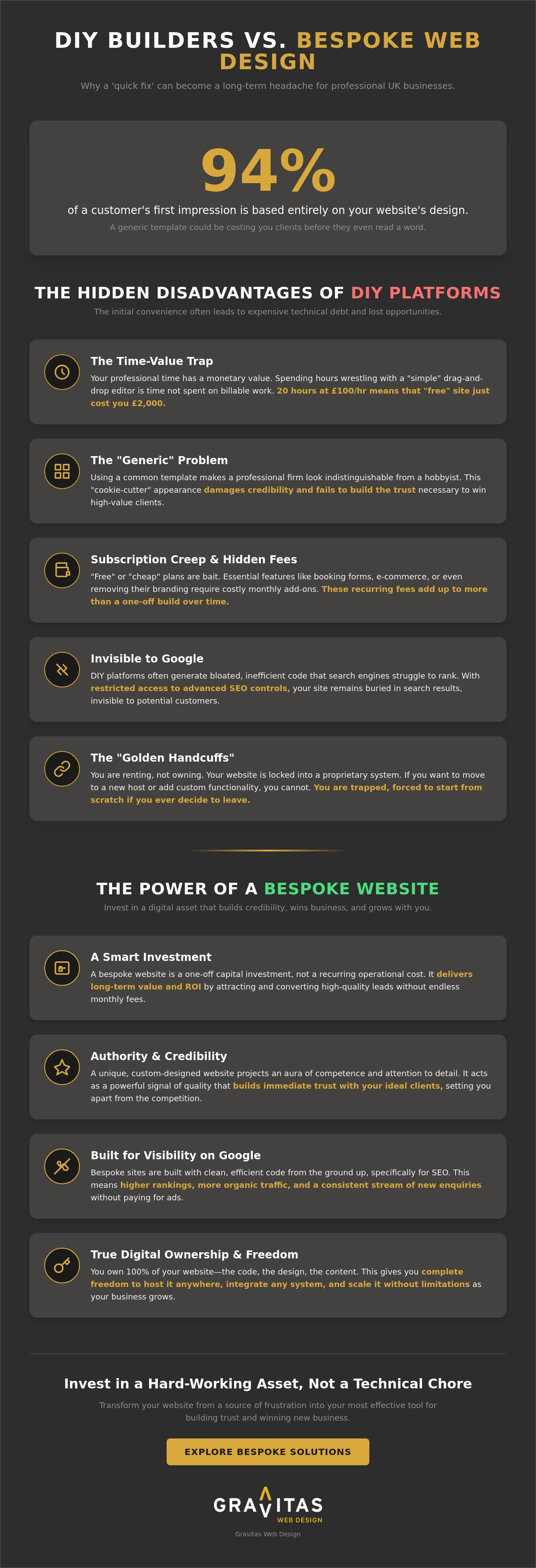
We completely get it. The promise of an “all-in-one” solution is incredibly tempting when you are busy building a brand. You want to look professional, yet you often end up with a site that feels a bit “amateurish” next to your competitors. Since 94% of a customer’s first impression is based entirely on design, a generic template could be scaring away leads before they even see your expertise.
In this guide, you will discover why these “rented” platforms often cost more in lost enquiries and technical stress than they save in fees. We will look at the legalities of the Equality Act 2010 and the latest UK GDPR updates, showing you how to trade clunky templates for a bespoke site that you truly own.
Key Takeaways
- Uncover the true cost of “free” platforms and why the initial convenience often leads to expensive technical debt and hidden fees later on.
- See how “cookie-cutter” templates can make a professional UK firm look indistinguishable from a hobbyist, damaging that crucial first impression for potential clients.
- Explore the technical disadvantages of DIY website builders that often leave your site invisible to Google due to bloated code and restricted SEO controls.
- Understand the “Golden Handcuffs” of proprietary builders and why owning your digital assets is the only way to ensure true scalability as you grow.
- Learn how a bespoke approach transforms your website from a clunky technical chore into a hard-working asset that builds trust and wins new business.
The Allure vs. The Reality: Why “Free” Website Builders Are Rarely Free
Proprietary Website builders like Wix, Squarespace, and Shopify often market themselves as the ultimate shortcut for busy professionals. The adverts are seductive. They show a stylish entrepreneur clicking a few buttons and, poof, a gorgeous website appears. It feels modern, easy, and, most importantly, cheap. However, these platforms are “closed-source” ecosystems. This means you are essentially renting space in a walled garden where you don’t own the soil or the fence. While the entry price looks like a bargain, the long-term disadvantages of DIY website builders start to pile up the moment you try to move beyond a basic landing page.
The Time-Value Trap
Have you ever spent an entire afternoon trying to make a single image sit next to a paragraph without the whole page jumping about? That is the hidden tax of “simple” drag-and-drop tools. When you are a professional, your time has a specific pound-sign value. If you bill your clients at £100 an hour and spend twenty hours wrestling with a template, that “free” website has already cost you £2,000 in lost billable time. The frustration factor is real too. These tools often behave in ways that feel illogical, leading to a “tech-rage” that sours your entire workday. For a Sutton Coldfield entrepreneur, every hour spent decoding CSS is an hour not spent closing local contracts or expanding their service range.
Subscription Creep and Hidden Fees
The “free” or “cheap” starter plans are often just bait. As soon as you need your site to actually do something, like take a booking, host a professional contact form, or offer a members’ area, the costs start to climb. You’ll find yourself trapped in “subscription creep,” where you are paying for five different “premium” apps just to get basic functionality. These monthly fees never stop. Over three or four years, you could easily spend more on these add-ons and proprietary hosting than you would on a one-off bespoke build. One of the major disadvantages of DIY website builders is this lack of transparency. You aren’t just paying for a site; you are paying a “convenience tax” that grows heavier every year, often with no way to move your content elsewhere if the platform decides to hike its prices.
The “Generic” Problem: Why Templates Often Kill Credibility
Visualize this for a moment. You have just landed on the website of a high-end property firm in London. It looks… alright. But then, you visit the page for a local cat-sitting service in Lichfield and realise they are using the exact same layout. The same fonts. The same “hero” banner style. Suddenly, that property firm doesn’t feel quite so high-end, does it? This is one of the most glaring disadvantages of DIY website builders. You are essentially wearing a digital uniform that millions of other people are already wearing. When your site looks like everyone else’s, you aren’t building a brand; you are just filling in the blanks.
First impressions happen in a heartbeat. In fact, research shows that 94% of a user’s initial reaction to a business is based entirely on its web design. If your site looks “good enough” rather than “expert,” you are handing your leads directly to the competitor who invested in a custom look. A templated site often feels like a borrowed suit. It might cover the basics, but it never quite fits the unique shoulders of your business. If you want to stand out, choosing bespoke web design Birmingham ensures your digital presence is as unique as your expertise.
The Credibility Gap in Professional Services
High-ticket sectors like Law or Finance rely on an aura of absolute competence. When a potential client sees a site that looks like a weekend hobby project, they sub-consciously wonder if your professional services are equally “off-the-shelf.” There is a massive difference between a site that is just “pretty” and one that projects authority. True authority comes from a visual identity that is consistent across every single touchpoint. Bespoke branding doesn’t just look better; it tells your clients that you care about the details. Even the U.S. Small Business Administration points out the downsides of DIY websites when it comes to building long-term trust with a sophisticated audience.
User Experience (UX) Limitations
Then there is the “clunk” factor. DIY builders are built on layers of generic code designed to make drag-and-drop possible for everyone. This “bloated” code often slows down your site speed, which is a major frustration for mobile users who expect instant results. Have you ever tried to move a button two inches to the left only for the template to snap it back or break the entire header? It is maddening. This rigidity makes it nearly impossible to implement a truly conversion focused design that guides a visitor naturally toward an enquiry. If you are tired of fighting your own website, it might be time to look at a custom solution that actually works for you.
Invisible to Google: The SEO Hurdles of Drag-and-Drop
Imagine opening a stunning high-street shop, but the street signs are missing and your front door is hidden behind a brick wall. That is essentially what happens when you rely on a platform that prioritises “pretty” over performance. One of the most frustrating disadvantages of DIY website builders is the “Technical Debt” they carry. Because these tools are designed to let anyone build a site, they are packed with excess code that acts like digital sludge. This bloat makes it incredibly difficult for Google’s crawlers to sift through your content and understand what you actually do. Forbes highlights the limitations of website builders when it comes to the technical flexibility required for high-level rankings.
You are also often locked out of the “engine room.” Professional SEO requires access to critical files like .htaccess or the ability to customise your sitemap precisely. Most DIY platforms keep these under lock and key. Whilst you might feel like you have control over your headings, you are actually working with one hand tied behind your back. A winning local SEO strategy requires more than just sprinkling keywords like fairy dust; it needs a lean, clean technical foundation that most drag-and-drop tools simply cannot provide.
Site Speed and Mobile Performance
Google is obsessed with speed. If your site takes more than a couple of seconds to load, potential clients in Birmingham or London will bounce back to the search results before your “hero” image even appears. DIY builders often struggle with “Core Web Vitals” because they host thousands of sites on shared, proprietary servers. These platforms frequently fail “PageSpeed Insights” due to unoptimised scripts that you cannot disable. In the centre of a competitive market, a slow mobile site isn’t just a nuisance; it is a direct signal to Google that your business is less relevant than the faster, bespoke competitor next door.
The Myth of “Built-in SEO”
Don’t be fooled by the “SEO Checklists” or “Green Light” plugins that these builders offer. These tools are basic at best. They might tell you to add a meta description, but they often ignore advanced requirements like custom schema markup or structured data. These are the “hidden” bits of code that tell search engines exactly who you are, what services you offer, and where you are located. Relying on a builder’s “built-in” tools is like trying to win a Formula 1 race in a golf buggy. Technical SEO is the digital foundation that ensures your business actually exists in the eyes of a search engine.
The Golden Handcuffs: Ownership and Scalability Issues
Think of your business website as your digital headquarters. When you use a DIY builder, you aren’t actually the owner of that building; you are merely a tenant in a very restrictive “rented flat.” You don’t own the code, the underlying technology, or the platform itself. If you decide to leave, you can’t just pack up your bags and move your site to a new host. You have to leave the entire structure behind and start again from a blank canvas. This lack of portability is one of the most significant disadvantages of DIY website builders for a growing UK firm.
Imagine your business is thriving. You have spent years building up blog posts, case studies, and customer testimonials. Suddenly, you realise you’ve hit the “Feature Ceiling.” Your builder can’t handle the complex membership area you want to launch, or it won’t play nicely with your new booking system. Because you don’t own the freehold on your digital assets, you are faced with a nightmare scenario: copy-pasting years of content into a new platform manually whilst trying to keep your business running. Choosing a custom wordpress design gives you the ultimate freedom of movement, ensuring you own your site’s “DNA” from day one.
Proprietary Lock-in Explained
Proprietary lock-in is a bit like being stuck in a relationship that started out easy but has become incredibly controlling. You are tied to the provider’s service quality, their server speeds, and, most worryingly, their pricing. If the platform decides to double its monthly fees overnight or remove a feature you rely on, you have very little recourse. You are stuck. There is also a distinct lack of “future-proofing.” Whilst bespoke builds can be updated to embrace emerging technologies, DIY platforms move at their own pace, often leaving you waiting months or years for critical updates that your competitors are already using.
Scalability Roadblocks
As your professional reputation grows, so do your technical needs. You might want to integrate a third-party CRM to manage your leads or build a bespoke calculator to help clients estimate their project costs. On a DIY platform, these requests are often met with a hard “no” or a clunky, expensive “app” that doesn’t quite fit. Bespoke builds are designed to grow with you. They are flexible enough to integrate with ERP systems or complex databases without breaking a sweat. Don’t let your technology be the thing that holds your ambition back; it’s much better to break free from the golden handcuffs today and build something you actually own.
The Bespoke Alternative: Investing in Credibility and Growth
By now, it’s likely clear that the “cheap and easy” route often ends up being the most expensive mistake a growing business can make. When you calculate the billable hours lost to fiddling with margins and the potential clients who vanished because your site felt “off,” the true disadvantages of DIY website builders become impossible to ignore. It is a classic case of being penny-wise but pound-foolish. Choosing a bespoke alternative isn’t just about getting a prettier layout; it’s about shifting from a frustrating technical chore to a collaborative partnership that actually drives your business forward.
Professional website maintenance and hosting is a huge part of this shift. Instead of waking up to a broken plugin or a “site down” notification and having to fix it yourself, you have a team of experts keeping things running smoothly in the background. This removes the entire technical burden from your shoulders. You get to focus on what you actually enjoy doing, whilst we handle the security patches, the server optimisations, and the awkward tech stuff that usually causes a Sunday night headache. It’s about peace of mind and knowing your digital reputation is in safe, expert hands.
Why Gravitas is the Antidote to DIY Stress
We don’t do corporate stiffness or hide behind a confusing ticketing system. Our approach is built on “human-to-human” connection and radical transparency. We believe in being a straight-talking partner who tells you exactly what you need without the fluff. We organise the entire journey for you, from the initial branding and logo design through to a robust Search Engine Optimisation (SEO) strategy. Because we are a Birmingham-based team, we truly understand the local UK market. We know how to position your business so it resonates with clients in the Midlands and across the country, ensuring your site doesn’t just look good, but actually performs in the real world.
Ready to Stop Fiddling with Templates?
There comes a point in every successful business owner’s journey where they have to decide what their time is worth. Are you a web designer, or are you the leader of your firm? If you are tired of looking “good enough” whilst your competitors look like industry leaders, it is time to value your professional reputation. Avoiding the long-term disadvantages of DIY website builders means choosing a digital foundation that is built to scale, not one that holds you back. We invite you to a “no-jargon” discovery call where we can chat about your goals and show you a friction-free path to a better online presence. Let’s build something you’re actually proud of.
Take Back Your Time and Your Brand
You have spent years building a reputation that clients can trust. Why let a clunky, off-the-shelf template suggest otherwise? We have explored how the disadvantages of DIY website builders go far beyond a monthly fee; they impact your time, your Google rankings, and your professional pride. From the “Golden Handcuffs” of proprietary code to the invisible hurdles of technical SEO, the “quick fix” often proves to be a costly distraction for a serious UK firm.
It is time to trade the frustration of drag-and-drop for a bespoke, high-performance design that reflects your actual expertise. With local, UK-based support across Birmingham and London, we provide end-to-end SEO and Branding integration that ensures you aren’t just appearing online, but actually generating enquiries. You deserve a digital presence that works as hard as you do, without the technical headaches that keep you up at night.
Ready to ditch the template and get a website that actually works? Let’s talk.
Your business is unique, and your website should be too. We are here to help you make it happen.
Frequently Asked Questions
Is a DIY website builder good for a small startup?
A DIY builder is a valid starting point for a brand-new startup with a zero-pound budget. They help you get a basic presence online whilst you find your feet. However, the honeymoon period ends quickly once you need to look professional or compete for high-value leads. For a serious business, these platforms are often a temporary fix that you will eventually outgrow.
Can I move my Wix or Squarespace site to WordPress later?
You cannot simply “export” a Wix or Squarespace site to WordPress with a single click. These platforms are proprietary, meaning their code is locked to their specific servers. If you want to switch, you will have to manually migrate every blog post, image, and page. It is a tedious, technical process that often leads to broken links and lost rankings if not handled by an expert.
Why do DIY websites often rank poorly on Google?
DIY websites often struggle with SEO because they are built on heavy, bloated code designed for ease of use rather than performance. These technical disadvantages of DIY website builders mean your site is often slower to load, which Google hates. It is much harder to pass “Core Web Vitals” on shared, proprietary servers, making it difficult to beat a leaner, bespoke competitor in the search results.
How much time does it actually take to build a DIY website?
Building a DIY site that actually looks professional typically takes dozens of hours of your time. Whilst the adverts promise a “five-minute” setup, that doesn’t include writing copy, optimising images, or testing mobile layouts. For a busy entrepreneur, that is a huge amount of billable time lost to a task that isn’t your core expertise. You often end up “fiddling” rather than growing your business.
What is the main difference between a template and a bespoke website?
The main difference is that a template is a pre-made box you have to fit into, whereas a bespoke site is built entirely around your business goals. A template makes you look like thousands of other businesses. A bespoke build is a custom-tailored tool designed to convert your specific visitors into customers. It prioritises your unique brand identity and user journey from the very first click.
Do I own my website if I use a DIY builder?
No, you don’t truly own the website if you use a proprietary builder. You own the “stuff” you put on it, like your photos and text, but the code and the platform belong to the provider. You are essentially a tenant. If you stop paying your monthly “rent,” or if the provider decides to change their terms, your website can be taken down without your permission.
Are bespoke websites really worth the extra investment?
Bespoke websites are absolutely worth the investment if you want a site that generates leads and grows with your firm. A bespoke site is an asset that pays for itself through higher conversion rates and better visibility. Instead of a monthly expense that holds you back, you get a high-performance tool that you own outright. It is about valuing your professional reputation over a “cheap” fix.
What happens if a DIY platform goes out of business?
If the platform goes bust, your website will simply vanish from the internet. Since you don’t own the code or the database, there is no way to take a backup and host it elsewhere. This creates a massive single point of failure for your digital presence. With a bespoke build on an open platform, you own the files and can move your site to any host you like at any time.