
Web Design Blog
Squarespace Limitations for Business: Is Your Website Holding You Back?
Imagine spending hours tweaking a “perfect” template, only to realise your website looks exactly like your competitor’s down the road. It’s a bit like wearing the same outfit to a party, isn’t it? Whilst Squarespace is a brilliant starter kit, many entrepreneurs eventually hit a wall when they realise the Squarespace limitations for business are actually stifling their growth. You might be staring at a rigid design grid that refuses to budge (no matter how much you click) or wondering why your mobile performance scores are looking a bit peaky despite your best efforts.
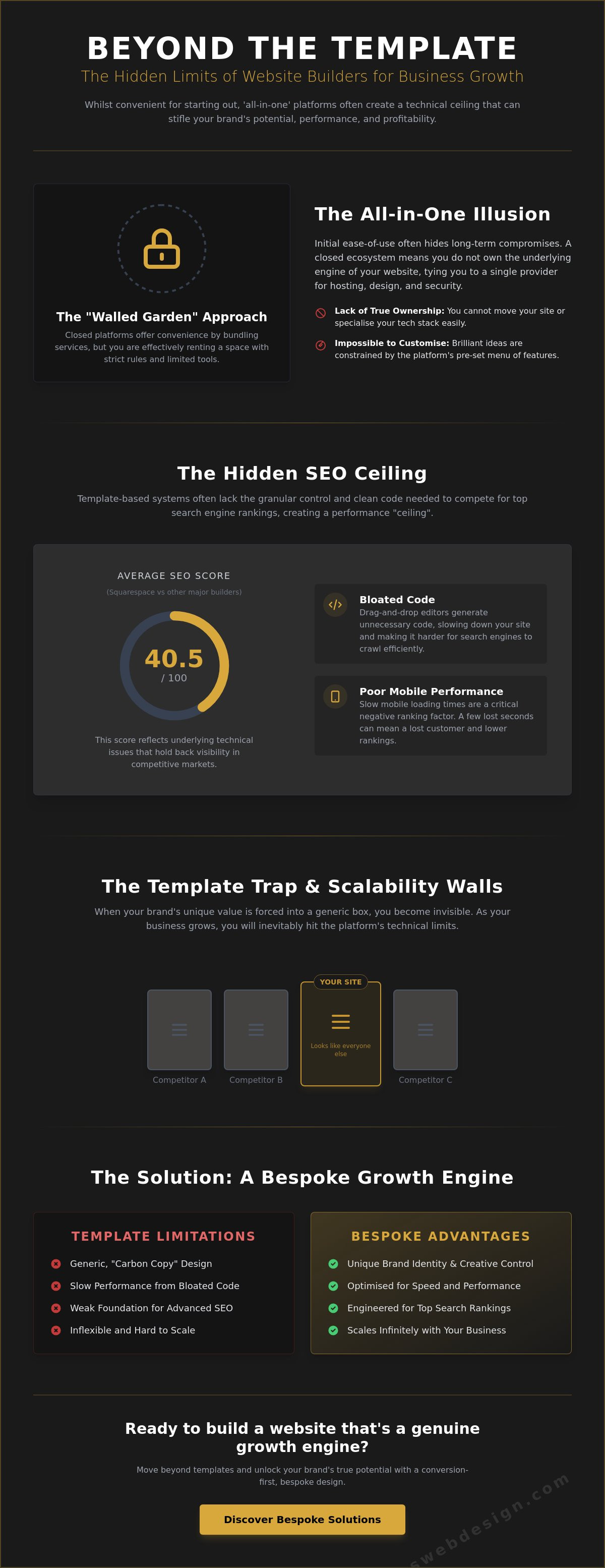
We’ve all been there, feeling that slight pinch of anxiety when our digital presence doesn’t quite match our professional pride. You want a site that feels like you, not a pre-packaged box. In this article, you will discover the hidden constraints that might be holding your brand back and learn exactly when it’s time to move beyond templates to achieve real, bespoke growth. We’ll explore why the average SEO score for these sites sits at just 40.5 out of 100 and how to break through the “all-in-one” illusion to find a website that finally scales with you.
Key Takeaways
- Understand why the “all-in-one” convenience of a closed-source platform often leads to technical compromises that hinder your long-term flexibility.
- Uncover how bloated code and rigid architecture create a “ceiling” for your search rankings and why your mobile performance might be stalling.
- Learn how to identify the specific Squarespace limitations for business that might be making your brand look like a carbon copy of your competitors.
- Discover the technical “walls” you’ll hit when trying to integrate bespoke CRM systems or manage complex e-commerce growth.
- See why shifting to a conversion-first bespoke design is the most effective way to turn your website into a genuine growth engine whilst maintaining total creative control.
The All-in-One Illusion: Why Squarespace is a Starting Point, Not a Finish Line
Think back to the day you first launched your site. You needed a digital home, you needed it quickly, and Squarespace looked like an absolute dream. It is the ultimate digital starter kit; a shiny, all-in-one box that promises to handle everything from your domain name to your drag-and-drop design. This Squarespace company overview highlights how the platform has grown into a massive player by making web design accessible to everyone. But for a scaling business, that convenience often hides a tricky reality. You aren’t just using a tool; you’re renting a space in someone else’s walled garden.
The “all-in-one” promise is a bit of a siren song. It sounds lovely until you realise that extreme convenience almost always requires technical compromises. Because it is a closed-source platform, you’re playing by their rules, using their pre-set code, and staying strictly within their boundaries. This is exactly where the Squarespace limitations for business start to bite. Whilst a DIY template works wonders for a side hustle, high-end London firms eventually hit a “ceiling effect.” This is the moment where the platform simply cannot keep up with your brand’s sophistication or your need for complex, high-performing features.
The Problem with Closed Ecosystems
When you build on a closed platform, you don’t actually own the underlying engine of your website. It’s a bit like leasing a car. You can change the seat covers and pick a lovely paint colour, but you can’t swap out the engine for something more powerful when you want to hit the motorway. You are tied to one provider for your hosting, your design tools, and your security. If you ever want to move your site or specialise your tech stack, you’ll find it’s nearly impossible to pack up and go. In the digital world, “easy to use” usually means “impossible to customise” once your needs become unique.
When Convenience Becomes a Constraint
We’ve all felt that specific pang of frustration. You have a brilliant idea for a new feature or a specific layout that would wow your clients, but you find it simply isn’t “on the menu.” It’s a bit like trying to add a basement to a flat-pack house; the structure just wasn’t built for it. That initial pride of “I built this myself” slowly shifts into a nagging anxiety that your site looks just like every other competitor in your niche. This is the point where your website stops being a powerful asset and starts feeling like a chore you have to manage. Real growth requires a bespoke strategy, not a one-size-fits-all template that holds you back.
The Hidden SEO Ceiling: Why Your Rankings Might Be Stalling
Have you ever felt like you’re doing everything “right” but still can’t crack the first page of Google? It’s a bit like shouting into a gale. You’ve filled in your page titles and added descriptions, yet your competitors seem to be gliding past you. One of the most significant Squarespace limitations for business is the technical “ceiling” that comes with a template-based system. Whilst the platform handles the basics well enough for a hobbyist, it often lacks the granular control required for serious SEO for service businesses.
Research indicates that the average SEO score for Squarespace sites is roughly 40.5 out of 100, which is the lowest amongst major website builders. This isn’t just about missing alt text. It’s about what’s happening under the bonnet. When you’re competing in a crowded UK market, you need every technical advantage you can get. A bespoke build allows for “clean” code that Google’s crawlers can navigate without tripping over unnecessary baggage. If your site is struggling to be seen, it might be because the platform itself is acting as a handbrake on your visibility.
Bloated Code and Mobile Performance
Every time you use a drag-and-drop editor to move a block, the platform generates layers of extra code to make that happen. This “bloat” can slow down your mobile loading times significantly. Imagine a potential client in a bustling part of Birmingham, trying to load your page on a patchy 4G connection. If your site takes more than a couple of seconds to appear, they’re gone. Page speed is a direct ranking factor, and losing those precious seconds means losing enquiries. Even a quick look at Squarespace e-commerce limitations reveals that whilst the interface is sleek, the underlying performance often struggles to match more robust, custom-coded alternatives.
Limited Control Over Technical Metadata
Advanced SEO requires precision. Unfortunately, Squarespace uses rigid URL structures, such as the mandatory “/blog/” or “/p/” prefixes, that you simply cannot change. You also can’t edit your robots.txt file to tell Google exactly which parts of your site to ignore. For a growing service business, these small constraints add up to a major disadvantage. Implementing advanced Schema markup for local search dominance becomes a technical headache rather than a simple task. The same risks apply when migrating from Wix to WordPress SEO issues are involved, where poorly handled URL changes and redirect structures can wipe out hard-earned rankings overnight. If you’re tired of fighting against your own website, it might be time to explore a bespoke solution that puts you back in the driving seat.
The Template Trap: When Sleek Design Makes Your Brand Invisible
Imagine a potential client sitting at their kitchen table in Sutton Coldfield, browsing for a local architect or solicitor. They open three tabs. Tab one looks clean and modern. Tab two looks clean and modern. Tab three looks… well, it looks exactly like the first two. Whilst the templates are undeniably “pretty,” they often lead to a peculiar kind of digital invisibility. This is one of the most frustrating Squarespace limitations for business; the platform makes it so easy to look good that everyone ends up looking the same.
Professional credibility isn’t just about looking “nice.” It’s about looking like you. When your website is built on the same “favourite” template as your direct competitor, you aren’t building a brand. You’re just blending into the background noise. High-end clients in places like Lichfield expect a unique digital experience that reflects the premium nature of your service. If your site feels like a carbon copy, it subtly signals that your business might be, too. It’s a bit like buying a “unique” sofa from a massive blue-and-yellow Swedish warehouse; it looks fine, but you’ll see it in every other house on the street.
Visual Credibility vs. Template Uniformity
The psychological impact of a custom-designed interface cannot be overstated. A bespoke site builds trust because it shows you’ve invested in your own identity. You aren’t squeezing your brand into a pre-made box; you’re building a digital home around your brand. When we talk about Squarespace limitations for business, we often mean the inability to lead with bespoke branding. Instead of your values dictating the design, the template’s grid dictates how you present your story. This uniformity can quietly erode the authority you’ve worked so hard to build.
User Experience (UX) Limitations
The “Fluid Engine” grid might feel flexible at first, but it still forces you to organise information based on pre-set blocks rather than actual user behaviour. For property firms or professional services, the way a user navigates your site is critical to conversion. Bespoke builds allow us to remove “template friction” by placing every button, image, and text block exactly where your specific audience needs them to be.
- Conversion-first logic: Every element is placed to guide the user toward an enquiry.
- Layout freedom: No more fighting with rigid grids to show off complex portfolios.
- Brand-led design: Your logo and colour palette dictate the site, not the other way around.
Ultimately, a website that looks like everyone else’s is a website that’s easy to forget. Moving beyond the template isn’t just about vanity. It’s about making sure your brand is the one that sticks in the client’s mind long after they’ve closed those browser tabs.
Scalability Walls: The Technical Limits You Will Eventually Hit
Imagine your business is finally taking off. You’re adding new services, more team members, and a growing list of happy clients. It’s a brilliant feeling, isn’t it? But then you notice your website dashboard starts to feel a bit sluggish. Maybe that “easy” inventory manager is now a total nightmare to navigate. This is where the Squarespace limitations for business really start to show their teeth. You’ve hit a scalability wall, and no amount of dragging and dropping is going to fix the underlying structural issues. You’ve simply outgrown the starter kit.
For many growing brands, the next logical step is moving from Shopify to a custom ecommerce site or leaving the template world behind entirely. Why? Because as you scale, you need a site that works for you, not one you have to work around. When you’re managing a large-scale content library or a complex inventory, you need a backend that is as professional as your front-facing brand. Relying on a basic interface to manage a sophisticated business is a recipe for operational headaches.
Integration Headaches
Standard integrations are often built for the “lowest common denominator.” They work fine for the basics, but the moment you need a bespoke CRM or a specific booking workflow that matches your unique way of working, things get messy. You end up relying on third-party tools like Zapier to glue everything together. It feels like digital duct tape. Before you know it, you’re paying multiple subscriptions for workarounds that should have been built-in from the start. A bespoke development approach creates a seamless centre for all your business tools, removing that friction entirely.
Performance at Scale
Did you know that whilst you can technically have 1,000 pages, the platform recommends a maximum of 400 to avoid slow loading times? That is a massive warning sign. As you add more blocks and sections, the performance lag becomes impossible to ignore. For larger service sites, relying on a shared platform is a bit like running a high-end restaurant out of a shared kitchen. It’s risky. During high-traffic periods, you need the security and speed that only dedicated website maintenance and hosting can provide. Don’t wait for a site crash to realise you’ve outgrown your current setup.
If your website is starting to feel like a bottleneck rather than a launchpad, it’s time to book a consultation to discuss your bespoke transition.
Beyond the Template: Why Bespoke Design is the Real Growth Engine
Staying with a template when your business has outgrown it is a bit like trying to run a marathon in a pair of flip-flops. They were easy to slip on at the start, but now they’re just causing blisters and slowing you down. Moving to a bespoke build is the only way to truly overcome the Squarespace limitations for business that we’ve explored. It’s the shift from being a digital tenant to becoming a digital landlord. You stop settling for “good enough” and start aiming for “industry-leading.”
The real secret? Bespoke design is built with “conversion-first” logic. Whilst templates are designed to look pretty in a gallery, a custom site is designed to make you money. We don’t start with a grid; we start with your customer’s journey. We look at why they hesitate, what they need to see to trust you, and exactly where that “Enquire Now” button needs to sit to get clicked. It’s about precision. When your website is an asset rather than just an online brochure, the long-term ROI far outweighs the initial cost of leaving a monthly subscription model behind.
Ownership and Future-Proofing
One of the most liberating things about moving away from a closed platform is the sense of ownership. You own your digital asset outright. There’s no monthly “rent” just to keep your site live, and no risk of losing your hard work if a provider decides to change their terms. For growing UK firms, a custom WordPress build remains the gold standard. It offers the perfect balance of user-friendly management and infinite scalability. You can add new features, integrate complex systems, and expand your site as your business evolves without ever hitting a technical wall again.
Taking the Next Step
How do you know it’s time? If you’re tired of saying “we can’t do that because of the website,” or if you’re embarrassed to send high-value leads to a site that looks like a DIY project, you’ve already arrived. Transitioning from a template to tailored excellence doesn’t have to be a headache. At Gravitas Web Design, we specialise in helping businesses break free from the Squarespace limitations for business that stall growth. We take the stress out of the move, ensuring your SEO is protected and your new brand identity is stronger than ever.
Ready to build a website that actually works for your business? Get started here.
Ready to Reclaim Your Digital Identity?
It’s time to stop fighting with your website and start letting it work for you. We’ve explored the technical ceilings and the “samey” design traps that come with a closed-source platform. Understanding the Squarespace limitations for business is the first step toward reclaiming your brand’s voice. You deserve a digital presence that doesn’t just look “nice” but actually converts visitors into loyal clients whilst reflecting the true quality of your work.
Whether you need a bespoke design tailored to Birmingham business needs or expert SEO integration for London firms, the transition should be exciting, not exhausting. We pride ourselves on a transparent, jargon-free development process that keeps you in the loop every step of the way. No more digital “renting” or hitting invisible walls. It’s time to move beyond the template and build something you’re genuinely proud to share with the world.
Stop settling for templates and start building your bespoke digital presence today.
Frequently Asked Questions
Is Squarespace bad for SEO compared to bespoke websites?
Squarespace isn’t “bad” for the basics, but it has a lower average SEO score of 40.5 out of 100 compared to other major builders. This is often due to technical Squarespace limitations for business like rigid URL structures and limited schema control. A bespoke site gives you total control over the technical architecture, allowing Google to crawl your pages without tripping over bloated code.
Can I move my Squarespace site to a custom WordPress build easily?
Moving your site is a manual process rather than a quick export. Because it’s a closed ecosystem, you can’t simply move a file over to WordPress. You’ll need to migrate your content and redesign the layout from scratch. This is actually a perfect time to upgrade to a bespoke build that truly reflects your brand’s growth whilst ensuring your SEO remains intact.
What are the hard page and product limits on Squarespace?
You can technically add up to 1,000 pages and 10,000 products to your site. However, performance often takes a hit long before you reach those numbers. The platform recommends staying under 400 pages to maintain decent loading speeds. If your inventory or content library is growing rapidly, these hard limits can quickly become a bottleneck for your daily operations.
Why does my Squarespace site load so slowly on mobile devices?
Slow mobile speeds are usually caused by “code bloat” from the drag-and-drop editor. Every time you move a block, the platform adds layers of extra code to keep things in place. Whilst it looks great on a desktop, it’s heavy for mobile processors to chew through. Bespoke sites use clean, lightweight code to ensure your pages snap into view instantly for your customers.
Do I own my content and design if I use Squarespace?
You own your text and images, but you don’t own the website’s underlying code or the template design. If you decide to leave the platform, you can’t take the actual “site” with you. You’re essentially renting a space in their walled garden. This is why many UK firms prefer bespoke ownership; it ensures you own your digital asset outright without any platform restrictions.
Is it cheaper to fix a Squarespace site or build a bespoke one?
Building a bespoke site is almost always the better investment for a growing brand. Trying to “fix” a limited platform usually involves expensive, fragile workarounds that still don’t offer the performance of a custom build. It’s the difference between constantly repairing a budget car and finally investing in a reliable engine that’s built for the long haul and tailored to your needs.
Can I add custom code to Squarespace to bypass its limitations?
You can add CSS and JavaScript, but it’s a bit like putting a spoiler on a family hatchback. It might look faster, but the underlying Squarespace limitations for business remain. Custom code can also be quite fragile. If the platform updates its core engine, your “hacks” might suddenly break, leaving you with a broken layout and an urgent repair bill.
How do I know if my business has outgrown its current template?
You’ve outgrown it when the phrase “we can’t do that” starts appearing in your marketing meetings. If you feel a pinch of anxiety when sending high-end leads to your site, or if your SEO has flatlined despite your best efforts, your template has become a cage. It’s a sign that your professional pride is ready for a digital home that matches your ambition.