
Web Design Blog
How to Plan a Website Redesign for Business Growth
What if your website didn’t just look “fine,” but actually worked like your hardest-working employee? Most business owners feel a pang of anxiety when they think about a digital overhaul. You worry about the techy bits, you’re terrified of your Google rankings vanishing into thin air, and you’re frankly bored of those cookie-cutter templates that make you look like everyone else. It’s a common frustration, especially when your current site feels more like a digital paperweight than a lead-generation machine. Learning how to plan a website redesign project shouldn’t feel like learning a second language or risking your reputation on a whim.
It’s time to stop crossing your fingers and start following a proven map. We’re giving you a step-by-step framework to turn that underperforming site into a high-converting digital asset, minus the usual industry jargon. We’ll walk through a stress-free process that prioritises your growth, protects your SEO, and ensures you finally have a professional site you’re proud to show off to the world.
Key Takeaways
- Identify the “silent killers” of conversion that are currently costing you leads and learn how to fix them before you touch a single pixel.
- Discover how to plan a website redesign project using a “Soul before Skin” strategy that aligns your brand voice with your customer’s actual journey.
- Learn why bespoke design beats generic templates every time when it comes to standing out and building professional credibility in the UK market.
- Guard your hard-earned Google rankings with a technical migration plan that ensures your SEO stays intact whilst your site evolves.
- Master a stress-free launch process and learn how to use initial user feedback to keep your new digital asset performing for the long haul.
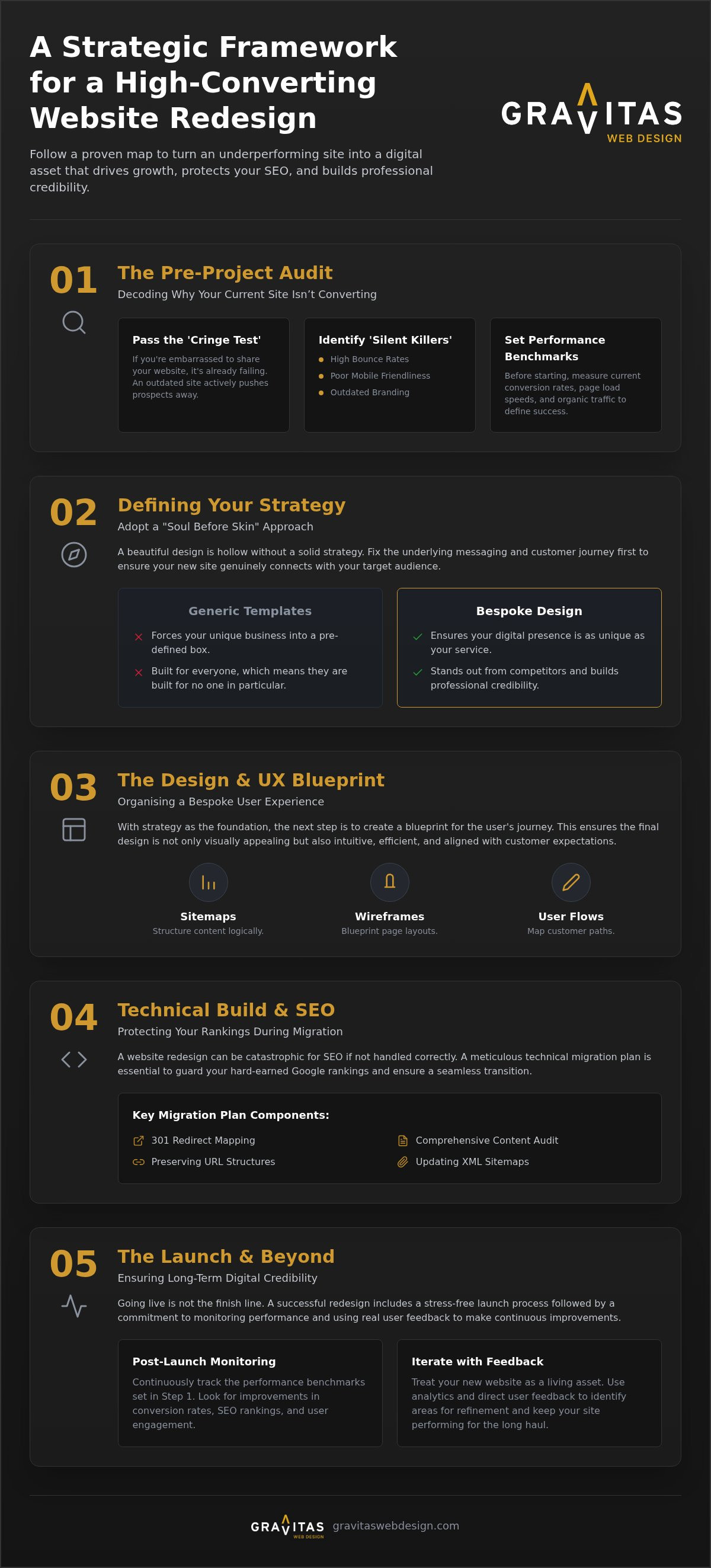
The Pre-Project Audit: Decoding Why Your Current Site Isn’t Converting
Imagine you are handing your business card to a dream prospect at a networking event. You are confident, your pitch is polished, and the connection is real. Then, you see them reach for their phone to look you up, and you feel a sudden, sharp pang of anxiety. You find yourself saying, “Oh, ignore the website, it is a bit out of date.” That is the Cringe Test. If you are embarrassed to show off your digital home, it is already failing you. A site that doesn’t reflect the current quality of your work is a digital paperweight. It isn’t just sitting there; it is actively pushing people away.
A brutally honest assessment is the vital first step in learning how to plan a website redesign project that actually delivers growth. You need to look past the “it is fine” mindset and hunt for the gaps in user behaviour. Are people landing on your homepage and immediately bouncing? That is a clear sign of a trust deficit. We often think of design as purely aesthetic, but a comprehensive overview of web design reminds us that user interface and search engine optimisation are just as vital for keeping people on the page as the colours you choose.
Identifying the ‘Silent Killers’ of Your Online Credibility
High bounce rates are usually a cry for help. They suggest that visitors don’t find what they need or, worse, they don’t believe you are the real deal. Then there is mobile responsiveness. Most sites are “functional” on a phone, meaning the text is legible, but are they actually “friendly”? If a potential client has to pinch and zoom whilst trying to find your contact details, they will leave. Outdated branding is another silent killer. It quietly whispers to your customers that you have stopped innovating, giving your local competitors a massive head start without them even trying.
Setting Performance Benchmarks Before You Begin
You cannot manage what you do not measure. Before the first wireframe is drawn, you need baseline stats. Check your current conversion rates, page load speeds, and organic traffic levels. This data acts as your North Star during the process of how to plan a website redesign project. Success shouldn’t be defined by a “pretty” new layout alone; it should be defined by measurable results. To keep your project on track, write down one clear, primary goal. For example: “Our primary goal is to increase our monthly lead enquiries by 25% by streamlining the user journey and improving mobile load speeds.”
Defining Your Strategy: Aligning Your Brand Voice with Customer Expectations
Before you start picking out colour palettes or debating the merits of a sticky header, you need to address the “soul” of your site. We call this the “Soul before Skin” approach. If you don’t fix the underlying strategy first, even the most beautiful new layout will eventually feel hollow. When considering how to plan a website redesign project, think of your strategy as the foundation of a house. You wouldn’t choose the curtains before you’ve seen the floor plan, right? A well-researched strategy ensures your new site actually talks to the people you want to serve, rather than just looking pretty on a screen.
In a world of generic, off-the-shelf templates, standing out is harder than ever. This is where bespoke web design in Birmingham makes all the difference. Templates are built for everyone, which often means they are built for no one in particular. They force your unique business into a pre-defined box. By choosing a custom path, you ensure your digital presence is as unique as your service, helping you bypass the “industry-standard awkwardness” that plagues so many UK business sites.
Messaging First: Why Copywriting is the Foundation of Great Design
Words move people; design just makes the movement look good. Your brand voice should feel like a genuine human-to-human conversation, not a corporate lecture. You have roughly three seconds to tell a visitor exactly what you do and why they should care. If your value proposition is buried under layers of jargon, they’ll be gone before the page even finishes loading. Professional copywriting builds that essential bridge of trust, positioning you as an ally who understands their specific pains. It’s about being clear, candid, and slightly cheeky where appropriate, ensuring your personality shines through every paragraph.
Mapping the Customer Journey for UK Markets
A customer in the heart of London often has different expectations and pressures than one in the West Midlands. Understanding these local nuances is a key part of strategic branding. Your site’s architecture should organise information to reduce friction, removing any “hoops” that stand between a visitor and their goal. Whether they are looking for a quick enquiry form or a deep dive into your case studies, the journey should feel effortless. If you want to see how a strategic approach can transform your digital presence, you might want to explore our bespoke process today.
The Design and UX Blueprint: Organising a Bespoke User Experience
When you are figuring out how to plan a website redesign project, it is incredibly tempting to jump straight into the fun stuff, like picking out vibrant colours and fancy fonts. However, if you have already spotted the clear indications it’s time for a redesign, you know that a pretty face isn’t enough. You need a blueprint. This stage is about organising the user experience (UX) so that your visitors don’t just admire the view, they actually take action. It is the bridge between your high-level strategy and the final, polished product.
We focus on bespoke design because it is the only way to truly scale a professional service business in the UK. Generic templates often feel like wearing a suit that is two sizes too big; it technically covers you, but it doesn’t make you look your best. A custom-built site allows for unique brand storytelling, ensuring your digital presence is a perfect fit for your specific goals and your audience’s expectations. It is about creating a visual identity that makes you feel genuinely proud to share your URL with a high-value prospect.
Wireframing: The Architectural Plan for Your Website
Before we add the “skin” and colours, we build the “skeleton.” Wireframes are simple, black-and-white layouts that focus purely on structure and flow. Why do we do this? Because we want to ensure your most important calls to action are always within easy reach, regardless of the device your customer is using. We take this approach because converting visitors into customers is a design choice, not a happy accident. By stripping away the visual distractions, we can map out a path that guides your visitors from their initial curiosity straight to an enquiry.
Bespoke Design vs. Templates: The Credibility Gap
There is a hidden ceiling with “off-the-shelf” builders like Wix or Squarespace. Whilst they are fine for hobbyists, they often stifle growing businesses with rigid layouts and limited functionality. Custom layouts allow you to break free from these boxes. You can create a journey that is entirely unique to your brand, which is essential for building professional credibility. Part of this process involves choosing high-quality, professional imagery. Generic stock photos are the digital equivalent of elevator music; they are safe, but they are also completely forgettable. Real, authentic photos of your team and your work build a level of trust that a stock library simply cannot match.
Finally, we must consider accessibility. Ensuring your site is inclusive for a diverse UK audience isn’t just a legal hoop to jump through; it is about making sure every potential client can navigate your site with ease. This means thinking about font sizes, colour contrasts, and screen-reader compatibility from the very first wireframe. When you consider how to plan a website redesign project with everyone in mind, you aren’t just being “nice,” you are expanding your market reach.
Technical Build and SEO: Protecting Your Rankings during Migration
The thought of your hard-earned Google rankings vanishing overnight is enough to keep any business owner awake at night. You’ve spent years building authority, and the last thing you want is for a new look to reset your progress to zero. This is why understanding how to plan a website redesign project requires a heavy focus on the “under the bonnet” technicalities. We start by executing a comprehensive technical SEO audit to identify exactly what is currently working for you. We aren’t just building a new site; we are protecting a valuable business asset by carrying over the “SEO juice” that already brings you leads.
Your choice of Content Management System (CMS) plays a massive role in your long-term sanity. We champion WordPress because it offers the perfect balance of flexibility and ease of use, ensuring you aren’t tethered to a developer every time you need to change a comma. It also provides a robust framework for complex strategies, such as local SEO for multiple locations. This is essential if you are looking to scale your digital presence across different UK regions without creating a technical mess.
The SEO Migration Checklist
A successful migration is all about the details. We map every single old URL to a corresponding new one using 301 redirects. This tells Google, “We’ve moved house, here is the new address,” preventing those dreaded ‘404 Not Found’ errors that frustrate users and tank your rankings. We also take this opportunity to polish your on-page elements, from meta titles to H1 tags, ensuring SEO for service businesses is baked into the very foundation of the build. By doing this, we make sure your site isn’t just a pretty face but a high-performing engine ready to climb the search results.
UK Hosting and Security Foundations
Let’s talk about hosting. “Cheap” hosting is often the most expensive mistake a business can make. If your site takes five seconds to load because it’s on a cluttered, overseas server, your conversion rate will suffer. We prioritise premium UK-based hosting because it offers superior speeds and ensures your data handling is fully compliant with GDPR. Slow-loading websites contribute to a £2 billion annual revenue loss for online businesses according to data from ColorWhistle, so speed is a commercial necessity. Once the site is live, our WordPress maintenance services act as a digital bodyguard, protecting your reputation from security threats. If you are ready to build a site that is as secure as it is beautiful, let’s discuss your technical roadmap.
The Launch and Beyond: Ensuring Long-Term Digital Credibility
You have done the hard graft. The strategy is set, the pixels are perfect, and the technical migration is locked in. However, launch day isn’t actually the finish line; it is the starting gun. If you really want to know how to plan a website redesign project that delivers lasting value, you have to treat your site like a living, breathing member of your team. It isn’t a static brochure that you print once and forget in a desk drawer. It needs regular love, attention, and a bit of a polish to keep it performing at its absolute peak whilst your business grows.
Post-Launch Testing and Quality Assurance
Before we pop the champagne, we run the gauntlet. This involves testing every button, enquiry form, and checkout flow across every device and browser imaginable. Is the mobile experience still “friendly” under the pressure of real-world traffic? We verify site speed performance on both desktop and mobile devices because we know that even a one-second delay can frustrate a potential client. Finally, we conduct a thorough “human” review. We read every line of copy one last time to ensure that cheeky, professional brand voice we worked so hard on remains consistent from the homepage right down to the footer.
The Importance of Ongoing Maintenance and Evolution
Think of your website like a high-performance car. It might look stunning in the showroom, but if you never change the oil or update the software, it will eventually break down on the hard shoulder of the M6. Regular security updates are non-negotiable for professional sites. They protect your digital reputation and keep your data safe. Beyond safety, we use real-world data to see how people are actually navigating your new home. Are they clicking where we expected? Are they getting stuck on a specific page?
We take these initial user insights and make data-driven adjustments to continuously improve your user experience and lead generation. This is where having a straight-talking partner really pays off. We handle all the technical “hoops” and maintenance tasks so you can focus on actually running your business. Learning how to plan a website redesign project is as much about the “after” as it is the “before,” ensuring your investment continues to pay dividends for years to come. Ready to evolve? Let’s start your project today.
Your Journey from Digital ‘Fine’ to Digital Powerhouse
A website redesign isn’t just a lick of paint; it is a strategic pivot that can redefine your business growth. By moving through the “Cringe Test” and prioritising the “Soul before Skin” approach, you ensure your new site actually connects with humans. You’ve seen how to plan a website redesign project that protects your SEO rankings whilst elevating your brand above the sea of generic templates. It is about building a digital home you are genuinely proud to show off to high-value prospects.
At Gravitas Web Design, we take the “hoops” out of the process with founder-led management and a transparent, end-to-end service. From bespoke designs that build instant credibility to integrated SEO and ongoing maintenance, we handle the technical heavy lifting so you don’t have to. You deserve a site that works as hard as you do, without the corporate stiffness or industry jargon. We are here to be your straight-talking partner from the first wireframe to the final go-live.
Ready to ditch the ‘template’ look? Let’s plan your bespoke redesign
It is time to stop settling for a site that just exists and start building one that performs. We can’t wait to see what your business achieves with a digital presence that finally matches the quality of your work.
Frequently Asked Questions
How long does a website redesign project typically take?
A bespoke project usually takes between 8 and 12 weeks from the initial strategy session to the final launch. The timeline depends on the complexity of your requirements and how quickly you can provide feedback on designs and content. We aim for a pace that feels energetic but never rushed, ensuring every pixel and paragraph is placed with purpose to support your business growth.
Will I lose my current Google rankings if I redesign my website?
You won’t lose your rankings if you have a solid technical migration plan in place. By using 301 redirects to map your old URLs to the new ones, you tell Google exactly where your content has moved. This preserves your hard-earned authority and prevents traffic drops. It is a vital step when considering how to plan a website redesign project without risking your visibility.
What is the difference between a website refresh and a full redesign?
A refresh is a digital facelift, whilst a redesign is a total structural overhaul. Think of a refresh as new paint and curtains; it looks better, but the floor plan stays the same. A redesign involves rethinking the user journey, the messaging, and the technical foundation from the ground up. It is the only way to fix deep-seated conversion issues that a new colour palette cannot touch.
How much should I realistically budget for a bespoke website redesign?
Budgeting depends entirely on your specific goals and the complexity of the features you need. Whilst generic templates are cheaper upfront, they often lack the professional credibility required for high-growth service businesses. A bespoke redesign is a strategic investment in your future lead generation. We focus on delivering value that outweighs the initial cost, ensuring your new digital asset actually pays for itself through better conversions.
Do I need to write all the content for my new website myself?
You don’t have to tackle the blank page alone. Whilst you are the expert on your business, we offer in-house copywriting to turn your knowledge into high-converting messaging. We craft a brand voice that feels authentic and human, taking the pressure off your plate. This ensures your value proposition is clear, punchy, and designed to move visitors towards an enquiry from the very first paragraph.
Can I keep my current hosting provider during a redesign?
You can, but we often recommend a switch if your current provider is slow or unreliable. Cheap, overseas hosting is a silent killer for site speed and user experience. We prioritise premium UK-based hosting to ensure your site is fast, secure, and fully GDPR compliant. It is about building a solid foundation that protects your digital reputation and keeps your visitors from bouncing to a competitor.
How often should a business website be redesigned?
Most businesses look at a redesign every two to three years to stay ahead of the curve. Technology moves fast, and what looked modern a few years ago can quickly start to feel like a digital relic. Regular updates keep your site secure and aligned with changing customer behaviour. It isn’t just about following trends; it’s about ensuring your site remains a high-performing tool for business growth.
What happens if I need to change something after the site is launched?
Your website is a living asset, so changes are expected and encouraged. We use WordPress because it is incredibly easy for you to make minor updates yourself without needing a degree in computer science. For bigger shifts or technical tweaks, our maintenance services ensure you always have a straight-talking partner on hand. We don’t just “launch and leave”; we stay with you to ensure your site evolves.