
Web Design Blog
How to Choose a Web Design Agency: The No-Nonsense Guide to Finding Your Perfect Partner
Imagine opening your laptop, clicking on your own website, and feeling that sharp, familiar “cringe” because your digital presence doesn’t match the quality of your actual work. It’s a common frustration, especially if you’ve been burned by unreliable freelancers or felt lost in a sea of confusing technical jargon. You want a site that builds instant credibility, but you’re terrified of hidden costs and projects that never seem to end. To avoid the usual pitfalls, you need a clear list of questions to ask a web design agency before you ever hand over a single penny.
We agree that finding a professional partner shouldn’t feel like a high-stakes gamble. You deserve a transparent, stress-free development process that results in a bespoke website you’re actually proud to share. This guide is your no-nonsense roadmap to cutting through the industry fluff and finding a team that truly understands your business goals. We’ll show you how to spot the red flags, ensure you get long-term support, and finally secure a digital home that works as hard as you do.
Key Takeaways
- Stop the “website cringe” by learning how to treat your agency as a strategic partner rather than just another software vendor.
- See through the allure of “quick-fix” templates and understand why investing in a bespoke digital presence saves you money and stress in the long run.
- Get a checklist of the tough questions to ask a web design agency so you can weed out the jargon-heavy talkers from the actual doers.
- Realise why the work doesn’t end at launch, and how SEO and proper maintenance ensure your site actually reaches your customers.
- Learn to identify a partner who prioritises radical transparency and plain English over confusing corporate-speak and hidden fees.
Why Choosing a Web Design Agency Feels Like a High-Stakes Gamble (and How to Lower the Odds)
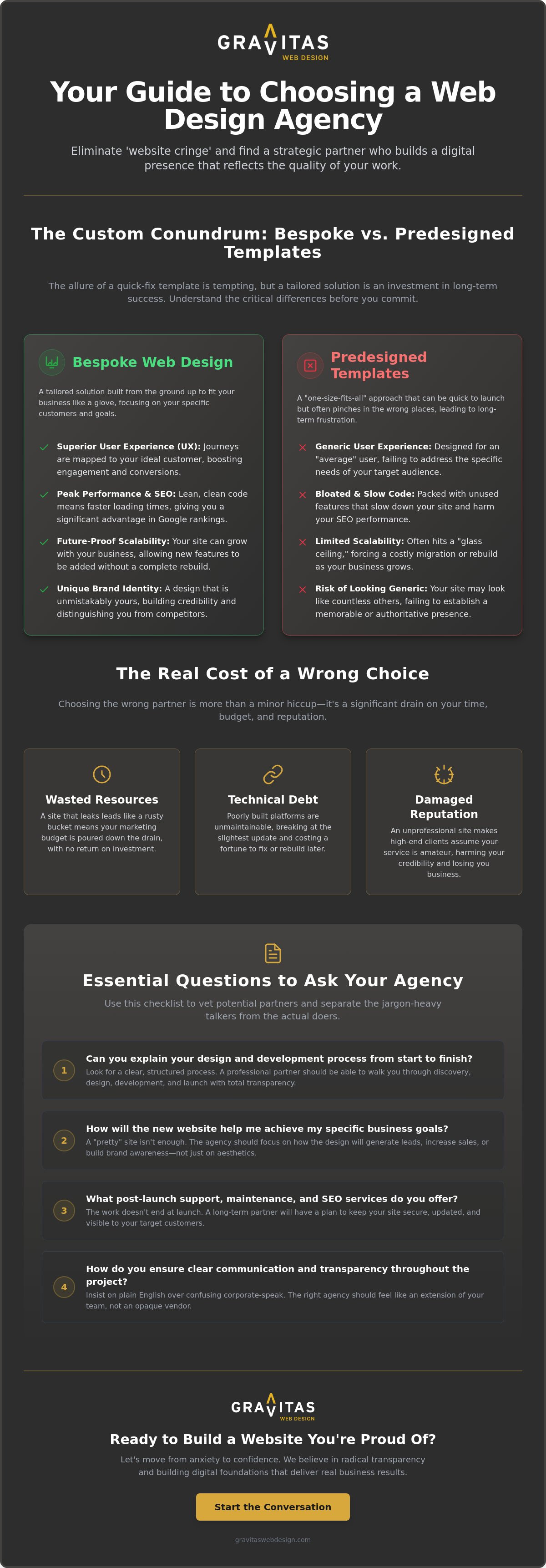
We’ve all been there. You’re at a networking event, someone asks for your website, and you feel that internal wince. You mumble something about it being “under construction” or “a bit out of date” whilst secretly hoping they don’t look at it on their mobile. This “website shame” isn’t just about aesthetics; it’s the nagging feeling that your digital front door is actually a bit of a liability. Having a solid set of questions to ask a web design agency ensures you aren’t just buying a template with a fresh coat of paint. When you start looking for help, the market often feels like a minefield. It’s easy to view a web design agency as just another software vendor, but that’s a mistake. A truly professional agency acts as a strategic partner, building the digital foundation of your business credibility.
The problem is that a “pretty” site isn’t always a profitable one. You can have the most beautiful colour palette in the world, but if the site doesn’t convert visitors into customers, it’s just an expensive digital brochure. Understanding the fundamentals of web design means recognising that your site is a conversion-focused asset. This is why transparency is the most vital trait you should look for. A reliable partner will be open about what works, what doesn’t, and why they are making certain technical choices.
The Real Cost of a Wrong Choice
Picking the wrong partner isn’t just a minor hiccup; it’s a drain on your resources. You might end up wasting your marketing budget on a site that leaks leads like a rusty bucket. Then there’s the technical debt. Poorly built platforms are often unmaintainable, meaning they break the moment you try to update a plugin. Most importantly, an unprofessional site damages your reputation amongst high-end clients who expect a polished experience. If your site looks amateur, they’ll assume your service is too.
Moving from Anxiety to Confidence
To lower the stakes, you need to change your approach. Before you start your search, set clear business goals. Are you looking for more leads, better brand awareness, or a smoother checkout process? When you do start interviewing, remember that you are hiring strategy and expertise, not just someone who can write code. This is where your list of questions to ask a web design agency becomes your best friend. Look for teams that speak your language instead of hiding behind confusing jargon. We believe in radical transparency and zero unnecessary bureaucracy, prioritising straight-talking honesty over corporate-speak. If an agency can’t explain their process without using “synergy” or “disruption”, they probably don’t understand your business well enough to help it grow.
The Custom Conundrum: Bespoke Web Design vs Predesigned Templates
We’ve all been tempted by the “quick and easy” promise of a £50 template. It looks stunning in the demo (usually because it’s filled with professional stock photos of people in minimalist offices), but the reality is often a bit more frustrating. A template is like a “one size fits all” suit; it might technically cover you, but it’s going to pinch in all the wrong places. Bespoke web design, on the other hand, is a tailored solution built from the ground up to fit your business like a glove. It allows for superior user experience (UX) because the entire journey is mapped to your specific customer, not a generic “average” user. When you are refining your list of questions to ask a web design agency, you need to know if they are actually building for you or just reskinning a tired old theme.
There is also the hidden technical cost of templates. Most predesigned themes are bloated with “kitchen sink” code, containing features and scripts you’ll never use but that still slow down your site. Google hates bloat. Bespoke code is lean, clean, and gives you a significant SEO advantage because your site actually loads quickly and functions perfectly on every device. It’s an investment in your business’s future scalability, ensuring you don’t have to start from scratch the moment you want to add a new service or function.
When a Template Simply Is Not Enough
Growing professional firms eventually hit a “glass ceiling” with DIY platforms. If you are a high-end service business in London or Birmingham, your digital identity needs to reflect the premium nature of your work. You can’t command top-tier fees if your website looks like it was cobbled together on a Sunday afternoon. Recognising when to move from a template to a bespoke website is a vital milestone for any serious brand. It’s about moving from “just having a site” to owning a digital asset that actively builds trust before you’ve even picked up the phone.
The Bespoke ROI: Long-Term Value vs Initial Fee
It’s easy to focus on the initial cost, but the real calculation is the return on investment. A bespoke site supports complex business logic, unique customer journeys, and specific integrations that a template simply can’t handle. Imagine a site that actually generates enquiries whilst you sleep because the user journey was designed to lead people exactly where they need to go. This flexibility allows you to evolve and organise your site as your business grows, rather than being stuck in a rigid box. If you’re ready to stop wrestling with templates and start building something real, you might want to chat with us about your goals to see what’s actually possible.
Vetting for Credibility: How to Spot a Professional Partner Amongst the Noise
Scrolling through an endless list of Google results for digital partners can feel like a bit of a fever dream. Everyone promises the moon (and a high-ranking spot on page one), but how do you separate the professionals from the pretenders? One of the most telling questions to ask a web design agency is actually one you shouldn’t have to ask: “What are your business goals?” If they don’t ask you that within the first ten minutes, it’s a massive red flag. A credible partner cares more about your bottom line than their favourite hex code. Having a solid list of questions to ask a web design agency helps you peel back the layers of marketing fluff to see if there’s any substance underneath.
Don’t be fooled by agencies that only work in one tiny niche. Whilst it sounds safe, it often means they’ve stopped thinking and started copy-pasting. A diverse portfolio shows a team that can solve unique problems across different industries and adapt to different audiences. You also need to feel a bit of “spark” during that initial discovery call. This is a long-term relationship, and if the chemistry feels off or they’re hiding behind a wall of corporate-speak, the project will likely be a slog. Ask for a detailed breakdown of their process; a pro will have a clear roadmap from the first sketch to the final launch. Finally, look for testimonials that mention actual results (like increased enquiries or faster load times) rather than just “it looks nice.”
Analysing the Portfolio Like a Pro
Take a proper look at their past work with a critical eye. Does every site feel unique, or are they clearly just reskinning the same basic layout? Open their portfolio on your phone and give it a proper poke. Is the experience truly responsive, or does the text overlap and the buttons disappear? You should also look at the words. A site that looks great but reads like a technical manual is a missed opportunity. Great agencies prioritise professional copywriting just as much as the pixels, ensuring the message is as sharp as the design.
The Power of Integrated Branding
Your website doesn’t exist in a vacuum. It’s the digital home for your brand identity, which is why a professional agency understands how your logo and your website need to speak the same language. If your branding is outdated, even a shiny new site will feel disjointed and confusing to your customers. This is why many growing firms look for professional logo design London specialists who can weave strategic branding into the very fabric of the site. A unified brand voice is essential for establishing that instant credibility that turns a casual browser into a loyal client.
Beyond the Launch: Why Post-Project Support and SEO Define Your Success
The champagne cork has popped, the site is live, and you’re finally ready to show the world your new digital home. It’s a great feeling, but here’s the cold, hard truth: a website is never actually finished. Thinking of your launch as the finish line is like buying a high-performance car and then never changing the oil or checking the tyres. Without regular care, even the most beautiful bespoke site will eventually slow down, become vulnerable to security threats, or simply lose its edge in the search rankings. You need a partner who sticks around for the long haul, not one who treats your business like a one-off transaction.
This is why one of the most vital questions to ask a web design agency is what their support looks like after the “go-live” date. Some agencies are brilliant during the honeymoon phase but vanish the moment the final invoice is settled. A “launch and leave” approach is a massive risk to your digital investment. A professional partner should offer secure hosting, proactive security monitoring, and a clear plan for ongoing maintenance. This long-term support ensures that as the web evolves, your site doesn’t get left behind in the digital dust.
The Maintenance Safety Net
Technical updates are the “boring but essential” part of running a successful business online. They keep your site running smoothly and protect you from the latest security exploits. For local firms, this is about more than just code; it’s about reputation. If you’re based in the West Midlands, for example, investing in WordPress maintenance services Lichfield gives you the peace of mind that someone is watching your back. Regular backups and proactive updates mean you won’t wake up to a broken site or a “site not secure” warning that scares off potential clients.
SEO: Driving Enquiries, Not Just Traffic
A stunning website is useless if nobody can find it. Real success comes from baking technical SEO into the bespoke design process from day one. You need a team that understands how to structure your site so Google actually likes what it sees. This becomes even more critical if you’re looking to scale, as you’ll need an agency that understands local SEO for multiple locations to ensure you’re visible in every area you serve. Ongoing content and optimisation are the fuel that keeps your organic growth moving forward. If you’re ready to build a site that stays fast, secure, and visible, let’s talk about your long-term digital strategy.
The Human Element: Why Your Agency Should Feel Like an Extension of Your Team
Think back to the last time you dealt with a big corporate company. You were probably shuffled between departments, assigned a generic ticket number, and left wondering if anyone actually knew your name. Choosing a partner for your digital presence shouldn’t feel like that. At Gravitas Web Design, we believe in radical transparency and zero unnecessary bureaucracy. We’ve seen the “boardroom presentation” style of working, and quite frankly, it’s exhausting for everyone involved. We prioritise straight-talking and honesty over corporate-speak because we want to be an extension of your team, not a distant vendor hiding behind a wall of jargon. When you’re considering your final questions to ask a web design agency, ask yourself: do they actually get me? An empathetic partner helps you navigate the emotional highs and lows of a rebrand, from the initial “what if” anxiety to the final “wow” moment when your new site goes live.
You also want a partner who isn’t afraid to challenge your ideas. If an agency says “yes” to every single request without question, they aren’t being a strategist; they’re being a pixel-pusher. A true ally will tell you if a feature is a waste of money or if a design choice might confuse your customers. It’s about finding a long-term ally who is as invested in your success as you are, helping you build something that actually lasts. This human-to-human connection is what turns a standard project into a transformational business asset.
A Partnership Built on Honesty
We don’t sugarcoat the creative process. We openly discuss the aspects of the journey that might be nerve-wracking, such as the initial design reveal or the complex technical migration. Clear communication is the only way to prevent project delays and that frustrating budget creep that plagues so many UK digital projects. Working with a founder-led agency like Gravitas Web Design means you get direct accountability. You aren’t talking to a junior account manager who has to “check with the team” every time you have a query. You’re talking to the people making the decisions, ensuring every choice aligns with your business goals.
Ready to Feel Proud of Your Website?
The journey from an outdated, embarrassing site to an industry-leading digital presence is shorter than you think. Once you’ve vetted for credibility and confirmed the post-launch support, you can move forward with absolute confidence. Your final checklist should look for transparency, technical skill, and that vital human connection. If you’re ready to stop making excuses for your URL and start winning high-end clients, book a candid chat about your next project with Gravitas Web Design. We’ll help you cut through the noise and build a bespoke site that truly reflects the standard of your work. It’s time to feel proud of your digital home again.
Ready to Build a Digital Presence You’re Actually Proud Of?
Choosing a partner to build your digital home shouldn’t feel like a shot in the dark. We’ve explored why bespoke design beats a tired template every time and how the right support keeps your site fast and secure long after the launch party. By keeping your list of questions to ask a web design agency focused on business goals rather than just aesthetics, you’ve already lowered the odds of making a costly mistake. You’re looking for an ally who understands the UK market and speaks your language, not a distant vendor who hides behind a wall of technical fluff.
At Gravitas Web Design, we do things differently. As a founder-led agency, we ditch the corporate bureaucracy to focus on high-end, bespoke solutions that actually drive results. We’re specialists in branding and SEO for professional service firms, and we pride ourselves on a jargon-free process that keeps you in the loop from the first discovery session to ongoing hosting. If you’re tired of “website shame” and ready for a site that matches the quality of your work, book a candid chat about your next project with Gravitas Web Design. It’s time to build something brilliant together.
Frequently Asked Questions
How much should a bespoke web design project actually cost in the UK?
The investment for a bespoke project depends entirely on your specific requirements and the complexity of the build. Whilst off-the-shelf templates are cheaper upfront, a custom solution is a strategic investment in a digital asset that scales with your business. Most professional agencies will provide a clear, transparent quote after a discovery session rather than a one-size-fits-all price list, ensuring you only pay for what you actually need.
How long does it typically take to build a custom website from scratch?
A typical custom build takes anywhere from 8 to 14 weeks from the initial kickoff to the final launch. This timeframe allows for deep discovery, unique design phases, and rigorous technical testing. Rushing the process often leads to messy code and missed opportunities, so it’s better to focus on quality rather than just speed to ensure your site is built to last.
Should I choose a local agency in Birmingham or a larger London firm?
Choosing between a local Birmingham team and a large London firm often comes down to the type of relationship you want. Local agencies usually offer more face-to-face time and a deeper understanding of your regional market. Large firms can be impressive, but you might find yourself paying for their expensive office space rather than just the expertise of the people actually building your site.
Will I own the website and all its assets once the project is finished?
You absolutely should own your website, its code, and all design assets once the final invoice is paid. It’s one of the most important questions to ask a web design agency before signing any contracts. Some agencies use proprietary systems that essentially “lock” you into their service, so always ensure you have full portability and ownership of your intellectual property from the start.
What happens if I need to make changes to my site after it launches?
Post-launch changes are a natural part of growing your business. Most bespoke sites are built on flexible platforms like WordPress, allowing you to update text and images easily yourself. For more technical updates or structural changes, having a maintenance agreement in place ensures your site stays fast and secure without you having to touch a single line of code or worry about breaking something.
Do I really need professional copywriting, or can I write the text myself?
Whilst you know your business best, a professional copywriter knows how to sell it to the world. They balance engaging storytelling with technical SEO requirements to ensure your site actually shows up in search results. Investing in professional copy prevents your shiny new design from being weighed down by “corporate-speak” or confusing explanations that drive visitors away and hurt your credibility.
Is it better to hire a freelancer or a full-service web design agency?
Freelancers can be brilliant for small, specific tasks, but they’re often a single point of failure if they get sick or vanish. An agency provides a team of specialists working in sync, covering everything from branding to technical SEO. This collective expertise means your project benefits from multiple perspectives and a more reliable support structure, making it one of the vital questions to ask a web design agency during your search.
What are the main red flags to watch out for during a sales pitch?
Watch out for anyone promising “instant” results or guaranteed top spots on Google; no one can actually promise that. Other warning signs include a lack of a portfolio, vague answers about ownership, or a total lack of interest in your business goals. If they spend the whole time talking about themselves rather than your customers, it’s probably time to walk away and find a more empathetic partner.