
Web Design Blog
When to Move from a Template to a Bespoke Website: The Guide to Scaling Your Digital Presence
What if the very tool you bought to save money is actually the thing throttling your bank account? It is a bit of a sting, but your pre-made template might be quietly capping your revenue. We get it; when you launched, a standard layout was a lifesaver. It was quick, easy, and looked “fine.” But “fine” does not win the trust of high-value clients who make split-second decisions about your worth. Since first impressions are formed in a tiny 50 milliseconds, knowing exactly when to move from a template to a bespoke website is the difference between plateauing and truly scaling.
If you are currently frustrated by rigid layouts that will not budge or mobile performance that feels sluggish, you are not alone. It is that awkward “teenage phase” of business where you have clearly outgrown your old clothes. We are going to pinpoint the exact tipping points where your current site starts costing you more in lost leads than it saves in subscription fees. You will learn how to transition to a site that reflects your professional credibility, boosts your SEO rankings, and finally grows with your business without breaking.
Key Takeaways
- Recognise the technical “red flags,” like sluggish speeds and flatlining SEO, that prove your template has reached its limit.
- Understand the “Amateur Aura” and how an off-the-shelf look might be scaring away your most valuable enquiries.
- Pinpoint the specific business milestones that signal when to move from a template to a bespoke website without wasting your budget.
- Discover how to stop “renting” your digital presence and start building a high-conversion asset that you actually own.
- Learn the secret to a friction-free migration so you can upgrade your look whilst keeping your Google rankings perfectly intact.
The Template Starting Point: Why You Began There and Why It Is Okay
Let’s be honest; starting a business is a bit like a chaotic kitchen renovation. You just need a working hob and a sink so you can eat. That is exactly what a template provides. Platforms like Wix or Squarespace are fantastic for testing a new concept or getting a side hustle off the ground. They are fast, relatively cheap, and they stop you from overthinking the small stuff when you should be finding your first customers. It is a sensible, low-risk move that we would actually recommend to most startups.
However, there is a fundamental difference between a site that gets you started and one that helps you scale. A bespoke web design is a site built from the ground up to meet specific business goals, rather than a generic layout that you have tried to squeeze your brand into. Whilst templates offer incredible speed, they often lack the “gravitas” and professional weight needed for high-end services. If you are asking yourself when to move from a template to a bespoke website, you have likely already felt that nagging sense that your digital shopfront does not quite match the quality of the work you actually do.
Starting with a template is a smart business move; staying on one for too long is a strategic risk. As you grow, you need a digital asset that works as hard as you do. Looking back at the history of web design, we can see how the industry has shifted from basic, static pages to the complex, high-performance custom builds that modern businesses now require to stay competitive.
The Definition of Bespoke vs Template Web Design
Bespoke design is a zero-compromise approach to digital architecture where every element is crafted for your specific needs. There is a massive technical gap between “customising a theme,” which is essentially just rearranging the furniture in a pre-built house, and “building a custom site” from the foundations up. Think of a template as a rented flat. You can paint the walls and hang a few pictures, but you cannot knock through the kitchen to build that island you have always wanted. A bespoke site is your custom-built home, designed specifically for how your business actually functions.
When “Good Enough” is No Longer Enough
We have all been there; you spend three hours trying to move a single button, only for the entire mobile layout to collapse into a heap. This is the moment your business goals outpace the capabilities of a drag-and-drop editor. There are very real Squarespace limitations for growing businesses that eventually turn into revenue ceilings. It is incredibly frustrating to hit a creative wall whilst trying to organise your content. When you start compromising your business strategy to fit the limits of your software, you know the “good enough” phase is officially over.
Recognising the Invisible Ceiling: 4 Signs You Have Outgrown Your Template
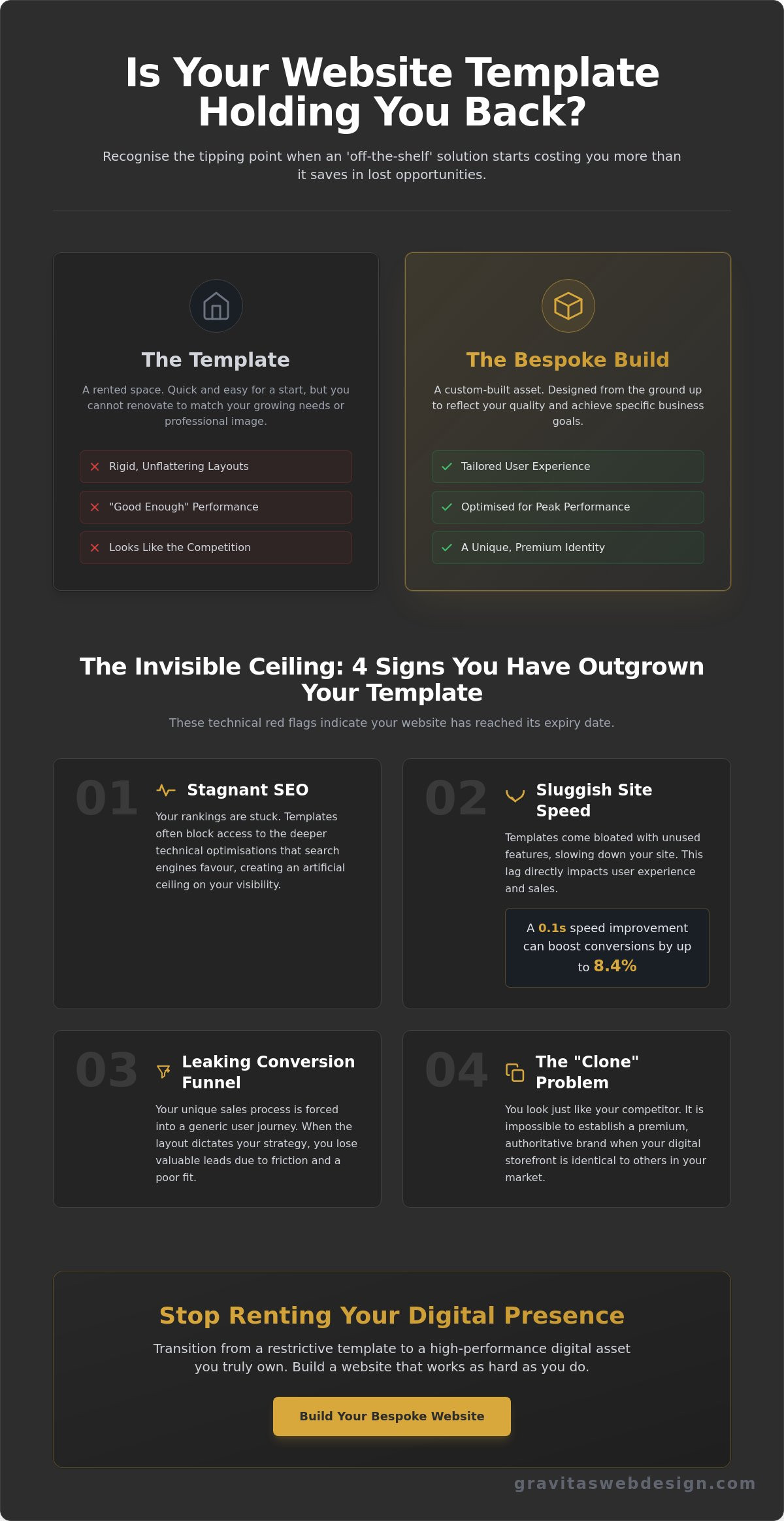
You’ve likely felt it. That moment when the tools that helped you launch start feeling like a straitjacket. It isn’t just a hunch; it’s a measurable decline in performance that happens when your business growth hits the technical limits of a pre-made theme. Identifying when to move from a template to a bespoke website is essential because, eventually, that “easy” solution starts working against you. Here are the four red flags that your current site has reached its expiry date:
- Sign 1: Your SEO has plateaued. You’ve ticked all the basic boxes, but your rankings won’t budge. This usually happens because you cannot access the technical backend to optimise the deeper code that Google loves.
- Sign 2: The site feels sluggish. Every template comes packed with dozens of features you’ll never use, yet they still load in the background. Research from A2 Hosting suggests that just a 0.1-second improvement in mobile site speed can increase conversion rates by up to 8.4%. If your template is dragging its heels, you are literally leaving money on the table.
- Sign 3: You are losing leads. Your sales process is unique, but your website forces users into a generic journey. If the layout dictates how you sell, rather than your sales process dictating the layout, your conversion rate will suffer.
- Sign 4: The “Clone” Problem. You stumble across a local competitor and realise they are using your favourite layout. It’s hard to position yourself as a premium leader when you look exactly like the person down the road.
The Technical Debt of Templates
Templates are often built to be “everything to everyone,” which results in massive amounts of hidden code bloat. This unnecessary weight slows down your PageSpeed scores, making for a frustrated user and a grumpy search engine. Implementing advanced SEO strategies on closed platforms is like trying to tune an engine through a locked bonnet; you simply can’t get to the parts that matter. In the Wix vs custom web design UK debate, the winner is always the one that gives you total technical control over your digital assets.
Rigid Layouts and the User Experience (UX) Gap
The “drag and drop” dream often turns into a mobile nightmare. Because templates rely on rigid grids, they rarely translate perfectly across every device, leading to a messy, unprofessional experience for your customers. A bespoke site centres entirely around your customer’s behaviour, guiding them naturally toward a call or enquiry. Custom builds also allow for seamless CRM integrations that templates simply cannot handle, making your internal life much easier. If you’re tired of fighting your own website, it might be time to chat about your specific goals and see what a custom build could do for your workflow.
The Credibility Tipping Point: When ‘Off-the-Shelf’ Starts Costing You Leads
“If it isn’t broken, why fix it?” It is the most common pushback we hear from business owners who have a site that “works.” But here is the uncomfortable truth: just because your contact form sends an email does not mean your website is doing its job. In the world of high-end professional services, a “functional” template is often a silent lead-killer. You might not see the people leaving, but they are clicking away the second they sense that “off-the-shelf” vibe. Understanding when to move from a template to a bespoke website is less about technical failure and more about the invisible cost of lost opportunities.
There is a certain “Amateur Aura” that clings to even the best templates. It is subtle, but high-value leads can smell it. When your site looks like a slightly tweaked version of a thousand other businesses, you unintentionally signal that you are a “one-man band” or a startup still finding its feet. In competitive hubs like London or Birmingham, looking professional is not a bonus; it is the bare minimum for entry. If your digital presence feels like a pop-up stall whilst your competitors are building flagship boutiques, you have already lost the battle for trust.
The Psychology of the High-Value Lead
Imagine a client in Birmingham searching for a premium service. They expect quality, attention to detail, and a sense of permanence. A cookie-cutter site suggests you might not be around in three years, or that you do not value your own brand enough to invest in it. Bespoke web design removes that doubt. It tells the visitor that you are established, successful, and here to stay. It transforms your site from a static brochure into a digital storefront that reflects your actual worth and professional standing. Of course, the design itself is only part of the equation; understanding how to get more enquiries from your website through smart conversion strategy is what turns that credibility into real business results.
Uniqueness as a Competitive Advantage
Standing out in a sea of “me-too” layouts is your greatest lead-generation tool. Bespoke design allows you to bake your unique selling points into the very structure of the site, rather than hiding them in a generic bulleted list. By integrating custom branding from the start, you create a cohesive experience that feels intentional. There are no compromises on mobile layouts or weird spacing issues; your brand remains sharp and authoritative on every screen. This level of polish is exactly what turns a casual browser into a committed enquiry.
The Strategic Advantage of Bespoke Web Design for Growing Firms
If your business is no longer a “new kid on the block,” you need to stop thinking about your website as a monthly expense and start seeing it as a high-performance asset. Deciding exactly when to move from a template to a bespoke website is a strategic pivot from short-term survival to long-term market dominance. It is the moment you stop trying to fit your big ideas into a small, rigid box and instead build a platform that is actually capable of carrying your brand’s weight.
Bespoke web design offers a “conversion-first” architecture. This means every pixel, button, and scroll depth is engineered to lead your specific audience toward a single goal; whether that is an enquiry, a booking, or a sale. Unlike templates that offer a “one-size-fits-all” user journey, a custom build is mapped to your unique sales process. It removes the friction that causes potential clients to drop off, ensuring your digital presence works just as hard as your best salesperson.
Ownership vs Rental: The Long-Term ROI
Whilst template platforms feel affordable at first, they are essentially a monthly rental agreement for your brand’s home. You don’t own the underlying code, and you are often locked into their ecosystem. If the platform changes its rules or raises its prices, you have very little say in the matter. A bespoke build is a digital asset you actually own. Once it is built, you have the freedom to host it where you like and maintain it on your own terms. To keep that asset in peak condition, many firms rely on WordPress maintenance services Lichfield to ensure their custom site remains secure, fast, and fully backed up without the constraints of a “closed” platform.
Tailored Functionality and Third-Party Integrations
As you scale, your website needs to talk to your other systems. Whether it is a bespoke CRM, a complex booking engine, or a private client portal, templates often fall over when asked to do anything “non-standard.” Custom builds allow for seamless integrations that save your team hours of manual data entry every week. This is particularly true for growing retail brands; many find themselves moving from Shopify to a custom e-commerce site because they need the freedom to create unique data structures and custom post types that generic platforms simply cannot support. If you are ready to remove the technical ceiling on your growth, you can speak to us about a custom build that fits your business perfectly.
Finally, there is the matter of security. Popular themes are common targets for hackers because one vulnerability can grant access to thousands of identical sites. A bespoke site is a unique target, making it a much tougher nut to crack. When you combine this with the ability to add new features as your business evolves, the long-term value of custom design far outweighs the initial “convenience” of a template.
Navigating the Move: How to Transition from Template to Custom Without the Stress
Let’s be real: the thought of moving your entire digital existence feels a bit like moving house after a decade in the same spot. It is daunting and you are fairly certain you will find some digital skeletons in the closet. But navigating the transition does not have to be a headache if you have a solid plan. Once you have identified when to move from a template to a bespoke website, the goal is to protect your existing success whilst building a foundation for the next level of growth.
A thorough content audit is your first port of call. Before you move a single pixel, you need to decide what is actually serving your business and what is just digital clutter. It is the perfect time to bin those outdated blog posts and refine your messaging. Most importantly, you need to address the technical hurdles head-on. Many business owners worry about migration from Wix to WordPress SEO issues, and rightly so. Without a careful strategy, you could lose the rankings you worked so hard to build. Protecting your traffic is a top priority during any transition.
The Migration Roadmap
- Step 1: Inventory your content. Take a look at every page you currently have. Be ruthless about what stays and what goes. If it does not help a customer make a decision, it probably does not belong on the new site.
- Step 2: Map out new user journeys. Use your actual customer data to see where people are currently getting stuck. We want to build paths that lead straight to your goals.
- Step 3: Technical safety nets. Ensure 301 redirects are in place for every single URL. This prevents those dreaded “404 Not Found” errors and keeps Google happy after the launch.
Setting a realistic timeline is also vital. A bespoke build takes longer than a template setup because we are actually building a unique tool; not just skinning a pre-made layout. It involves deep strategy, custom coding, and rigorous testing. It is a few months of work for a decade of results. That extra time spent at the start saves you years of frustration later on. Knowing when to move from a template to a bespoke website is a big step, but it is the one that finally aligns your digital presence with your actual professional standard.
Choosing the Right Partner in Birmingham or London
When scouting for an agency, look for radical transparency and strategic thinking. You want a partner who asks about your revenue goals, not just your favourite colours. A good portfolio should show variety; if every site they build looks the same, they are likely using “premium templates” and calling them bespoke. That is just a template with a higher price tag. A true bespoke partner builds for your specific needs. Ready to shed the template? Let’s chat about your bespoke web design project and get your business the digital home it deserves.
Time to Stop Renting and Start Owning Your Digital Future
You have worked hard to build a reputation that actually means something. But if your website still feels like a generic placeholder, you are essentially asking your brand to run a marathon in flip-flops. We have explored the technical red flags, from sluggish code bloat to that frustrating SEO plateau, and looked at how a “good enough” template can unintentionally signal an amateur status to high-value leads. It is about moving past the limitations of a rented platform and building something that truly belongs to you.
Deciding exactly when to move from a template to a bespoke website isn’t just about a fresh lick of paint; it’s about removing the ceiling on your revenue and taking full ownership of your most important digital asset. At Gravitas, we specialise in high-end web design for firms in Birmingham and London. Our founder-led team prioritises radical transparency, handling everything from your initial logo design to secure hosting and maintenance. We are here to ensure the transition is as smooth and stress-free as possible.
Ready to give your business the gravitas it deserves? Book a discovery call today. It is time to stop fighting with your layout and start leading your industry with a site that finally matches your ambition.
Frequently Asked Questions
Is a bespoke website really worth the extra cost for a small business?
Yes, it is absolutely worth it if you are looking for long-term growth rather than a quick fix. A bespoke site is a tailored tool built to convert your specific audience. Whilst the initial investment is higher than a monthly subscription, you are building an asset that you actually own. It removes the revenue ceiling that generic templates often impose on scaling firms.
How long does it typically take to move from a template to a custom website?
A typical custom project takes between 8 and 12 weeks from the initial strategy session to the final launch. This timeline allows for deep research, custom design, and rigorous testing across all devices. We aren’t just picking a theme and changing the colours; we are building a unique digital architecture from the ground up to support your specific business goals.
Will I lose my current Google rankings if I move to a bespoke site?
You shouldn’t lose your rankings if the migration is handled with a proper SEO strategy. We use 301 redirects to tell Google exactly where your old pages have moved. Knowing when to move from a template to a bespoke website involves planning for this technical transition so your hard-earned search visibility remains perfectly intact after the switch.
Can I still update a bespoke website myself without knowing how to code?
Yes, you will have full control over your content without needing to touch a single line of code. We build our bespoke sites using intuitive editors that make updating text, swapping images, or adding new blog posts as easy as using a word processor. You get all the power of a custom build with the simplicity of a user-friendly backend.
What are the main SEO benefits of bespoke design over a template?
The main benefits are clean code and total technical control. Search engines love sites that load quickly and follow a logical structure without the bloat found in most pre-made themes. You can optimise every single meta tag, image alt text, and schema markup to ensure you are squeezing every bit of SEO value out of your digital presence.
Do I need to change my hosting provider when I move to a custom site?
Most likely, yes. Closed platforms like Wix or Squarespace include hosting in their monthly fee, but you cannot move that hosting elsewhere. For a custom site, you will need high-performance, secure hosting that can handle your specific traffic needs. We offer managed hosting to ensure your site stays fast, updated, and completely secure around the clock.
How do I know if my business is “ready” for a bespoke website?
You will know you are ready when your digital presence starts feeling like a bottleneck for your ambition. If you’re embarrassed to send high-value prospects to your site, or if you’re fighting with a drag-and-drop editor to make simple changes, you’ve hit the limit. These are the classic signs of when to move from a template to a bespoke website to match your professional credibility.
Can I keep my current branding when moving to a bespoke web design?
Absolutely, you can keep your existing brand identity whilst elevating the way it’s presented. We can take your current logo, fonts, and colours and integrate them into a more sophisticated, high-performance layout. It is often the perfect opportunity to tidy up your brand assets to ensure they look sharp and authoritative on modern high-resolution screens.