
Web Design Blog
Moving from Shopify to a Custom Ecommerce Site: The Ultimate Transition Guide
Have you ever felt like you’re paying a “success tax” just for the privilege of growing your own business? It starts with a few extra transaction fees, but soon you’re buried under a mountain of monthly app subscriptions and templates that make your brand look, well, a bit generic. If you’ve started to feel the “Shopify ceiling” pressing down on you, you’re certainly not alone. Moving from Shopify to a custom ecommerce site is the strategic leap from renting a shopfront to owning the entire building. It is about reclaiming your margins and finally having total control over how your customers experience your brand.
We completely understand that the idea of a migration can feel a bit like performing open-heart surgery on a moving vehicle. It is nerve-wracking, but it’s also the only way to stop those opaque fees from eating your profits. This guide will walk you through the entire transition, showing you how to scale without the rigid constraints of a platform that wasn’t built for your specific needs. We will explore how to protect your search rankings, ditch the slow site speeds, and build a bespoke engine that turns your digital presence into a genuine asset.
Key Takeaways
- Identify the warning signs that you’ve hit the “Shopify ceiling” and why those sneaky transaction fees and app costs are quietly draining your monthly profits.
- Follow a clear, stress-free roadmap for moving from Shopify to a custom ecommerce site whilst keeping your product data and SEO rankings perfectly intact.
- Decide between a bespoke WordPress build or a headless solution to create a lightning-fast, secure shopping experience tailored specifically for the UK market.
- Learn how to reclaim your margins and drive a higher average order value (AOV) by building the unique, custom features your brand actually needs to scale.
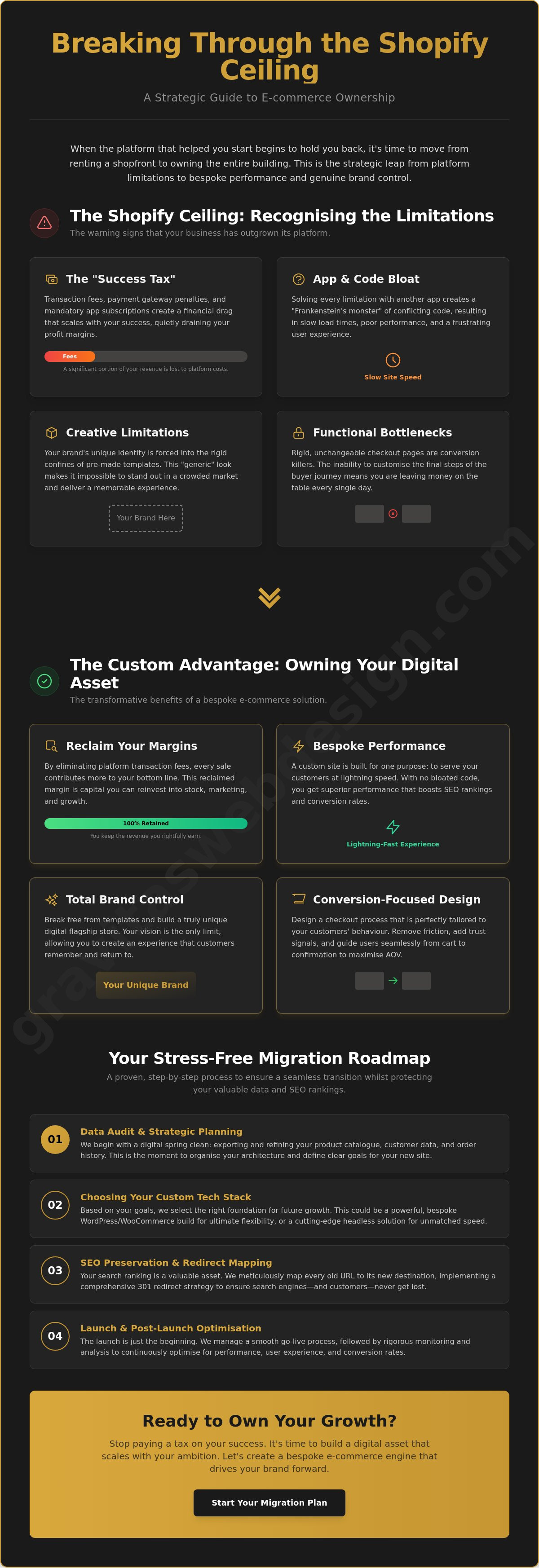
Recognising the Shopify Ceiling: When it is Time to Move
Imagine your business as a high-street shop. At first, renting a little space in a shared market was perfect. It was quick, easy, and the landlord handled the maintenance of the roof. But now? You’re tripping over boxes; you can’t paint the walls your favourite shade of teal, and every time you ring up a sale, the landlord sticks his hand in your till. This is the “Shopify Ceiling.” It’s the moment when the platform that helped you start begins to hold you back. Moving from Shopify to a custom ecommerce site isn’t just a technical upgrade; it’s about reclaiming your independence and building a digital asset you actually own.
The “App Fatigue” is real. We’ve seen so many businesses try to solve every minor limitation by bolting on another monthly subscription. Eventually, your site becomes a Frankenstein’s monster of conflicting code, dragging down your loading speeds and your conversion rates. When your brand identity starts to feel “generic” because you’re stuck within the confines of a pre-made template, it’s a clear signal that your ambitions have outgrown the rented stall. You shouldn’t have to compromise your vision because a platform’s rigid structure says “no.” This same frustration applies to other website builders too, and if you’ve ever wondered how the Wix vs custom web design UK debate stacks up for growing businesses, the underlying limitations are remarkably similar. The same is true when you examine the Squarespace limitations for business, where rigid design grids and restricted functionality can quietly stifle your brand’s growth in much the same way.
The Financial Breaking Point
The maths usually starts to look a bit grim once you hit a certain volume. Between the monthly subscription fees and those opaque transaction costs, you’re essentially paying a tax on your own success. If you’re using a third-party gateway, Shopify hits you with an extra fee, often ranging from 0.15% to 0.20% even on their high-end Plus plans. When you look at a comparison of e-commerce software, you’ll see that whilst SaaS platforms offer convenience, they lack the long-term margin protection of a bespoke solution.
Bespoke web design often pays for itself simply through reclaimed margins. Instead of sending a slice of every transaction to a platform provider, those funds stay in your business. For a growing UK brand, that extra percentage back in the pocket can be the difference between investing in new stock or staying stagnant. You are effectively shifting from a recurring expense to a long-term investment.
Creative and Functional Limitations
There is a specific kind of frustration that comes from wanting to tweak your checkout experience and being told “the platform doesn’t allow that.” Rigid checkout pages are conversion killers. If you can’t customise the final steps of the buyer journey to match your customers’ behaviour, you’re leaving money on the table. A custom build removes these barriers entirely. You aren’t just changing colours; you’re building a functional tool that works exactly how your customers need it to. This level of credibility and professional polish is something a pre-made template simply cannot replicate.
Preparing for Migration: The Essential Pre-Flight Checklist
Let’s be honest. The thought of moving thousands of product variants and customer records is enough to make any business owner reach for the nearest biscuit tin. It feels like moving house, but instead of bubble-wrapping plates, you’re trying to protect years of hard-won digital growth. Moving from Shopify to a custom ecommerce site shouldn’t be a “fingers crossed and hope for the best” situation. It requires a robust ecommerce digital strategy to ensure that your transition is as smooth as possible.
Before we touch a single line of code, we need to look at what’s actually under the bonnet of your current store. Shopify makes it easy to add “just one more app,” but over time, these create a tangled web of dependencies. This preparation phase is your chance to decide what truly adds value and what is just digital clutter slowing your site down. It is about being intentional with your data rather than just dragging and dropping your old problems into a new environment.
The Data Audit
Think of this as a digital spring cleaning. You’ll need to export your entire product catalogue, including variants, SKUs, and those high-resolution images you spent a fortune on. But don’t just dump the old data into a new home. This is the perfect time to prune “ghost” products that haven’t sold in years and refine your category architecture. If you’re feeling overwhelmed by the sheer volume of data, we can help you organise your migration roadmap to ensure nothing gets left behind.
We also need to talk about your customers. Moving historical order logs and account details requires a delicate touch, especially whilst staying on the right side of UK GDPR regulations. You can’t just move data around willy-nilly; it must be handled securely and transparently. Ensuring your customer database is clean and compliant is non-negotiable for a professional transition.
Preserving Your SEO Authority
This is usually the part that keeps people awake at night. You’ve spent years building your Google rankings, and you don’t want to see them vanish overnight. To prevent this, we start by crawling your existing site to map every single URL. We identify your “hero” pages, those high-performing blog posts and landing pages that bring in the most traffic, and ensure they have a priority seat on the migration bus.
301 redirects are the absolute backbone of a successful migration because they tell search engines exactly where your old content has moved to. Without them, your customers will hit “404 Not Found” errors, and your rankings will plummet. By mapping your existing SEO structure early, we ensure that the authority you’ve built stays exactly where it belongs: with you.
Choosing Your Custom Tech Stack: Building for the Future
Think of your tech stack as the engine under your car’s bonnet. Whilst Shopify is like a reliable but restricted lease car, a custom build is like owning the factory. You get to decide exactly how it runs; you aren’t just a passenger in someone else’s software. Moving from Shopify to a custom ecommerce site allows you to choose between a bespoke WordPress setup or a headless commerce architecture. WordPress offers a familiar, user-friendly dashboard with infinite flexibility; headless architecture separates your shopfront from the back-end engine for ultimate speed and security. Both options mean you finally stop paying for features you don’t use and start building a tool that fits your business like a glove.
We also need to talk about your brand’s voice. A custom site is a blank canvas, which is why integrating professional copywriting is so vital. You aren’t just filling boxes in a template anymore. You’re telling a story that resonates with your customers. This works hand-in-hand with a mobile-first design. Instead of using a “responsive” template that just squashes your desktop site until it fits a phone, we build custom layouts designed for thumbs first. It ensures your checkout is as slick on a rainy Birmingham bus stop as it is on a posh office desktop.
Performance and Speed
Custom code is lean. It eliminates the “Liquid” bloat and the heavy third-party scripts that come pre-packaged with Shopify themes. This isn’t just about being tidy; it’s about survival. Site speed is a primary ranking factor for local SEO, especially if you’re competing for customers in a busy hub like Birmingham. By using a fast, secure hosting environment right here in the UK, you ensure your site stays snappy and keeps that 99.9% uptime your customers expect. No more “page unresponsive” errors during your biggest sales.
Ownership and Scalability
The real magic happens when you realise you’re no longer “renting” your success. You gain the freedom to add complex features, like bespoke loyalty programmes or advanced product filters, without a single monthly subscription fee hitting your bank account. You can scale your server resources to handle seasonal traffic spikes without the platform taking an extra cut of your revenue. This is how bespoke web design ensures your site grows alongside your vision rather than becoming a bottleneck that holds you back.
How to Move from Shopify to a Custom Site: A Step-by-Step Roadmap
Don’t let the “simplified” guides fool you. If it were as easy as a ten-minute CSV upload, everyone would be doing it between tea breaks. Moving from Shopify to a custom ecommerce site is a proper project; it’s the difference between buying a flat-pack wardrobe and commissioning a master carpenter. We start by building your staging site, a digital “safe room” where we can test every feature without your customers seeing the sawdust. This is where we rebuild your category architecture, ensuring your product data flows through APIs with total consistency rather than just being shoved into a spreadsheet.
Once the foundation is solid, we move through the remaining steps with surgical precision:
- Step 3: Replicating or enhancing your aesthetic. We take the bits of your brand you love and ditch the template restrictions that were holding you back.
- Step 4: Implementing the 301 redirect map. This is the digital equivalent of a “we have moved” sign, ensuring your SEO metadata stays intact.
- Step 5: Rigorous testing. We break the checkout, fix it, and break it again to ensure your payment integrations are bulletproof before the first real customer arrives.
If you’re feeling a bit overwhelmed by the technical jargon, don’t worry. We can help you let’s map out your roadmap together so you know exactly what to expect at every turn.
The Technical Transition
Precision beats speed every single time. Whilst automated tools can handle the heavy lifting of moving thousands of SKUs, we often use a hybrid approach. This allows us to maintain formatting consistency amongst your product descriptions and variants. We also ensure your new site passes every Core Web Vitals test with flying colours. Shopify’s “Liquid” code can be notoriously bloated; custom builds allow us to keep things lean, fast, and ready for Google’s ever-changing standards.
Launch and Post-Launch Monitoring
The “big day” shouldn’t be a gamble. We choose a low-traffic window, usually in the early hours of a Tuesday morning, to make the final DNS switch. This minimises any potential disruption to your sales. Once live, we aren’t just crossing our fingers. We monitor Search Console like hawks for any 404 errors or indexing hiccups. We also verify that every single internal link is pointing to your new, cleaner URL structure. It’s about making sure your customers have a seamless experience from the very first click on your new custom engine.
Maximising ROI: Life After Shopify
The feeling of launching your own custom platform is a bit like moving from a cramped rented flat into a house you’ve actually designed and built yourself. No more checking with the landlord before you hang a picture; no more monthly fees for “premium” features that really should have been standard. Moving from Shopify to a custom ecommerce site is where the real business growth begins. You’re no longer just a tenant in someone else’s ecosystem. You’ve become the owner of a digital asset that carries genuine value on your balance sheet.
Let’s talk about the money. Reclaiming those transaction fees is often the most immediate win for your bottom line. When you aren’t losing a percentage of every single sale to a platform provider, your marketing budget suddenly looks a lot healthier. But the real long-term ROI comes from the bespoke features that drive higher average order values (AOV). Whether it’s a custom-built “complete the look” tool or a loyalty programme that actually rewards your best customers without requiring a clunky third-party app, you’re finally building for your specific audience rather than a generic user base.
Local businesses in London and Birmingham often find that bespoke support is the “missing link” in their digital strategy. Instead of shouting into the void of a global support ticket system, you have a straight-talking partner who understands the UK market and your specific business goals. It’s about having a real person you can actually call when you want to try something new or need a quick update. It is a level of professional pride that a template simply cannot provide.
Conversion Rate Optimisation (CRO)
Shopify templates are built to be “good enough” for everyone, which usually means they aren’t perfect for anyone. A custom build allows us to identify the specific friction points in your buyer journey and smooth them over for good. We can leverage custom landing pages that work perfectly with SEO for service businesses, ensuring your traffic isn’t just high, but highly qualified. It’s about creating a checkout experience that feels like a natural, helpful conversation rather than a frustrating obstacle course.
Peace of Mind with Professional Maintenance
Owning your site doesn’t mean you’re on your own in the digital wilderness. Dedicated hosting ensures you aren’t sharing server space with a “noisy neighbour” whose sudden traffic spike slows your own site down. You get a secure, stable environment that is maintained by people who actually know your code inside and out. If you are ready to own your store, the transition to a bespoke platform is the most powerful move you can make for your brand’s future. It is time to stop paying for permission to grow and start building your own engine.
Your Brand Deserves an Engine, Not a Rented Stall
You have the roadmap; now you just need to turn the key. Deciding that your business has outgrown its current constraints is a massive milestone. By moving from Shopify to a custom ecommerce site, you’re finally trading generic templates for a bespoke design that reflects your brand’s unique personality. It is the strategic shift from paying for permission to grow to owning the very engine of that growth.
We’ve seen how this transition reclaims your margins by ditching those pesky transaction fees. We have also explored how expert SEO preservation ensures your hard-earned visibility remains intact throughout the move. With our teams in Birmingham and London providing local, straight-talking support, you’ll have a partner who is as invested in your success as you are. It’s time to stop fitting your big ideas into small boxes and start building the digital asset your business truly deserves.
Ready to escape Shopify and own your digital future? Get started here. We are ready when you are.
Frequently Asked Questions
Will I lose my Google rankings if I move from Shopify to a custom site?
You won’t lose your hard-earned rankings as long as you implement a meticulous 301 redirect map. This process tells search engines that your content has simply moved house rather than vanished into thin air. We crawl your entire site to catch every single URL, ensuring that your high-performing pages keep their authority. Without this vital step, you’d be starting from scratch, which is a risk no scaling business should take.
How long does a typical migration from Shopify to a bespoke site take?
A professional migration usually takes between eight to twelve weeks, depending on the complexity of your product catalogue and custom features. It isn’t just about moving data from A to B; it’s about building the new engine, testing the checkout flow, and perfecting the design. We don’t believe in rushed jobs that break on launch day, so we build in plenty of time for rigorous staging and testing.
Can I keep my existing customer passwords during the migration?
No, you cannot directly migrate passwords because Shopify encrypts them for security purposes. When moving from Shopify to a custom ecommerce site, your customers will usually need to reset their passwords on the new platform. It’s actually a brilliant excuse to send a friendly “welcome to our new home” email, encouraging them to log back in and see the shiny new improvements you’ve made for them.
Is a custom ecommerce site more expensive to maintain than Shopify?
Whilst the upfront build is a larger investment, the long-term maintenance is often more cost-effective because you aren’t paying a “success tax” on every sale. You’ll swap Shopify’s monthly subscriptions and transaction fees for a flat hosting and maintenance fee. For many scaling UK businesses, the money saved on those sneaky percentages pays for the site’s upkeep and hosting many times over throughout the year.
What are the biggest risks when moving away from Shopify?
The biggest risks are broken links and data loss during the transfer. If you don’t map your redirects correctly, you’ll frustrate customers with 404 errors and see your SEO standing plummet. Data gaps, like missing order histories or broken image paths, can also make your brand look unprofessional. This is why we treat the “pre-flight checklist” as the most important part of the journey to protect your reputation.
Do I need to hire a developer to move from Shopify to a custom site?
Yes, you definitely need a professional developer to handle a custom migration safely. Shopify is designed to be user-friendly for beginners, but building a bespoke engine requires deep technical knowledge of APIs, databases, and secure hosting. Trying to “DIY” a migration often leads to broken checkouts and lost revenue, which costs far more than hiring an expert to get it right the first time.
Can I migrate my Shopify blog posts to a new bespoke website?
Yes, we can migrate all your Shopify blog posts to your new bespoke website without losing your content. We treat your articles as vital assets, ensuring that images, internal links, and formatting stay consistent amongst the new layout. Preserving your blog history is essential for maintaining your SEO authority and keeping your brand’s voice alive as you transition into your much more powerful digital home.
How do I handle my domain name during the transition?
You keep your existing domain name; you just need to point it to your new server. We handle the DNS switch during a low-traffic window to ensure there is no downtime for your customers. It’s a bit like a “Change of Address” form at the post office; your brand identity stays exactly the same, but the technical pipes now lead to a much better building.


34 High Street
Sutton Coldfield
Birmingham
B72 1UP

© 2026 | All rights reserved | Terms and Conditions | Privacy Policy | Cookie Policy
How can we help you?