
Web Design Blog
Why Is My Website Not Converting Visitors? 5 Digital Myths Debunked
Imagine checking your analytics and seeing a healthy stream of traffic, only to look at your inbox and find total silence. It’s a bit like throwing a lavish party where everyone walks in, stares at the wallpaper for three seconds, and then leaves without saying hello. You’re likely left wondering, why is my website not converting visitors when you’ve put so much effort into getting found? It’s incredibly draining to spend money on traffic that disappears, especially if you feel a secret twinge of embarrassment because your site doesn’t quite look the part.
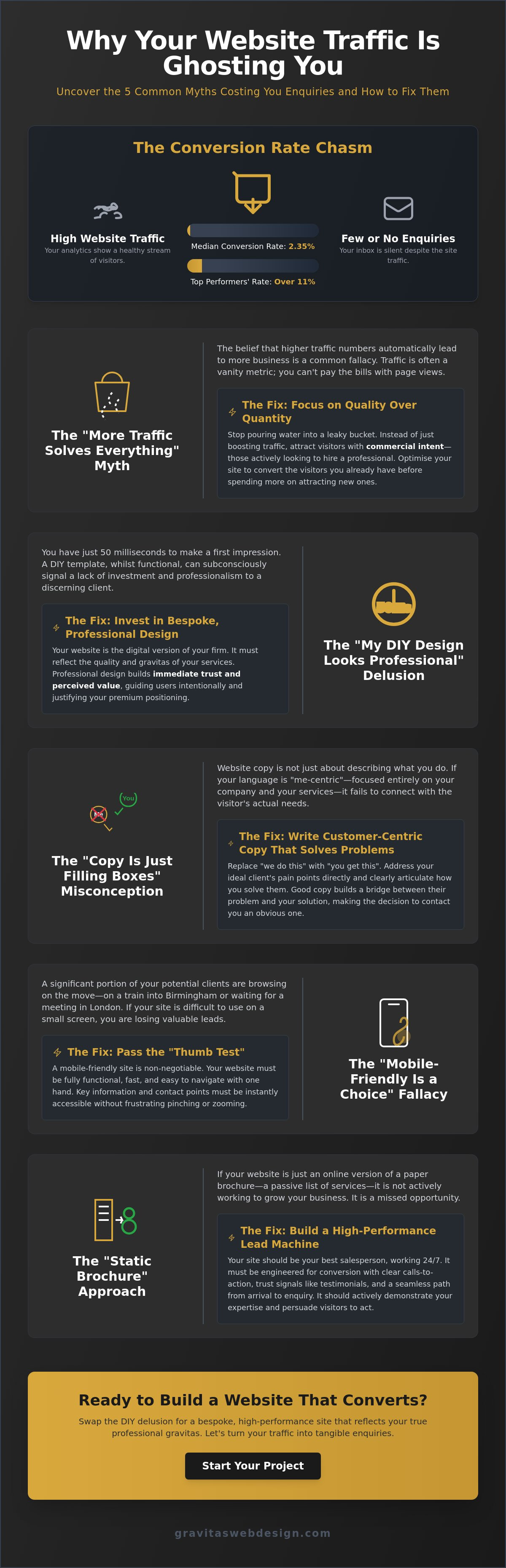
We’ve all been there, caught between confusing technical jargon and a site that feels more like a liability than an asset. While the median conversion rate across industries is just 2.35%, the top performers are reaching over 11%. You’re about to discover why your traffic is ghosting you and how to transform your site into a high-performance lead machine that makes you feel genuinely proud. We’re debunking five common digital myths and providing a clear checklist of exactly what to fix to turn those clicks into credible enquiries.
Key Takeaways
- Focus on quality over quantity; a thousand clicks are useless if they don’t match your ideal client profile.
- Recognise the 50-millisecond rule where visitors judge your professional credibility based on your layout and colour choices.
- Pinpoint exactly why is my website not converting visitors by replacing “me-centric” copy with words that solve your customer’s problems.
- Ensure your site passes the “thumb test” so it’s actually functional for leads browsing on a train into Birmingham or London.
- Swap the “static brochure” approach for a bespoke, high-performance site that reflects your true professional gravitas.
The “More Traffic Solves Everything” Myth
It’s a common trap. You spend your morning refreshing Google Analytics, watching that little blue line climb higher and higher. You’ve got traffic! Hundreds, maybe thousands of people are landing on your pages. So, why is my website not converting visitors into actual paying clients? The uncomfortable truth is that traffic is often just a vanity metric. It feels good to see the numbers go up, but you can’t pay your mortgage with “page views”. If those visitors aren’t the right fit for your specific service, they are essentially digital ghosts passing through your site without leaving a trace.
It’s time to stop obsessing over the graph and start looking at your enquiry forms. The “conversion gap” is that frustrating space between a click and a phone call. It’s where trust is either built or lost in an instant. You might be ranking for keywords that bring in volume, but volume doesn’t always equal value. If your site attracts people who aren’t ready to buy, or people who don’t understand what you offer, your “success” in traffic is actually a failure in strategy.
Quality over Quantity: The Right Kind of Traffic
Imagine you’re a high-end consultant in Sutton Coldfield. If your SEO strategy targets broad, “how-to” keywords, you’ll attract plenty of window shoppers from across the globe who just want free advice. These visitors have informational intent; they want to learn, not buy. You need visitors with commercial intent, the ones who are actively looking for a professional to solve their problem right now. In the context of a local service business, your conversion rate is the percentage of total website visitors who take a specific, desired action, such as submitting an enquiry form or clicking your phone number to call you.
The “Broken Bucket” Syndrome
Think of your website as a bucket. If that bucket is riddled with holes, such as confusing navigation, slow speeds, or vague messaging, then pouring more water into it won’t help. You’re just making a soggy mess of your marketing budget. Doubling your traffic is often an expensive, uphill battle that requires significant investment in content and outreach. However, improving your site through Conversion rate optimization is often far more achievable and significantly more profitable. You need to identify where potential leads are “leaking” out of your sales funnel. Is it a confusing checkout? A contact form with too many fields? Fix the holes first, and then worry about the volume of water.
The “My DIY Design Looks Professional” Delusion
You have about 50 milliseconds to make an impression. That is roughly the time it takes to blink. In that tiny window, a visitor has already subconsciously decided if you are a serious professional or a hobbyist playing at business. If you have been scratching your head and asking why is my website not converting visitors, the answer might be staring you in the face. A DIY template might look “fine” to you, but to a high-end client in London or a savvy business owner in the Midlands, it often signals a lack of investment. It suggests you are “small time”, even if your actual service is world-class.
Professional branding and a bespoke logo do more than just look pretty; they create an immediate sense of perceived value. When your site lacks a clear visual hierarchy, the visitor’s eye does not know where to land. They get confused, they get frustrated, and then they leave. To truly increase your website conversion rate, you must guide the user’s journey with intentional design. It is about using colour, spacing, and layout to tell the visitor exactly what to do next without them having to think about it. Investing in user experience (UX) design services Birmingham businesses trust can make the difference between a visitor who bounces and one who picks up the phone.
The Professionalism Paradox
Your website should be a digital twin of the actual service you provide. If you offer a premium, five-star experience but your site looks like a budget blog from a decade ago, there is a massive disconnect. This is the professionalism paradox. Bespoke design creates that “premium” feel that a cheap template simply cannot replicate. It is about consistency. Local firms that maintain a sharp, unified brand across all platforms build long-term loyalty because they look reliable and established. They don’t just exist; they command attention.
Trust Signals You Are Likely Missing
We have all seen those cheesy stock images of people in suits shaking hands. They are everywhere, and they are incredibly boring. If your site features the same generic photos as every other firm in Lichfield, you are not building authority; you are just blending into the background. Using bespoke web design Birmingham allows you to stand out with professional photography and custom icons that scream credibility. These are the trust signals that turn a casual browser into a confident lead. It provides an immediate competitive advantage that your “off-the-shelf” rivals simply won’t have. If you’re tired of your site holding you back, you can explore how we can elevate your brand today.
The “Copywriting is Just Filling Boxes” Misconception
Think about the last time you sat through a presentation where the speaker only talked about themselves. You probably tuned out within minutes, right? Many websites do exactly this. They treat their copy like a dusty brochure tucked away in a filing cabinet. If you’re asking why is my website not converting visitors, it might be because you’re shouting into a megaphone about your history instead of having a genuine chat with your customer. Your website copy should be a warm conversation. It needs to lower the reader’s guard and make them feel understood before you ever ask for a penny.
We see it all the time; the “Me, Me, Me” trap. Pages filled with “We were established in 1994” or “We are the leaders in our field”. Honestly? Your visitors don’t care yet. They care about their own problems. They have landed on your site because they have a headache and they’re hoping you have the aspirin. Stop talking about your internal processes and start talking about their desired outcomes. Pivot your messaging to focus on the client’s hurdles and how your specific solutions clear the path. When you lead with empathy, the sale follows naturally.
Then there is the clutter problem. If you have five different buttons on one page, you’re giving your visitor too much homework. A single, clear Call to Action (CTA) is far more powerful than a messy scattergun approach. Tell them exactly what to do next. Don’t make them hunt for a way to give you their business.
Answering the “So What?” Question
Every single sentence on your site must earn its keep. If a line doesn’t deliver value or move the reader closer to an enquiry, it has to go. You need a value proposition that makes it impossible for someone to leave without getting in touch. This is why professional copywriting is a non-negotiable part of your strategy. It ensures your brand voice remains consistent, persuasive, and focused on the reader’s needs rather than just filling white space on a screen. If you want a deeper dive into the craft, our guide on how to write service page copy that sells walks you through exactly how to transform dry descriptions into enquiry-generating content.
Emotional Connection vs. Technical Specs
B2B buyers in London aren’t robots. They make decisions based on trust and empathy, just like everyone else. Technical specs have their place, but they don’t build relationships. Use human-to-human language to lower the visitor’s guard. When you organise your service pages to lead naturally from a recognised problem to a clear solution, you create a friction-free path to that final enquiry. It’s about guiding them home, not forcing them through a maze of jargon.
The “Mobile-Friendly is a Choice” Fallacy
Picture this: a potential client is on a packed train into Birmingham New Street. They have five minutes before their stop, and they’ve finally decided to look for a service like yours. They pull out their phone, tap your link, and… nothing. The page hangs. When it finally loads, the text is microscopic and the buttons are so small they’d need a needle to click them. They’re gone. If you’re still asking why is my website not converting visitors, the answer might be in the palm of your hand. Mobile traffic now accounts for over 52% of global web traffic, yet many sites still treat mobile users like second-class citizens.
A slow-loading site is the quickest way to lose a lead. We live in an era of instant gratification; if your page takes more than a couple of seconds to appear, the “back” button becomes very attractive. Technical glitches, broken links, and overlapping text act as invisible obstacles. They don’t just annoy people; they erode trust. If you can’t keep your own digital front door swinging smoothly, why should a client trust you with their business? There’s also the matter of security. If your site lacks an HTTPS certificate, most browsers will slap a “Not Secure” warning across the screen. It’s the digital equivalent of a “Beware of the Dog” sign on a shop door.
Speed and Security as Conversion Factors
Think of your hosting like the foundations of a house. You wouldn’t build a bespoke office on a swamp, so why put a high-end website on cheap, shared hosting? Premium hosting is an investment in your conversion rate, ensuring your site stays fast and responsive even during traffic spikes. Ongoing website maintenance is equally vital. It prevents those “broken” user journeys that happen when plugins clash or code gets outdated. A fast, secure site doesn’t just please Google; it makes you look like a pro who pays attention to the details.
Frictionless Forms and Navigation
We’ve all seen those contact forms that ask for everything including your inside leg measurement. It’s a total conversion killer. If you want more enquiries, stop making people work for it. Your navigation should feel intuitive, not like a puzzle. Aim for the “one-click” rule: a visitor should never be more than one tap away from getting in touch with your business. Keep your forms short, your buttons big, and your path to purchase clear. If you’re ready to remove the friction from your site, you can book a technical audit with us to see exactly where you are losing leads.
Building a High-Converting Presence with Gravitas
We’ve deconstructed the myths and looked under the bonnet of your digital presence. By now, the answer to why is my website not converting visitors should be becoming clearer. It isn’t usually one massive failure, but a collection of small, invisible leaks that drain away your potential profit. Transforming your site from a static brochure into a dynamic lead-generation asset requires moving away from the “good enough” mindset. It requires gravitas.
Bespoke design and strategic branding aren’t just about looking fancy. They are the ultimate conversion tools because they remove the friction between a stranger’s problem and your solution. When your site is tailored specifically to your audience, every pixel and every word serves a purpose. You aren’t just another tab open in a browser; you’re the clear, credible answer they’ve been searching for. It’s about moving from a digital business card that people ignore to a high-performance machine that works as hard as you do.
The Antidote to Industry-Standard Awkwardness
Let’s be honest: the world of web design is often filled with unnecessary jargon and awkward bureaucracy. We prefer a refreshingly candid approach that prioritises human connection and straight-talking advice over corporate stiffness. Gravitas Web Design exists to be the antidote to that industry-standard awkwardness. We focus on bespoke work because templates simply cannot capture the unique personality or professional pride of your business. In a crowded market, standing out is your only option. Stop settling for a site that doesn’t work and start building one that makes you feel genuinely proud to share your URL.
Your Conversion Roadmap
The first step is identifying your site’s biggest leak and fixing it first. Is it the confusing navigation we discussed earlier, or perhaps the “me-centric” copy that isn’t landing with your prospects? Once you plug the main holes in your bucket, the results often follow quickly. Remember, a high-performance site isn’t a “set and forget” project. The long-term benefits of professional website maintenance and hosting ensure your digital front door stays open and swinging smoothly. If you’re ready to stop guessing and start growing, you should book a consultation with us to audit your current performance. Let’s turn that silent inbox into a consistent stream of high-quality enquiries.
Stop the Ghosting and Start Growing
You’ve seen the data and we’ve debunked the myths. It’s clear that simply pouring more traffic into a leaky bucket won’t fix the underlying problem of why is my website not converting visitors. Real success comes down to building a bridge of trust between you and your audience. This bridge is built on three essential pillars: bespoke design that commands respect, human-to-human copywriting that solves problems, and a technical foundation that never lets a mobile user down.
You don’t have to settle for a site that makes you cringe when you hand out a business card. We specialise in creating bespoke designs tailored for credibility, backed by expert UK-based copywriting and SEO. With our transparent, founder-led management, you’ll always know exactly where you stand. It’s time to move away from the “static brochure” and own a lead-generation machine you can finally be proud of.
Ready to turn those visitors into customers? Let’s get started. You’ve got the vision; let’s give your business the digital home it deserves.
Frequently Asked Questions
Why is my website traffic high but my enquiries low?
High traffic is often a vanity metric that masks a lack of intent. You might be ranking for broad terms that attract “window shoppers” looking for free information rather than motivated buyers ready to hire a professional. If your visitors don’t see an immediate solution to their specific problem, they’ll leave without getting in touch, creating a frustrating gap between your clicks and your actual phone calls.
How much does a bespoke website design cost for a UK business?
The investment for a professional build varies depending on your specific requirements and the complexity of your brand. Whilst DIY templates are cheap, a bespoke site involves deep research into your user experience and visual hierarchy. You should check with your chosen agency for a tailored quote, as this investment covers the strategic expertise required to turn a static site into a high-performance lead machine.
Can a bad logo really stop people from buying from me?
Yes, because visitors judge your professional credibility in about 50 milliseconds. A dated or “DIY” logo signals that you might be “small time” or lacking in attention to detail. This initial lack of trust makes potential leads nervous about the quality of your actual service, often causing them to bounce before they’ve even read your value proposition.
What is a good conversion rate for a service-based business website?
The median conversion rate across all industries is roughly 2.35%, but the top 10% of websites achieve rates of 11.45% or higher. If you are asking why is my website not converting visitors, aiming to beat that 2.35% baseline is your first goal. For local UK service firms, a well-optimised site should ideally be converting at 5% or more to be considered a success.
How do I know if my website is mobile-friendly enough?
Try navigating your site while you’re on the move, perhaps using a 4G connection on a busy street. If you find yourself pinching to zoom or struggling to tap small buttons with your thumb, it isn’t mobile-friendly enough. Since mobile devices account for over 52% of global web traffic, a clunky mobile experience is likely invisible friction that is killing your enquiry rate.
Do I really need professional copywriting for my service pages?
Professional copy is the difference between a boring brochure and a persuasive conversation. Most business owners fall into the “me, me, me” trap by focusing on their own history. A copywriter flips the script to focus on the customer’s pain points and your specific solutions. This emotional connection is what actually lowers a visitor’s guard and encourages them to get in touch. For a practical walkthrough of the process, see our guide on how to write service page copy that sells for UK businesses.
How long does it take to see results after a website redesign?
You’ll notice technical improvements, such as faster loading speeds and better mobile behaviour, the moment the site goes live. However, the full impact on your lead volume and search engine rankings usually takes a few months to stabilise. This is the time it takes for Google to re-index your pages and for your new, persuasive messaging to start resonating with your target audience.
Is my slow website speed killing my conversions?
Absolutely, as speed is a fundamental reason why is my website not converting visitors in a fast-paced market. If your pages take more than two seconds to load, your bounce rate will soar. Visitors interpret a slow site as a sign of poor maintenance or lack of professionalism, and they won’t hesitate to head back to the search results to find a faster competitor.