
Web Design Blog
SEO for Small Business UK: The Ultimate 2026 Growth Guide
What if the secret to winning at seo for small business uk isn’t actually about outsmarting a robot, but about proving you’re a real human with a real pulse? It is a bit of a cheek, isn’t it? You spend years building a reputation, only to feel like you’re being buried by AI-generated fluff or hidden behind a “canonical tag” you never even asked for. If your inbox is currently a graveyard of spam from “experts” promising the world while the volatile March 2026 core update sent your rankings on a rollercoaster, we hear you. It’s frustrating, it’s loud, and it’s enough to make any business owner want to bin their laptop.
We agree that you shouldn’t need a degree in computer science just to get noticed by your local customers. This guide is here to cut through the jargon and show you exactly how to transform your digital presence from invisible to indispensable. You’ll learn how to master the 2026 essentials, from building genuine topical authority to making Google’s latest AI Overviews work for you rather than against you. We’re skipping the corporate fluff and getting straight to the practical bits that actually grow your UK business.
Key Takeaways
- Discover why organic search remains the most sustainable way to grow your firm without the exhausting cycle of paying for every single click.
- Learn how to master the three pillars of seo for small business uk to ensure your website is both human-friendly and easy for search engines to navigate.
- Find out how to define your digital “catchment area” so you can stop shouting into the void and start ranking where your customers actually live.
- Uncover the technical “leaks” that might be draining your traffic and identify the quick wins that can boost your visibility almost immediately.
- Understand why a bespoke website build gives you a massive head start over clunky templates by ditching the code bloat that slows your rankings down.
Demystifying SEO for Small Business UK: The 2026 Landscape
Let’s be honest about the state of search. If you are still thinking about SEO as a way to “trick” Google into liking you, you’re living in the past. In 2026, the game has changed completely. Google’s March 2026 core update was a bit of a bruiser, causing about 80% of top search positions to shift during the rollout. It proved that the old ways of keyword stuffing are well and truly dead. Instead, the focus has shifted entirely to topical authority and user intent. Essentially, Google wants to know if you actually know your onions. If you’re wondering What is SEO? in this new era, it is about building a digital presence that AI and humans both find useful. With the rise of Search Generative Experience (SGE), Google often provides an AI summary at the top of the page. This means your content needs to be the definitive answer to a customer’s problem, not just a list of services. For anyone tackling seo for small business uk, this shift is a massive opportunity to stop renting space on page one through ads and start owning it through organic trust.
Why Small Businesses Can Outmanoeuvre Giants in 2026
You might feel like a David amongst Goliaths, but being small is your secret weapon. Since approximately 46% of all Google searches have local intent, being physically close to your customer gives you an immediate leg up. Big national corporations cannot replicate your local nuance or your specific expertise. You can update your site, pivot your strategy, and publish a helpful guide on a Tuesday afternoon whilst the big guys are still stuck in a board meeting. Your agility allows you to build deeper topical authority because you aren’t trying to be everything to everyone. Mastering seo for small business uk isn’t about having the biggest budget; it’s about being the most relevant person in the room (or the search result).
The “SEO Expert” Red Flags to Avoid
We’ve all seen the emails. “Guaranteed number one ranking for fifty quid!” It is tempting, isn’t it? But here is the truth: anyone promising overnight success is likely selling you a one-way ticket to a Google penalty. Real growth takes time, transparency, and a bit of elbow grease. If an “expert” cannot explain their strategy without using words that sound like they belong in a sci-fi movie, walk away. Cheap packages often rely on spammy links that might give you a tiny bump before crashing your site entirely. You deserve a partner who talks to you like a human and shows you exactly where your effort is going. Transparency isn’t just a nice-to-have; it is the only way to build a presence that lasts.
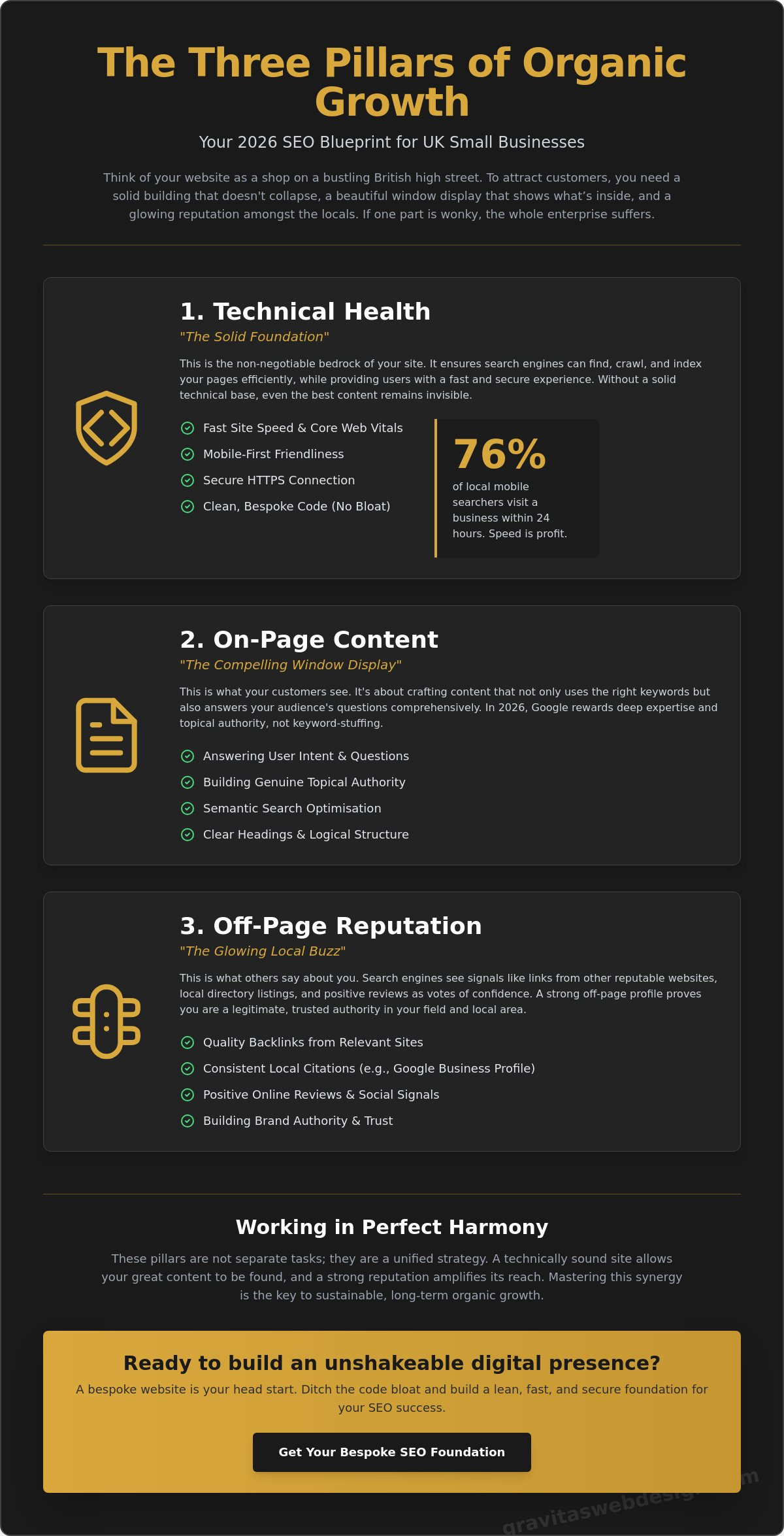
The Three Pillars of Organic Growth: Technical, On-Page, and Off-Page
Think of your website like a brick-and-mortar shop on a busy British high street. You need a solid building that doesn’t collapse (Technical), a beautiful window display that tells people what’s inside (On-Page), and a glowing reputation amongst the locals (Off-Page). If one of these is wonky, the whole thing falls over. For anyone diving into seo for small business uk, understanding how these three bits work together is the difference between being a local legend and a digital ghost. These pillars work in a constant, beautiful harmony; technical health gets you invited to the party, on-page content makes you the life of the party, and off-page reputation ensures you get invited back next year.
Technical Health and Core Web Vitals
Imagine walking up to a shop and the door is jammed shut. That is what a slow website feels like to a potential customer. In 2026, site speed and mobile-friendliness are not just “nice to have” extras. They are non-negotiable. Google prioritises sites that load instantly and work perfectly on a smartphone. This is critical when you consider that 76% of people who search for something local on their phone visit a business within 24 hours. This is where bespoke code really shines. Unlike bloated templates that come with thousands of lines of unnecessary “junk” code, a custom-built site is lean and mean. It’s also about trust. Having a secure HTTPS connection and reliable hosting tells your UK visitors that their data is safe with you. If your site feels clunky or unsafe, people will bounce faster than a rubber ball on concrete.
On-Page Content and Semantic Search
Gone are the days when you could just repeat your service name fifty times and hope for the best. Modern search engines are far too clever for that. They now use semantic search to understand the “vibe” and context of your pages. Instead of targeting a single lonely keyword, we look at topic clusters. This means covering a subject from every angle to prove you’re an expert. If you have ever wondered what is on-page SEO and how it applies to your specific business, it comes down to writing for humans first and robots second. High-quality copywriting is your best friend here. By organising your thoughts with clear headers (H1 to H3), you help AI search engines summarise your content for those fancy new AI Overviews. If you want to see how your current site stacks up, having a quick look at our Search Engine Optimisation (SEO) services might give you a head start on the competition.
Off-Page SEO: Building Your Digital Reputation
Finally, we have the “word of mouth” of the internet. Off-page SEO is about building a reputation across the wider UK web. It isn’t just about getting any old link from a random site in another country. It is about getting mentions from local directories, industry blogs, and trusted UK publications. When other reputable sites link back to you, it tells Google that you’re a trustworthy authority. It is the digital equivalent of a local business being recommended by the town mayor. It takes time to build, but it is the most powerful way to cement your spot at the top of search results without relying on expensive, temporary ads.
Local SEO vs National Reach: Where Should You Focus?
Do you want to be the talk of the town or the toast of the nation? Choosing where to plant your digital flag depends entirely on where your customers actually live. If you are a plumber in Birmingham, ranking for “plumber near me” is your bread and butter. If you are selling high-end services across the country, you might be aiming for “bespoke web design UK” or similar national terms. Most people think local SEO is just for shops with a physical front door, but that is a bit of a myth. Even if you work from a home office in Sutton Coldfield and travel to clients, you are a service area business. You can still dominate your local patch without ever having a customer step foot in your spare bedroom.
Determining your primary catchment area is about being honest with yourself. Don’t waste energy trying to rank in Glasgow if you can’t realistically get past Lichfield. In the world of seo for small business uk, understanding how we actually talk is vital. We search for a “chippy”, not a “fish fry”. We look for “bespoke” services, not just “custom” ones. These small linguistic tweaks signal to Google that you are a local expert who understands the British market. Often, a hybrid approach is the smartest move for growth-minded firms. You secure your local base first to keep the lights on, then slowly expand your reach as your authority grows.
Mastering Your Google Business Profile (GBP)
Your Google Business Profile is your fastest route to the top of the search results for local queries. It is about more than just filling in your opening hours. You need authentic UK customer reviews and recent photos to prove you are the real deal. Use the “Updates” feature like a mini-blog to show Google you are active. It is like keeping your shop window clean; it shows you are open for business and ready to help. Having an active, fully completed profile is your most powerful tool for seo for small business uk.
UK Citations and Local Directories
Then there is the “NAP” rule: Name, Address, and Phone number. This needs to be identical across high-value UK directories like Yell and Thompson Local. If one site says “St.” and another says “Street”, Google gets a bit confused. It sounds picky, but consistency builds trust. You can also snag high-quality local backlinks by sponsoring a local football team or getting a mention in the London press. These citations act as digital votes of confidence, proving to search engines that your business is a legitimate and trusted part of the UK landscape.
Avoiding the Pitfalls: A Roadmap for Sustainable Rankings
Ever felt like you are trying to fill a bucket that has a massive hole in the bottom? That is exactly what it feels like when you pour energy into new content while your website has underlying issues. To build a presence that actually lasts, you need to stop guessing and start auditing. A proper roadmap for seo for small business uk begins with identifying those technical “leaks” where potential customers are dropping off because of a broken link or a confusing navigation menu. Fixing these is a massive quick win. It makes the traffic you already have far more valuable before you even think about hunting for new visitors. Once the foundation is solid, you can start looking for the low-hanging fruit keywords that your bigger competitors have completely ignored because they are too busy chasing vanity terms.
Keyword Research for the Time-Poor Owner
You don’t need a thousand-pound subscription or a room full of servers to find out what your customers are typing into Google. Free tools are often more than enough to uncover the specific long-tail phrases that indicate someone is ready to spend money. Instead of fighting a losing battle for a massive, generic term, look for specific phrases like “bespoke kitchen fitters in Sutton Coldfield” or “independent accountants in Lichfield”. These have much lower competition but much higher purchase intent. By analysing competitor gaps in these specific local markets, you can swoop in and claim the territory whilst the giants are still looking at the national picture. It is about being a big fish in a smaller, much more profitable pond.
The Importance of E-E-A-T in 2026
Google’s recent algorithm shifts made one thing very clear: they want to see real human experience. This is where E-E-A-T (Experience, Expertise, Authoritativeness, and Trustworthiness) comes into play. Your “About Us” page is no longer just a bit of fluff; it is a vital asset. Use it to showcase real-world UK case studies and author bios that prove you actually know your onions. If you can show you have solved real problems for real British customers, you will win the trust of the algorithm and the person behind the screen. Showcasing your genuine expertise is the best way to protect yourself from being buried by AI-generated noise. If you are ready to stop the guesswork and start climbing the ranks, our Search Engine Optimisation (SEO) experts are ready to help you map out the journey.
Consistency is your final secret weapon. You don’t need to post every single day, but you do need a schedule you can actually maintain. Whether it is one high-quality guide a month or a weekly tip, sticking to it signals to search engines that your business is active and reliable. Monitor your data, see what’s working, and adjust your plan based on real UK search behaviour. This isn’t a “set and forget” job, but the rewards for staying the course are immense.
The Bespoke Advantage: Why Quality Wins Over Quantity
Ever bought a suit off the rack only to find the sleeves are three inches too long and the waist is a bit pinchy? That is exactly what using a generic website template feels like for your business. It might look “fine” from a distance, but it doesn’t really fit. In the world of seo for small business uk, this lack of fit is more than just an aesthetic issue; it is a performance killer. Most off-the-shelf templates are stuffed with “code bloat”. These are thousands of lines of unnecessary instructions that your site has to load every single time someone visits. It is like trying to win a sprint whilst wearing a lead-lined backpack. A custom-built site is different. It only contains what you actually need, making it lightning-fast and far easier for Google to crawl.
There is also the “bounce rate” problem to consider. If a potential customer clicks your link and finds a site that looks like it hasn’t been updated since the dial-up era, they’ll leave immediately. Google sees this quick exit and assumes your site isn’t helpful, which drags down your rankings over time. This is why a bespoke web design Birmingham setup is essentially an SEO superpower. It ensures your site looks professional, loads instantly, and keeps people sticking around. High-quality copywriting then acts as the bridge. It takes that visitor by the hand and explains exactly why you’re the best choice for them, turning a random click into a genuine business opportunity.
Converting Traffic into Enquiries
Ranking on page one is a fantastic ego boost, but it doesn’t pay the bills. The real magic happens when that traffic turns into enquiries. SEO brings them to the door, but your design and branding make them come inside and stay for a conversation. A professional UK site needs clear, bold “Call to Action” (CTA) buttons that tell people exactly what to do next. Whether it is “Book a Survey” or “Request a Quote”, these small details matter. Looking the part is the final, vital step in the SEO journey. If you don’t look like a trustworthy expert, all that effort getting to the top of Google will be wasted.
Next Steps for Your Small Business
Look, we know this feels like a lot to take in. SEO isn’t a one-and-done job; it is a marathon, not a sprint. You can certainly handle the basics yourself, like updating your Google Business Profile or writing the occasional helpful guide. However, there comes a point where you need to focus on running your business rather than fighting with algorithms. Balancing your own DIY efforts with professional support is usually the smartest way to grow. If you’re tired of the guesswork and want to know exactly where your site is leaking money, we can help. You can Get a straight-talking SEO audit from Gravitas Web Design to find out exactly how to make seo for small business uk work for you in 2026. Let’s stop the invisible struggle and make your business indispensable.
Ready to Turn Your Website into a Local Powerhouse?
You have the roadmap, the tools, and hopefully a bit of fire in your belly. We have seen how the 2026 landscape rewards those who prioritise human trust over robotic tricks. From fixing technical leaks to embracing the bespoke advantage, the steps you take today will define your visibility for years to come. It is about being found by the right people at the right time without the headache of constant algorithm anxiety.
Mastering seo for small business uk shouldn’t feel like a chore you want to bin. Since 2019, we have been founder-led and focused on delivering bespoke UK web solutions that cut through the noise. Our process is entirely transparent and refreshingly jargon-free, because you deserve to understand exactly how your investment is working. We specialise in making the technical bits feel like a walk in the park.
Ready to stop being invisible? Book your straight-talking SEO and web audit today and let’s get your business the attention it deserves. You have done the hard work of building something great; we will just make sure Google knows it too. You’ve got this.
Frequently Asked Questions
Is SEO still worth it for small businesses in the UK for 2026?
SEO is absolutely worth it because it builds long-term digital equity rather than just burning cash on temporary ads. While the volatile March 2026 update shook things up, organic traffic remains the most reliable lead source for seo for small business uk. It’s about building a brand that AI search engines actually trust to recommend to local customers.
How much does a professional SEO service cost for a UK small business?
According to current industry data, local SEO services for UK firms usually range from £300 to £1,000 per month. For broader national reach, costs typically sit between £500 and £1,500 monthly. These figures vary based on your specific industry competition and the current state of your website’s technical health.
How long does it take to see results from SEO?
You should expect to see meaningful shifts in your search rankings within three to six months of starting a campaign. SEO is a slow-burn strategy rather than an overnight miracle. It takes time for search engines to crawl your new content, recognise your expertise, and decide you’re more trustworthy than established competitors.
Can I do my own SEO or do I need to hire an agency?
You can definitely tackle basics like updating your Google Business Profile or writing helpful blog posts yourself. However, the technical “under the bonnet” work and complex strategy often require professional support. Most owners find their time is better spent running their business whilst an ally handles the ever-changing algorithm updates.
What is the most important SEO factor for a local business?
Your Google Business Profile is the most critical asset for winning local customers in 2026. Since roughly 46% of all Google searches have local intent, being visible in the “Map Pack” is vital. Keeping your contact details consistent and gathering genuine reviews from your UK customers will do more for you than almost any other tactic.
How does AI search (SGE) affect my small business ranking?
AI search focuses on providing direct, conversational answers to specific questions rather than just a list of blue links. This means your content needs to be genuinely helpful and authoritative to be featured. If you can solve a customer’s specific problem clearly, you’re much more likely to appear in those fancy AI summaries at the top of the page.
Do I need a new website to improve my SEO?
You don’t always need a fresh start, but a slow, bloated site will always hold you back from the top spots. If your current website is built on a clunky template that takes ages to load, a bespoke build can provide an immediate performance boost. It removes the unnecessary code that slows down your rankings and frustrates your visitors.
How often should I update my website content for SEO?
Quality always beats quantity, so don’t feel pressured to post every single day. Updating your site with one truly valuable, well-researched guide once a month is far better than publishing daily fluff that nobody reads. Consistency signals to search engines that your business is active and your information is still relevant for your British audience.