
Web Design Blog
How to Write SEO Friendly Content: The Ultimate 2026 Blueprint for Humans and Robots
What if the secret to ranking on Google had nothing to do with sounding like a malfunctioning robot? It’s a frustrating cycle; you spend hours polishing a blog post, only for it to sink into the digital abyss without a single click from Birmingham or Sutton Coldfield. You want to know how to write seo friendly content that actually gets read, but the technical jargon makes you want to close your laptop and hide. It feels like you’re shouting into a void whilst your competitors snag all the attention.
I get it. Balancing a professional brand voice with the demands of a search engine can feel like a losing game of Tetris. You shouldn’t have to choose between being found and being liked. This blueprint is here to bridge that gap, showing you how to craft copy that delights your readers whilst climbing to the top of the search results.
We are going to strip away the awkward “corporate-speak” and provide a clear, repeatable process for writing articles that stick. We will explore how to satisfy the latest algorithm shifts, such as the move towards holistic performance scores, without losing the human spark that makes your business special. It’s time to make your website work as hard as you do.
Key Takeaways
- Learn how to build a “Human-to-Robot” bridge that satisfies complex search algorithms without losing the personal touch your readers love.
- Identify the specific “why” behind your customer’s search to ensure every word you write solves a real-world problem.
- Discover a repeatable structural framework that organises your expertise into a format that both Google and your audience can easily digest.
- Master how to write seo friendly content using the “Pub Test” to keep your brand voice authentic, relatable, and jargon-free.
- Explore the final optimisation checklist for meta data and internal linking to turn casual searchers into engaged website visitors.
What is SEO Friendly Content? (The Human-to-Robot Bridge)
Imagine walking into a local shop where the assistant just shouts “Cheap Shoes! Blue Shoes! Buy Shoes!” on repeat. You would leave immediately, wouldn’t you? That is exactly what old-school keyword stuffing feels like to your website visitors. When we talk about how to write seo friendly content, we aren’t talking about tricking a system. We are talking about the art of being the most helpful person in the digital room, organised in a way that Google can actually find you.
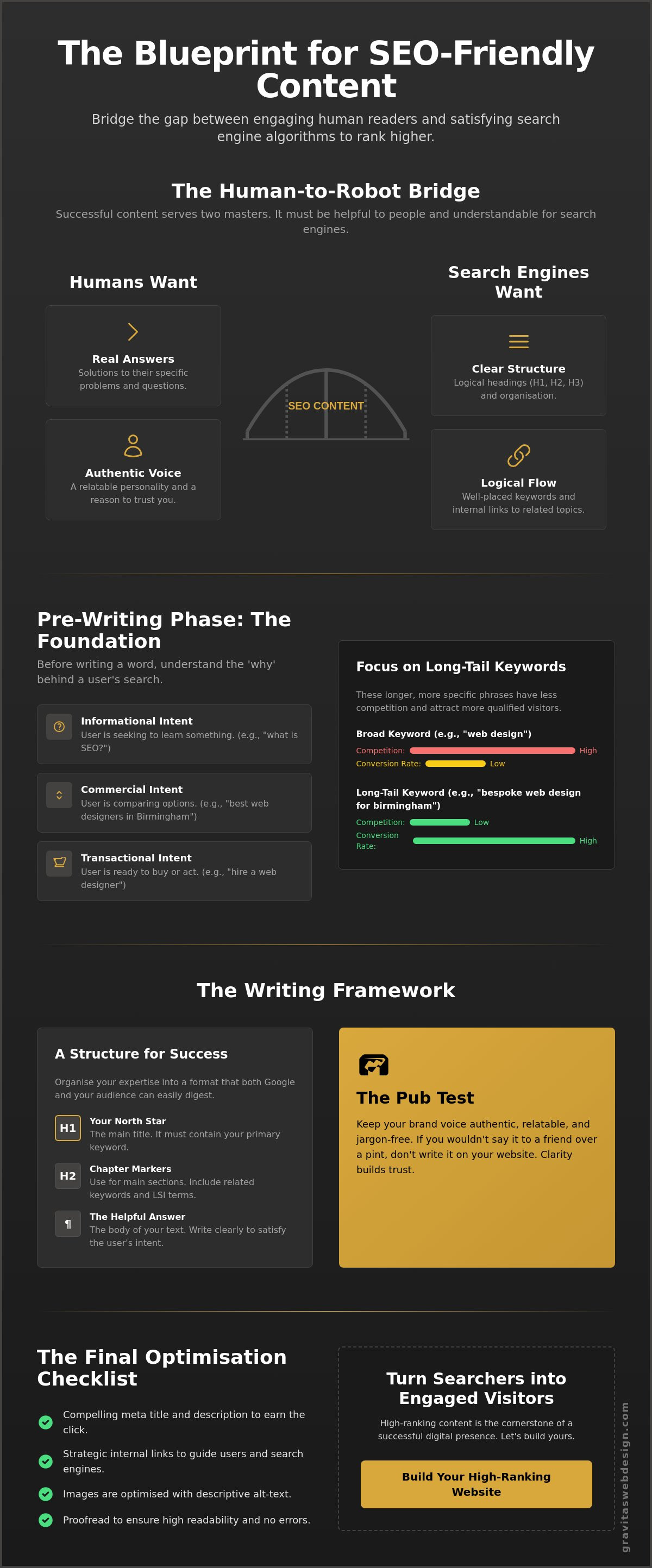
Think of it as a bridge. On one side, you have humans; they want answers, personality, and a reason to trust you. On the other side, you have robots; they want structure, clear headings, and logical flow. High-quality Search engine optimization (SEO) is the translator that sits in the middle. It ensures your brilliant ideas don’t just sit in a dark corner of the internet, but instead get the spotlight they deserve.
For a business in Birmingham or Sutton Coldfield, this is your chance to outshine the big, soulless national brands. They often rely on generic, mass-produced templates that feel cold and clinical. By mastering how to write seo friendly content that sounds like a real person, you create a connection that a corporate algorithm simply cannot replicate. SEO writing doesn’t have to be boring or repetitive; it just needs to be smart.
The Reality: Why Quality Beats Quantity
The days of churning out daily blog posts just to “feed the beast” are over. Google’s recent updates have made one thing clear: helpfulness is the only currency that matters. AI-generated fluff is failing because it lacks the lived experience and unique perspective that only you can provide. Your brand voice is your secret weapon for ranking whilst simultaneously building a rapport with your audience. Search Intent is the holy grail of modern SEO, representing the specific problem or question a user is trying to solve when they hit “search”.
The Emotional High of a High-Ranking Article
There is a specific kind of professional pride that comes from seeing your article on page one. It marks the transition from being an invisible entity to a genuine industry authority. We have all felt the frustration of past failed attempts at keyword stuffing; it feels clunky, looks unprofessional, and ultimately drives people away. Bespoke content is the digital equivalent of a high-end storefront in a busy shopping centre. It signals to the world that you are open for business, you are an expert in your craft, and you genuinely care about the person on the other side of the screen.
The Pre-Writing Phase: Researching Your Audience’s Intent
Before you even type a single word of your draft, you need to play detective. Why is your reader typing that specific phrase into a search bar? Are they in a panic because their website has crashed in Sutton Coldfield, or are they just casually wondering how to start a new brand? Understanding the “why” is the foundation of how to write seo friendly content that actually converts. If you get the intent wrong, you could write the most beautiful prose in the world and it still won’t rank. Why? Because you aren’t giving Google the specific type of answer it knows the user wants.
Keywords aren’t just technical labels; they are the literal language of your customers. Instead of chasing high-volume industry jargon that only your competitors use, look for the phrases your actual clients whisper into their phones late at night. This aligns with Purdue University’s SEO considerations regarding deep audience analysis. You have to know who you are talking to before you can provide a solution that sticks. We generally categorise this intent into three buckets: informational (learning something), commercial (comparing options), and transactional (ready to buy).
Finding Your Primary Keyword Without the Headache
You don’t need expensive, soul-crushing software to start. Open a private browser tab, type your basic idea into Google, and look at the Autocomplete suggestions. These are real-time glimpses into what people are searching for right now. The “People Also Ask” box is another goldmine of human curiosity. Focus on “long-tail” phrases. These are longer, more specific questions that usually have lower competition but much higher conversion rates. For example, “web design” is a broad battleground, but “bespoke web design for local businesses in Birmingham” is a niche you can actually win. Just remember to pick one primary keyword per page. If you try to target the same word across multiple articles, you’ll end up “cannibalising” your own results, which is a bit like racing against yourself.
Understanding the “Micro-Moments” of Search
Google is incredibly savvy at predicting what a user wants to see. If you search for a topic and the top three results are all “Top 10” listicles, don’t try to break through with a dense, academic essay. You need to match the format that is already performing well. This is particularly vital when looking at SEO for service businesses, where the intent can shift quickly from “how do I do this myself” to “who can do this for me”. If this feels like a lot to juggle whilst you are busy actually running your business, our copywriting team can help you find that sweet spot between data-driven strategy and human soul.
The SEO Content Template: A Structural Framework
If you want to know how to write seo friendly content, you have to stop thinking like an author and start thinking like an architect. You wouldn’t try to build a house by just piling bricks in a field; you would start with a blueprint. Your writing needs that same level of structural integrity. A well-organised post doesn’t just make life easier for your reader; it gives search engine crawlers a clear map of your expertise. Without this skeleton, your brilliant ideas are just a jumble of words that Google will likely ignore.
Every high-ranking article begins with a powerful H1. This is your shop sign. It needs to include your primary keyword whilst making a bold promise to the reader. But the real work happens in the first 100 words. We live in an era of digital impatience. If you don’t answer the reader’s main question or acknowledge their pain immediately, they will bounce back to the search results faster than you can say “algorithm”. You have to prove, right at the top, that they are in the right place.
Using a consistent template allows you to scale your content production without losing quality. It ensures that every piece of copywriting you produce feels professional and intentional. By following a set framework, you remove the “blank page” anxiety and focus on delivering the value your Birmingham or Sutton Coldfield audience is looking for.
Mastering the Hierarchy of Headings
Think of your headings as the chapters of a book. Your H1 is the title, your H2s are the main chapters, and your H3s are the specific sub-points within those chapters. It sounds simple, but many people get this wrong by skipping levels or using headings just to make text look big. Search crawlers use this hierarchy to understand which parts of your topic are the most important. Keywords placed in your headings carry significantly more weight than those tucked away in the body text. It’s a clear signal to Google about what each section is actually about.
The Inverted Pyramid: Delivering Value Fast
Most people don’t read every word on a webpage; they skim. To cater to this behaviour, you should adopt the “inverted pyramid” style of journalism. This means placing your most vital information and conclusions at the very top of the section, followed by the supporting details and background context. Use bold text to highlight key phrases and bullet points to break up dense blocks of information. If your article is particularly long, consider using jump links at the start. This allows users to hop directly to the answer they need, which drastically improves the user experience and keeps them on your site for longer.
Writing for Humans: Readability, Tone, and Engagement
Have you ever clicked on a search result only to be met with a wall of text that looks like a legal disclaimer? It’s exhausting. You probably closed the tab within seconds. When we talk about how to write seo friendly content, the “human” part of the equation is actually the most important factor for your ranking. Google monitors how people behave on your site; if they leave immediately because your writing is boring, your rankings will tank. You need to speak like a person, not a textbook.
I always recommend the “Pub Test”. Imagine you are sitting in a comfortable chair in a quiet pub in Lichfield, explaining your business to a client over a drink. Would you use words like “synergy,” “optimisation-driven,” or “leveraging”? Probably not. You would use simple, direct language that gets straight to the point. If you wouldn’t say it out loud in a casual conversation, you shouldn’t be writing it on your website. This approach builds an immediate human-to-human connection that robots simply cannot fake.
Metaphors are your best friend here. They turn complex, scary technical topics into something familiar. For instance, think of SEO as a massive, infinite library. Google is the librarian, and your website is a book. If your book has a confusing title, no page numbers, and is written in a language nobody understands, the librarian will never recommend it to anyone. Using accessible metaphors like this keeps your readers engaged whilst helping them visualise the value you provide.
Injecting Personality Whilst Maintaining Professionalism
Don’t be afraid to use “I” and “You”. It lowers the reader’s guard and makes the experience feel like a dialogue rather than a lecture. We are all naturally drawn to stories, so try to weave in real-world examples of how you have helped people. It makes dry data memorable. Remember that bespoke web design is about more than just clean code; it is about projecting the character and soul of your business. Your writing should reflect that same unique personality.
The Art of the “Visual Break”
Walls of text are the ultimate enemy of engagement. To keep the reader’s eye moving down the page, you need to master the visual break. This means using images, videos, and pull-quotes to punctuate your points. Keep your paragraphs short, ideally no more than 3 or 4 lines. This is particularly vital for mobile users who don’t want to squint at a never-ending block of tiny text on their screens. Short sentences and simple vocabulary don’t make you look less professional; they make you look like an expert who knows how to communicate clearly.
If you are struggling to find the right words to tell your story, our copywriting experts can help you craft a voice that resonates with your audience whilst ticking all the right boxes for search engines.
The Final Checklist: Optimising for Visibility and Clicks
You have done the heavy lifting. The research is finished, the draft is polished, and your “Pub Test” passed with flying colours. But hitting publish right now would be like building a beautiful boutique in Birmingham and forgetting to put a sign on the door. These final optimisations are what turn a great read into a high ranking asset. If you want to master how to write seo friendly content, you have to treat these last few steps as your pre-flight checklist. Without them, you are leaving your traffic to chance.
Think of this stage as the digital “kerb appeal” of your article. It is about making sure that when your post appears in a list of ten other links, yours is the one that feels irresistible. It is also about ensuring Google’s crawlers don’t get lost in the corridors of your website. A bit of technical housekeeping goes a long way in proving you are a professional authority in your niche.
Crafting Meta Tags That Earn the Click
The Meta Title and Description are essentially the “advert” for your page in the search results. Your Meta Title should be under 60 characters to avoid being cut off; ensure it includes your primary keyword and a clear benefit. The Meta Description is your 160 character sales pitch. It doesn’t directly impact your ranking position, but it drastically affects whether someone actually clicks your link. Your click-through rate is a vital, hidden signal that tells Google your page is exactly what the user wanted.
Internal Linking: Building Your Digital Web
Internal links are the secret sauce of a healthy website. By linking to your main pillar pages, you spread “link equity” across your site, helping your most important services rank higher. Avoid using lazy anchor text like “click here” or “read more”. Instead, use descriptive phrases like “professional Search Engine Optimisation (SEO)” or “bespoke branding” to tell Google exactly what the destination page is about. A site that is easy to navigate for a human is naturally easy to crawl for a robot. It keeps readers on your site for longer, which reduces your bounce rate and builds trust.
Do not forget your images. Google cannot “see” a photo of your latest project in Sutton Coldfield, so you have to tell it what is there using Alt Text. This helps with your ranking whilst making your site accessible for people using screen readers. Finally, never end an article without a clear Call to Action (CTA). Whether you want them to explore your Search Engine Optimisation (SEO) services or simply get in touch, tell them exactly what the next logical step is. You have earned their attention; now, give them a reason to stay.
Ready to Rule the Search Results?
You’ve now got the blueprint. From digging into the “why” behind a search to building a structural framework that even the grumpiest search robot would love, you’re equipped to make an impact. Remember; how to write seo friendly content isn’t about being perfect. It’s about being the most helpful person in the room for your customers in Birmingham, Sutton Coldfield, and Lichfield. You’ve seen that a human-to-human tone and a clear visual hierarchy are your best tools for keeping readers engaged whilst building real authority.
Business ownership is a wild ride of professional pride and digital anxiety. You shouldn’t have to add “deciphering search algorithms” to your list of daily chores. We are specialists in bespoke web design and branding, and we pride ourselves on a transparent, jargon-free process that gets results without the headache. Ready to stop being the best-kept secret in Birmingham? Get a bespoke SEO and copywriting strategy from Gravitas. It is time to stop shouting into the void and start building a digital presence you can actually be proud of. You’ve got the tools; now go and use them.
Frequently Asked Questions
How long should an SEO friendly blog post be?
Quality always trumps quantity. There is no magic word count that guarantees a top spot; however, aiming for 1,000 to 2,000 words allows you to cover a topic with the depth Google loves. If you can solve a reader’s problem perfectly in 500 words, don’t add fluff just to hit a target. Focus on being the most helpful resource on the internet for that specific query.
Can I use AI like ChatGPT to write my SEO content?
You can use AI as a brilliant assistant, but it shouldn’t be your lead writer. Recent global updates have targeted the abuse of scaled AI content, meaning generic, unedited drafts are likely to be flagged as spam. Use AI for brainstorming or outlining, then inject your own lived experience and local expertise to ensure your voice remains authentic and trustworthy.
How many times should I use my keyword in the text?
Forget about strict percentages or “keyword density”. When you are learning how to write seo friendly content, focus on placing your primary keyword naturally in the H1, the first paragraph, and a couple of subheadings. If you find yourself forcing the phrase into sentences where it doesn’t belong, you have probably overdone it. Write for the reader first.
Do images really help with SEO ranking?
Images are vital for keeping people on your page. Whilst they don’t directly “tell” Google your text is good, they break up long blocks of copy and lower your bounce rate. By using descriptive Alt Text, you also help search engines understand the context of your visuals, which can lead to extra traffic from image searches. They make your site more accessible too.
How long does it take for new content to show up on Google?
It usually takes anywhere from a few days to a few weeks for new pages to be indexed. The speed depends on how often you update your site and the strength of your internal linking. If you have a solid Search Engine Optimisation (SEO) strategy in place, Google will crawl your site more frequently, picking up your latest masterpieces much faster.
What is the difference between SEO writing and regular copywriting?
Regular copywriting is the art of persuasion; it is designed to make someone take action. SEO writing includes that same persuasive spark but adds a layer of technical structure to help robots categorise the page. The most effective content combines both, ensuring you attract the right traffic whilst also convincing them that you are the best choice for the job.
Is it better to write for humans or search engines?
Always write for humans. Google’s entire business model relies on showing people the most helpful results, so its algorithm is constantly evolving to think more like a person. When you focus on how to write seo friendly content for real people, you are actually future-proofing your website against algorithm changes. Trying to “game” the system with robotic text is a short-term tactic.
Should I update my old blog posts for better SEO?
Updating old content is one of the most efficient ways to boost your traffic. Refreshing an outdated article with new facts, better links, and updated keywords tells Google that your site is active and relevant. It is often much faster to move an existing post from page two to page one than it is to launch a brand-new article from scratch.