
Web Design Blog
How to Convince Your Boss to Invest in a New Website
Picture this: you’ve just nailed a pitch to a dream prospect, but as you go to share your URL, you feel that familiar prickle of embarrassment. You know the current site is a clunky, slow mess that doesn’t reflect your actual talent, and frankly, you’re tired of losing leads to competitors who just look more “together”. It’s a soul-crushing spot to be in, especially when technical debt makes even the tiniest update feel like a mission to Mars. You know a change is overdue, but figuring out how to convince your boss to invest in a new website can feel like a mountain you aren’t quite ready to climb.
We completely understand. To leadership, a website often looks like a vanity project rather than a vital tool. However, with 94% of first impressions being design-related, your site is actually a silent leak in your revenue bucket. This article will help you transform those technical frustrations into a compelling business case focused on ROI, credibility, and genuine growth. We’re providing a structured plan and the data-backed arguments you need to present your case with confidence and finally partner with a bespoke team that gets results.
Key Takeaways
- Stop treating your site as a cost centre and learn to pitch it as your hardest-working salesperson that never takes a holiday.
- Master the art of how to convince your boss to invest in a new website by swapping technical jargon for the language of ROI and conversion rates.
- Identify the “template trap” and discover why bespoke design is the only way to avoid the technical debt that stunts long-term growth.
- Follow a structured, data-led plan to audit your competitors and present a business case that leadership simply cannot ignore.
- Learn why choosing a partner who prioritises transparency and business strategy is essential for building executive trust.
Recognising the Awkward Digital Handshake that Scares Away Leads
Think of your website as a digital handshake. It’s the very first interaction a prospect has with your brand, often occurring long before they ever speak to a human. If that handshake is limp, clammy, or just plain confusing, you have lost them before the conversation even begins. Many businesses settle for a site that is “good enough”, but in a competitive market, mediocre is actually a massive liability. When you are developing a solid business case for a digital overhaul, you must start by acknowledging this reality. A website that doesn’t reflect your actual expertise is actively working against you.
There is also a deep psychological impact on your own team. Your sales staff should feel a surge of professional pride when they share a link; they shouldn’t be mumbling the URL under their breath whilst hoping the prospect doesn’t look too closely. This “digital embarrassment” creates a hesitation that can kill deals. Highlighting this internal friction is a powerful part of how to convince your boss to invest in a new website. Unlike off-the-shelf solutions, bespoke web design creates an immediate sense of authority that templates simply cannot replicate. It signals to the world that you are a serious player who cares about every detail of the customer journey.
The Psychology of First Impressions
Research shows it takes just 0.5 seconds for a user to form an opinion about your website. In that blink of an eye, they decide whether to trust you. A polished, professional site creates a “halo effect”; users assume that if your digital presence is high-quality, your actual services will be too. Conversely, a clunky interface suggests a clunky business. Looking the part isn’t just about vanity; it is the essential first step in your sales funnel that dictates every interaction that follows.
When “Good Enough” is Losing You Money
An outdated site is often a “Digital Liability”, which we define as a digital presence that actively drives potential customers into the arms of your competitors. If your bounce rates are high and engagement is low, you are paying a hidden tax on every marketing pound you spend. A site that feels like a relic of the past suggests your business approach is equally stagnant. By failing to invest, you aren’t saving money; you are subsidising your competitors’ growth by handing them the leads your own site failed to capture.
Turning Technical Grumbles into the Language of Executive ROI
Imagine walking into a boardroom and announcing that the “CSS hierarchy is inefficient”. You’ll likely see eyes glaze over faster than a frozen laptop screen. If you want to master how to convince your boss to invest in a new website, you have to stop speaking “developer” and start speaking “Director”. Leadership doesn’t see code; they see strategic assets or monthly expenses. Your job is to prove that an outdated site is a drain on the latter and a missed opportunity for the former. When you frame the discussion around growth, the question of how to convince your boss to invest in a new website becomes a much easier conversation to have.
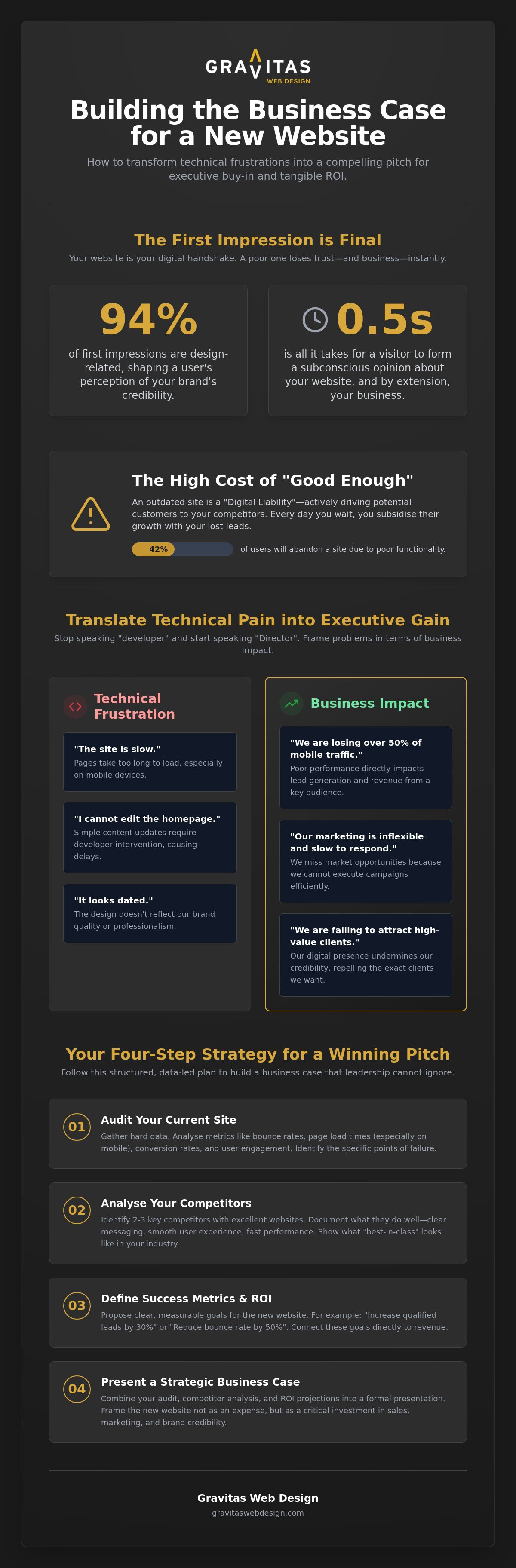
To do this, you need to align your pitch with the elements of a successful website that drive actual profit. Stop complaining about technical debt and start highlighting the “Cost of Inaction”. Whilst you stay static, your competitors are evolving. Research shows that 42% of people will leave a website simply because of poor functionality. Every day you wait is a day you subsidise a competitor’s growth with your lost leads.
Technical Pain vs. Executive Gain
Translation is your secret weapon. You need to turn your daily frustrations into financial metrics.
- Instead of “The site is slow”, try: “We are losing over 50% of our mobile traffic because the site takes longer than three seconds to load.”
- Instead of “I cannot edit the homepage”, try: “Our marketing is inflexible and slow to respond to market changes, which limits our campaign effectiveness.”
- Instead of “It looks a bit dated”, try: “We are failing to attract high-value clients who equate design quality with professional reliability.”
Measuring What Matters to Leadership
Leadership cares about the bottom line. Focus on lead generation. By improving the user experience (UX), you aren’t just making things “pretty”; you are performing conversion rate optimisation. Think about how to get more enquiries from my website through strategic, bespoke design rather than hope and a prayer. A site that ranks better through SEO also reduces your long-term reliance on expensive paid ads. If you are ready to build that case, we can help you map out your digital strategy today and turn those grumbles into growth.
Why Templated Shortcuts are Quietly Sabotaging Your Growth
Ever tried to run a marathon in a pair of flip-flops? They are cheap, certainly. They are incredibly easy to put on. But about three miles in, you are going to regret every single life choice that led you there. Templates are the flip-flops of the digital world. They look fine on the shelf, but they weren’t built for the long haul. When you are figuring out how to convince your boss to invest in a new website, you have to explain that the business has hit the limit of what a “plug-and-play” solution can do. We’ve reached the point where the shoes no longer fit the ambition.
DIY builders like Wix or Squarespace are fantastic for a weekend hobby, but for a professional service firm, they often become a “Template Trap”. You save money upfront, only to pay it back tenfold in awkward workarounds and lost opportunities. It is about the strategic importance of a strong website that actually supports your specific business goals, rather than forcing your brand to fit into a pre-made box. Bespoke design provides a friction-free path to scaling that templates simply cannot offer.
The Hidden Ceiling of Templates
Templates come with a heavy, invisible ceiling. Because they are designed to work for everyone, they are often bloated with unnecessary code. This isn’t just a minor technical issue. Research shows that 53% of mobile visits are abandoned if a page takes longer than 3 seconds to load. If your template is dragging its feet because of “code bloat”, your Google rankings will suffer. You end up amongst a sea of identical-looking competitors, unable to stand out or integrate the specific tools your team needs to work efficiently.
Bespoke Design as an Investment in Future-Proofing
Custom sites are built to grow alongside you. They are lean, fast, and significantly more secure than a plugin-heavy template. Instead of a fragile environment that breaks every time you try to add a new feature, bespoke design offers a stable, managed foundation. It is your “secret sales weapon” for high-end markets where prospects expect a premium experience. Knowing when to move from a template to a bespoke website is a critical part of how to convince your boss to invest in a new website. It is the shift from a “good enough” digital presence to a strategic asset that scales as fast as your business does.
Your Step-by-Step Strategy for a Winning Pitch
You have the logic and you have the passion, but walking into a boardroom without a plan is a recipe for a “maybe next quarter” dismissal. To master how to convince your boss to invest in a new website, you need to move from being a frustrated user to a strategic consultant. This isn’t about asking for a favour; it is about presenting a boardroom-ready battle plan that makes saying “no” look like a poor business decision. You need a mix of cold, hard data and a vision of what the brand could actually become if it were unburdened by technical debt.
Start by auditing the competition. Find three sites in your industry that make yours look inferior. If your rivals are offering a slick, friction-free experience whilst your prospects are still squinting at non-responsive text, that is your opening gambit. Align your new website goals with your boss’s specific KPIs. If they are obsessed with efficiency, talk about how a bespoke backend reduces manual work. If they want revenue, talk about conversion rates. Presenting a phased rollout can also mitigate perceived risk, showing that you aren’t just looking to spend money but to invest it wisely over time. Finally, bring in your chosen partner early. Let the experts handle the technical “why” so you can focus on the business “what”.
Gathering the Evidence
Data is the ultimate shield against “we’ll do it later”. Use free tools to show exactly how slow your current pages load compared to local rivals. Gather “social proof” from the front lines by asking your sales team for the most common client objections related to the site. If they are hearing that the site looks untrustworthy, that is a massive red flag. Create a simple “Before and After” vision. Show what the brand looks like now (the awkward handshake) and what it could look like with a professional, bespoke presence.
Anticipating and Overcoming Objections
Expect the “it’s too expensive” hurdle. Counter this by shifting the focus from the price tag to long-term ROI and the value of a site that actually closes deals. When they say “we don’t have time”, highlight that a partner with a transparent, managed process handles the heavy lifting. The cost of inaction is often significantly higher than the investment itself, as every day you wait is a day your competitors gain ground. If you are ready to start building your case, you can book a strategy call with us to get the expert insights you need for your pitch.
Navigating the Journey from Outdated to Outstanding with Gravitas
So, you have the data, the competitor audits, and a vision for the future. Now comes the part where you actually have to deliver. The final, critical piece of the puzzle in how to convince your boss to invest in a new website is choosing a partner who speaks their language. Most bosses have been burned by “techies” who hide behind jargon and missed deadlines. They don’t want a coder who lives in a dark room; they want a strategic ally who understands that every pixel must serve a business purpose. If you can show them a partner who prioritises ROI over artistic ego, the “yes” becomes inevitable.
This is where radical transparency becomes your best friend. Leadership needs to trust that the process won’t descend into a black hole of “we’re working on it”. At Gravitas, we operate as a straight-talking partner. We are honest about what is achievable, what is necessary, and what is just a vanity metric. By positioning the project as a collaboration with a founder-led team, you remove the anxiety of the unknown. You aren’t just buying a website; you are investing in a relationship that values your time and your bottom line.
The Human-to-Human Partnership
We’ve all been through those dry, corporate presentations that feel more like a lecture than a creative session. We prefer a different route. Our approach is built on energetic innovation and direct communication. We see ourselves as the antidote to industry-standard awkwardness. By handling all the technical “hoops” and administrative faff, we ensure the journey from an outdated site to a bespoke masterpiece is entirely friction-free. The goal is simple: to create a digital presence that every member of your team feels a genuine sense of professional pride in sharing with the world.
Long-Term Security and Performance
A website isn’t a “set and forget” purchase. It is a living, breathing digital asset that requires regular care to stay fast and secure. This is a key point to raise when discussing how to convince your boss to invest in a new website; the investment needs protecting. We offer comprehensive WordPress maintenance services to ensure your site remains a high-performance machine. From peak speed optimisation to shielding your reputation from security threats, maintenance is the insurance policy your new asset deserves. Remember, a new website isn’t the finish line. It is the starting block for your next major growth phase.
Stop Settling for a Digital Handshake That Doesn’t Close Deals
You’ve seen the evidence. An outdated site isn’t just a technical annoyance; it’s a silent drain on your credibility and your revenue. By shifting your focus from “pretty pixels” to executive ROI and auditing the competition, you’ve already mastered the hardest part of how to convince your boss to invest in a new website. You now have a battle plan to move past the template trap and toward a digital presence that actually reflects your talent.
At Gravitas, we specialise in helping UK professional service firms reclaim their digital pride through founder-led, bespoke design. We believe in transparent project management and radical honesty. There is no jargon here; just a straight-talking partnership that gets results. Let us help you build a business case that your boss cannot ignore and transform your website into your hardest-working salesperson.
It is time to stop mumbling your URL and start sharing it with confidence. Your next phase of growth is just one solid pitch away. You’ve got this.
Frequently Asked Questions
How much should a new bespoke website cost?
The cost of a bespoke website depends entirely on the features and functionality your business requires to grow. Rather than hunting for a bargain-bin quote, focus on the return you expect from a site that actually converts. A high-quality build includes custom design and robust security; it is a strategic investment. It is about buying a tool that works, rather than a digital paperweight that just looks pretty.
How long does it take to see an ROI from a new website?
You will often see the first signs of ROI through improved user engagement and lower bounce rates almost immediately after launch. However, a full return on investment usually develops over several months as your improved SEO rankings start to convert higher-quality leads. It is a long-term strategic asset that pays dividends by reducing your reliance on expensive ads. A site that works well is your hardest-working salesperson.
What is the best way to show my boss what competitors are doing?
Perform a side-by-side visual audit using screenshots of their mobile experience versus yours. Use objective data, like page load speeds, to show where rivals are outperforming you. When you can prove that 53% of mobile visits are abandoned if a page takes longer than 3 seconds, and your site is lagging behind, the case for how to convince your boss to invest in a new website becomes undeniable. It’s about staying competitive.
Can we just fix our current website instead of building a new one?
You can certainly apply band-aids to an old site, but you will eventually hit a wall of technical debt that makes updates impossible. If your current platform is built on a clunky template, fixing it often costs more in developer hours than starting fresh. Building a bespoke site ensures you have a clean, scalable foundation. It won’t break every time you want to change a headline or add a new service.
How do I explain technical debt to a non-technical boss?
Compare technical debt to an old car that needs significant work just to pass its MOT every single year. It still runs, but it is slow and prone to breaking down when you need it most. Explain that the current site is holding the marketing team back. You are spending money just to stay still, whilst a new bespoke site lets you actually drive the business forward and reach new customers.
What happens if my boss still says no after the pitch?
If the answer is no, don’t panic; simply pivot the conversation toward a “not yet” and ask what specific metrics would change their mind. Start tracking the leads you are currently losing and document every time a prospect mentions a glitch. Gathering this evidence of failure over a few months provides the hard data you’ll need when you bring up how to convince your boss to invest in a new website again.
Should I mention SEO in my proposal to leadership?
Yes, because SEO is the primary driver of organic traffic that reduces your long-term marketing costs. Explain that a bespoke site is built with search engines in mind from the ground up, unlike templates that often come with bloated code. This isn’t just about ranking; it’s about making sure the people who are already looking for your services can actually find you. It is a fundamental part of business growth.
How do I choose the right web design agency for my pitch?
Look for a partner who asks about your business goals and revenue targets rather than just your favourite colours. You want an agency that offers a transparent process and has a proven track record in UK professional services. A good partner will help you build your business case. They provide the data and strategic insights needed to win over your leadership team and ensure the project succeeds.