
Web Design Blog
How to Calculate the ROI of a New Website: A Guide for Business Owners
Have you ever felt that slight internal wince when a high-value prospect asks for your URL? It’s that tiny moment of hesitation where you hope they don’t look too closely at the “broken” bits or the layout that feels stuck in the past (it happens to the best of us). You aren’t alone in feeling that your digital presence doesn’t quite match your real-world reputation. Most business owners suspect their current site is leaking leads, yet they struggle with exactly how to calculate the ROI of a new website without it feeling like a finger-in-the-wind exercise.
It’s completely normal to feel protective of your marketing spend, especially when previous projects felt like expensive ego trips rather than profit drivers. We’re here to change that. This guide will help you move beyond the guesswork and discover how to calculate the precise financial impact a bespoke website has on your business growth. We’ll explore the clear maths behind lead generation, operational efficiency, and the “credibility premium” that finally lets you justify those premium prices with total confidence.
Key Takeaways
- Stop letting prospects “silently exit” your site because of an outdated layout that doesn’t match the high quality work you actually do.
- Get a handle on the specific maths of how to calculate the ROI of a new website, moving your focus from “hits” to actual revenue generating enquiries.
- Learn why a “cheap” template often ends up being the most expensive option once you factor in the missed sales and lack of brand authority.
- Discover how Search Engine Optimisation and professional copywriting work together to make sure your site is found by the right people and speaks their language.
- Understand why ongoing maintenance is the “secret sauce” for protecting your digital investment and keeping your ROI healthy for years to come.
The Hidden Cost of Inaction: Why an Outdated Website is a Digital Liability
Imagine a potential client finds your business through a glowing referral. They’re excited; they’re ready to buy. But then they click your link and find a site that looks like it was built during the era of dial-up. That immediate “back” button click is what we call the “Silent Exit”. It’s the sound of a lead disappearing before you even knew they existed. When we talk about the basic principles of Return on Investment (ROI), we usually focus on the gains, but for many business owners, the real story is in the losses.
If your website doesn’t reflect the high-quality service you actually provide, you aren’t just missing a “digital presence”; you’re actively damaging your brand’s perceived value. It’s like turning up to a high-stakes pitch in a stained tracksuit. You might be the best in the business, but nobody is sticking around to find out. Knowing how to calculate the ROI of a new website involves more than just looking at what you spend; it requires looking at what you’re currently leaking through the cracks of an outdated URL.
Quantifying Lost Opportunities
Start by looking at your current bounce rate. If it’s significantly higher than industry benchmarks for professional services, you’re effectively paying to drive people away. Every person who leaves because of a “Credibility Gap” represents a lost Lifetime Value (LTV) that could be worth thousands. It’s particularly painful for those who rely on referrals; if someone hears you’re great but sees a clunky, broken site, they’ll likely doubt the recommendation. The Cost of Inaction is the revenue lost by maintaining the status quo.
Understanding how to calculate the ROI of a new website starts with admitting that staying still is costing you money every single day. If you lose just one high-value client a month to a competitor with a slicker site, that’s your “Inaction Tax”.
The Drain on Your Marketing Budget
Paying for Search Engine Optimisation or digital ads is largely pointless if your landing page is poorly designed. You’re essentially pouring water into a leaky bucket. With over 62% of global web traffic now coming from mobile devices, a site that doesn’t work perfectly on a phone is a massive liability. Slow loading times don’t just frustrate users; they directly impact your bottom line by tanking your conversion rates.
For London property firms, where reputation and visual authority are everything, a clunky site doesn’t just look bad; it suggests your service might be equally outdated. A bespoke, high-performance site ensures that every penny of your marketing spend actually has a chance to convert, rather than being wasted on traffic that bounces within seconds of arrival.
The Website ROI Formula: Measuring Leads, Conversions, and Revenue
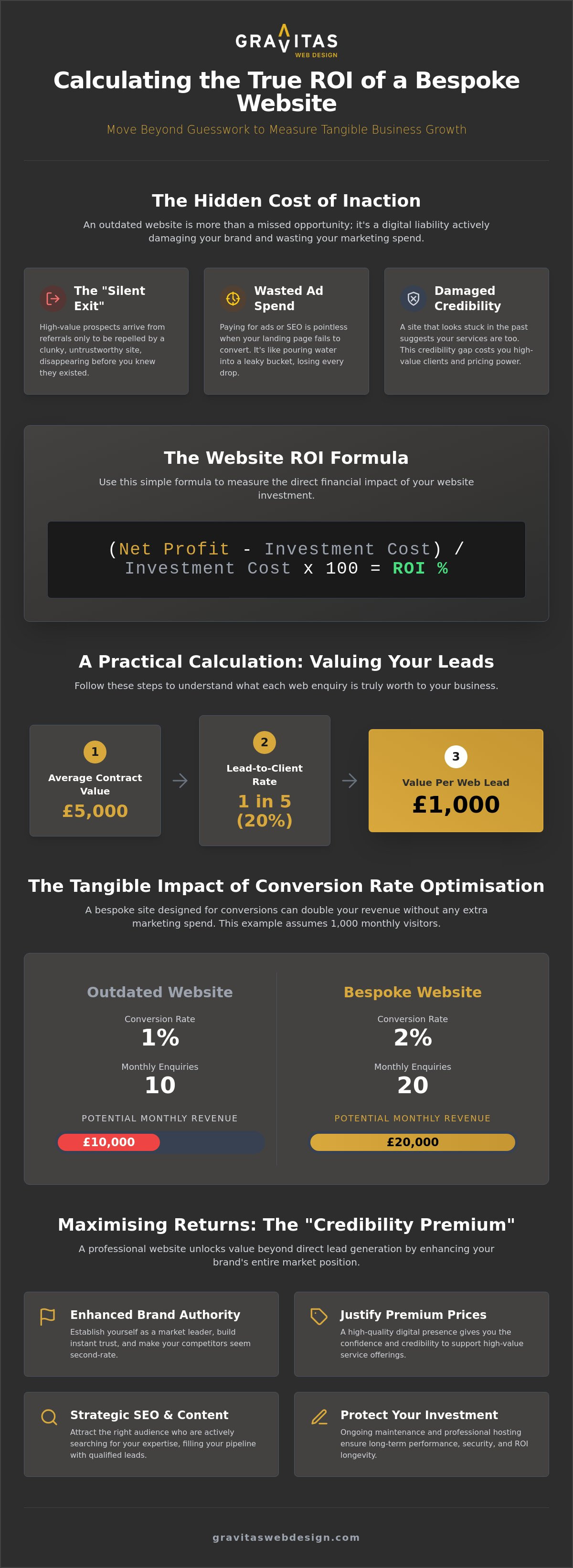
Let’s talk numbers. I know, “maths” is usually the part of the day where everyone’s eyes glaze over, but when it’s your money on the line, it gets a lot more interesting. To understand how to calculate the ROI of a new website, you need a solid formula. In its simplest form, you take the net profit generated by the site, subtract the cost of building it, and then divide that number by the cost of the site. Multiply by 100, and there’s your percentage. It looks like this: (Net Profit – Cost) / Cost x 100.
The trick, of course, is defining that “net profit” accurately. If you aren’t selling physical products through an online shop, you can’t just look at a dashboard of sales. You have to look at your Key Performance Indicators (KPIs). Forget about “hits” or “page views” for a moment. Those are vanity metrics that don’t pay the bills. Instead, focus on enquiries. How many people are actually picking up the phone or filling out your contact form? Establishing a baseline of what your current site does (or doesn’t) do right now is the only way to measure the climb once your new site goes live.
The Lead Generation Calculation
To get a real handle on how to calculate the ROI of a new website, you must assign a value to every lead. Start by looking at your average contract value. If a typical client is worth £5,000 to your business, and you close one in every five enquiries, then every single web lead is worth £1,000 to you. It’s simple, right? If a bespoke site uses better design and professional copywriting to double your conversion rate from 1% to 2%, you’ve just doubled your revenue without spending an extra penny on traffic. That is the power of a site that actually works for its living.
Operational Efficiency Gains
ROI isn’t always about new money coming in; sometimes it’s about less money (and time) going out. Think of your website as a tireless, 24/7 member of your admin team. How much time does your staff spend answering the same three questions over the phone? If a well-designed FAQ section or an automated booking system saves your team five hours a week, that’s twenty hours a month of reclaimed productivity. When you integrate your site directly with a CRM, you’re cutting out the manual data entry that usually leads to mistakes and headaches. If you’re ready to see how these numbers apply to your own business, you might want to explore our bespoke options to get the ball rolling. Reducing that “Administrative Burden” through better UX is a quiet but massive contributor to your total return.
Bespoke Design vs Templates: Evaluating the Credibility Premium
It’s tempting, isn’t it? That £500 website template that promises the world for the price of a fancy dinner out. But this is where many business owners fall headfirst into the “Template Trap”. Whilst the initial cost is low, these off-the-shelf solutions often cost you significantly more in the long run through missed sales and a diluted brand. When you sit down to figure out how to calculate the ROI of a new website, you have to account for the “Credibility Premium” that only a custom build can provide.
Bespoke web design isn’t just about looking “pretty”; it’s a strategic investment in your brand’s authority. In competitive areas like Sutton Coldfield and Lichfield, standing out is the difference between winning a contract and being ignored. If your site looks like a carbon copy of every other business in your industry, you’re essentially telling your prospects that you’re a commodity. Unique branding creates a sense of loyalty and shifts the conversation away from price, allowing you to build a more resilient market position.
Why One-Size-Fits-All Often Fits No One
Templates come with hidden baggage. They’re often built with bloated code to accommodate every possible user, which results in sluggish loading speeds and a nightmare for your Search Engine Optimisation. This “Visual Sameness” makes it incredibly difficult for a prospect to remember you ten minutes after they’ve closed the tab. If you find your business is outgrowing its current digital skin, it might be time to consider when to move from a template to a bespoke website to ensure your site can actually scale with your ambitions.
The ROI of Trust and Credibility
High-net-worth clients have a very sensitive “nonsense detector”. They expect a level of polish that matches the premium service they’re looking for. Bespoke layouts, combined with professional photography, build immediate trust that a template simply cannot mimic. This is the “Halo Effect” in action: when your website looks world-class, your prospects subconsciously assume your service is world-class too. By investing in a digital presence that radiates authority, bespoke design allows businesses to command higher fees and attract clients who value quality over the lowest quote. It’s about ensuring your online “handshake” is as firm and professional as your real-world reputation.
Maximising Returns through SEO, Copywriting, and Strategic Content
Having a stunning website that nobody visits is like owning a Ferrari that stays in the garage. It looks fantastic, sure, but it isn’t actually taking you anywhere. To truly understand how to calculate the ROI of a new website, you have to look at the fuel that makes the engine roar: Search Engine Optimisation and professional copywriting. These aren’t just optional extras; they are the core components that transform a digital brochure into a lead-generating machine that works whilst you sleep.
The Compounding Interest of SEO
SEO is essentially the compounding interest of the digital world. Whilst paid advertising is like a tap you have to keep paying to run, organic search traffic is more like building a well. It takes some initial effort to dig, but once the water starts flowing, it’s yours for the long haul. A well-structured site improves your rankings for high-value keywords, especially when targeting competitive hubs like Birmingham and London. This drives high-intent traffic to your door, people who are already looking for exactly what you offer. When you factor in these compounding gains, you’ll see that how to calculate the ROI of a new website becomes a lot more exciting than just looking at the initial invoice. If you’re scratching your head over how to get more enquiries from my website, the answer lies in that perfect synergy between being found and being convincing.
Copywriting: The Engine of Conversion
If design is the suit you wear to the meeting, copywriting is the pitch that closes the deal. The way you say things matters just as much as how your site looks. A clear Value Proposition tells your visitor exactly why you’re the best choice within seconds of them landing on the page. We favour a “human-to-human” tone because corporate-speak is the quickest way to make a prospect’s eyes glaze over. It’s about lowering barriers and building rapport through honesty.
Strategic content, like helpful guides or case studies, becomes a long-term asset that keeps working for you years after it was first published. When you combine this with compelling Calls to Action, you turn passive readers into active enquirers who are ready to talk business. This focus on conversion ensures that your traffic isn’t just a number on a graph, but actual revenue in the bank. If you’re ready to start building a site that actually pays for itself, it’s time to tell us about your project and let’s get to work.
Protecting Your Investment: Maintenance, Hosting, and ROI Longevity
You wouldn’t buy a high-performance car and then refuse to ever change the oil or check the tyres. The same logic applies to your digital presence. When you’re looking at how to calculate the ROI of a new website, you have to consider the Total Cost of Ownership. Maintenance isn’t just a boring line item on an invoice; it’s the shield that protects your profit margins. If your site speed starts to lag, your conversion rates will follow suit. Research suggests that every single second of delay can reduce your conversion rates by up to 7%. That’s a lot of potential revenue to lose just because your digital engine needs a tune-up.
Regular updates also save you from the dreaded “Big Bang” redesign. By making small, incremental improvements, you avoid the massive expense of having to bin the whole site and start again every few years. It’s about keeping your digital asset fresh, fast, and functional whilst ensuring your initial investment continues to pay dividends long after the launch party is over. A bespoke site is an asset that should grow with you, not a static object that slowly gathers digital dust.
Security as a Profit-Protection Strategy
A hacked website is more than just a technical headache; it’s a reputational disaster that can take months to fix. If a prospect lands on your site and sees a security warning, that hard-earned trust evaporates instantly. High-performance hosting and proactive WordPress maintenance services Lichfield provide the peace of mind that your business remains open for business. It’s a profit-protection strategy that ensures your site stays secure and stable, even when the internet gets a bit rowdy. Don’t leave the keys in the lock and hope for the best.
Continuous Improvement and Scalability
Your website should be a living organism, not a static monument. As your business grows from a local favourite in Sutton Coldfield to a national contender, your site needs to scale with you. Use analytics to see where people are getting stuck and refine your conversion funnel accordingly. This data-driven approach is a core part of how to calculate the ROI of a new website over the long term. By making small tweaks based on real user behaviour, you can squeeze even more value out of your digital presence. This ensures your site remains your most effective salesperson, constantly evolving to meet the needs of your growing client base.
Stop Guessing and Start Growing Your Digital Asset
You’ve seen the maths. You know that an outdated site isn’t just a bit embarrassing; it’s a quiet drain on your potential revenue. By moving beyond vanity metrics and understanding how to calculate the ROI of a new website, you’re finally treating your digital presence like the high-performance tool it should be. Whether it’s reclaiming time through operational efficiency or commanding higher fees via a “Credibility Premium,” the path to a better bottom line is clear.
As a founder-led agency, we don’t do corporate stiffness or vague promises. We specialise in high-end bespoke design with a proven track record of helping property firms and professional services turn their websites into their hardest-working employees. Our process is transparent, jargon-free, and laser-focused on your business growth. Ready to see what a bespoke website could do for your bottom line? Let’s have a straight-talking chat about your project.
You deserve a digital presence that matches the quality of the work you do every single day. It’s time to feel proud of your URL again. Let’s build something that actually pays for itself.
Frequently Asked Questions
How long does it usually take to see a positive ROI on a new website?
You should typically expect to see a positive return within six to twelve months of your new site going live. Whilst some businesses see a spike in enquiries immediately due to better UX, the compounding effects of SEO and brand trust take time to mature. It’s about building a sustainable lead generation engine rather than looking for a quick fix that fizzles out after a few weeks.
What is a “good” ROI for a bespoke web design project?
A “good” return is one where the site pays for itself through new business within its first year of operation. Many professional service firms aim for a 5:1 ratio, meaning for every pound spent on the build, they generate five pounds in profit. However, the real win is the long-term increase in your average contract value because your site finally reflects your premium status and expertise.
Can I calculate ROI if my website doesn’t sell products directly?
Yes, you absolutely can by assigning a monetary value to every enquiry you receive. This is a fundamental step in how to calculate the ROI of a new website for service-based businesses. You simply take your average project value, multiply it by your close rate, and you’ll know exactly what a single web lead is worth to your bottom line. No digital shopfront is required to see the profit.
How much should I spend on a new website to ensure a high return?
You should spend an amount that is proportionate to the value of the clients you are currently losing to your competitors. If your average client is worth thousands, then a cheap template is a false economy that will cost you more in missed opportunities. Focus on the specific business problems you need to solve, such as low conversion rates or poor mobile UX, rather than just looking at the initial price tag.
Does SEO really impact the ROI of my website design?
SEO is the fuel that makes your beautiful new design actually go somewhere. You could have the most stunning site in the world, but if it sits on page ten of Google, your ROI will be zero. High-quality search optimisation ensures that the right people, those who are already looking for exactly what you offer, are the ones landing on your pages and seeing your value proposition.
What happens to my ROI if I don’t invest in monthly maintenance?
Your ROI will slowly but surely start to leak away as the site becomes slower, outdated, and less secure. Digital assets require regular oil changes to stay fast and functional for your visitors. Without maintenance, you risk downtime, hacking, and a gradual drop in search rankings. It’s much cheaper to maintain a high-performing site than it is to fix a broken one after a disaster strikes.
How do I track which leads came from my new website?
You can track your leads with pinpoint accuracy using conversion goals in your analytics dashboard and integrated CRM forms. By setting up “Thank You” pages and tracking specific button clicks, you’ll see exactly which pages are doing the heavy lifting for your business. This data is vital for anyone learning how to calculate the ROI of a new website because it removes the guesswork from your marketing spend.
Is bespoke web design worth it for a small local business?
It is worth it if you operate in a competitive local market where trust is the primary currency for winning new contracts. If your competitors are all using the same tired templates, a bespoke site makes you look like the only professional option in the room. It’s about winning the credibility war in your local area so you can stop competing on price alone and start attracting better clients.