
Web Design Blog
How Often Should a Business Redesign Its Website? The Honest Truth for UK Brands
Have you ever found yourself hovering over the ‘send’ button on an email, feeling a sharp pang of dread because you have to include your website link? It’s that classic “website shame” where you know your digital front door looks more like a dusty cupboard than a modern UK brand. You’ve likely heard the techy types whispering that you need a total overhaul every few years, but how often should a business redesign its website, really? Is it a strict calendar event, or are you just bored of looking at the same home page?
We agree that the “every three years” rule feels like a trap, especially when your site still feels “fine” to you. You’ll discover why that arbitrary timeline is a myth and learn the specific triggers that signal your website is actually costing you money. Since research shows that 46% of all Google searches have local intent, having a site that fails to convert those visitors is a risk you simply cannot afford. We’re looking at the performance-driven signals that matter, from snail-paced loading times to the strategic cost of doing nothing, so you can stop guessing and start growing.
Key Takeaways
- Stop following the calendar; learn why the “every three years” rule is often just a sales tactic that doesn’t reflect your actual business needs.
- Identify the six red flags, like “website shame”, that truly answer how often should a business redesign its website based on performance rather than dates.
- Save your budget by distinguishing between a quick visual refresh (a new coat of paint) and a full technical redesign (a brand-new engine).
- Uncover the hidden “leaked revenue” caused by an outdated site and how it’s likely inflating your cost-per-lead across SEO and PPC.
- Follow a simple, stress-free framework to audit your content and define your goals so you’re never left guessing about your next digital move.
The “Every Two to Three Years” Myth: How Long Should a Website Really Last?
Let’s be brutally honest for a moment. If a web agency tells you that you need a total overhaul every twenty-four months like clockwork, they’re probably just looking to fill their own pipeline. The idea that there’s a universal expiry date for your digital presence is, quite frankly, nonsense. If you’re wondering how often should a business redesign its website, you’re likely looking for a safe number to put in your budget. But your website isn’t a carton of milk; it doesn’t just go sour on a Tuesday because three years have passed.
The truth is that a site’s lifespan depends on a messy cocktail of code quality, shifting user behaviour, and your own business growth. You might have a site that looks a bit “last season” but still converts visitors into loyal customers like a dream. Conversely, you could have a shiny, trend-heavy site that’s so technically bloated it makes Google’s crawlers weep. Because Web design encompasses many different skills, including both the visible interface and the invisible architecture, you need to know which part is actually failing you before you reach for the “delete” key.
Why Technology Ages Faster Than Your Branding
Your brand might be timeless, but the code holding your site together certainly isn’t. We call it “code rot”. Browsers like Chrome and Safari update constantly, and old code eventually starts to crumble under the weight of new standards. Then there’s Google. Their shifting goalposts, like Core Web Vitals, mean that a site which was fast enough two years ago might now be considered a digital snail. If your site isn’t ready for the latest high-resolution screens or mobile browsing habits, you’re essentially shouting into a void whilst your competitors pull ahead.
The Bespoke Advantage for Longevity
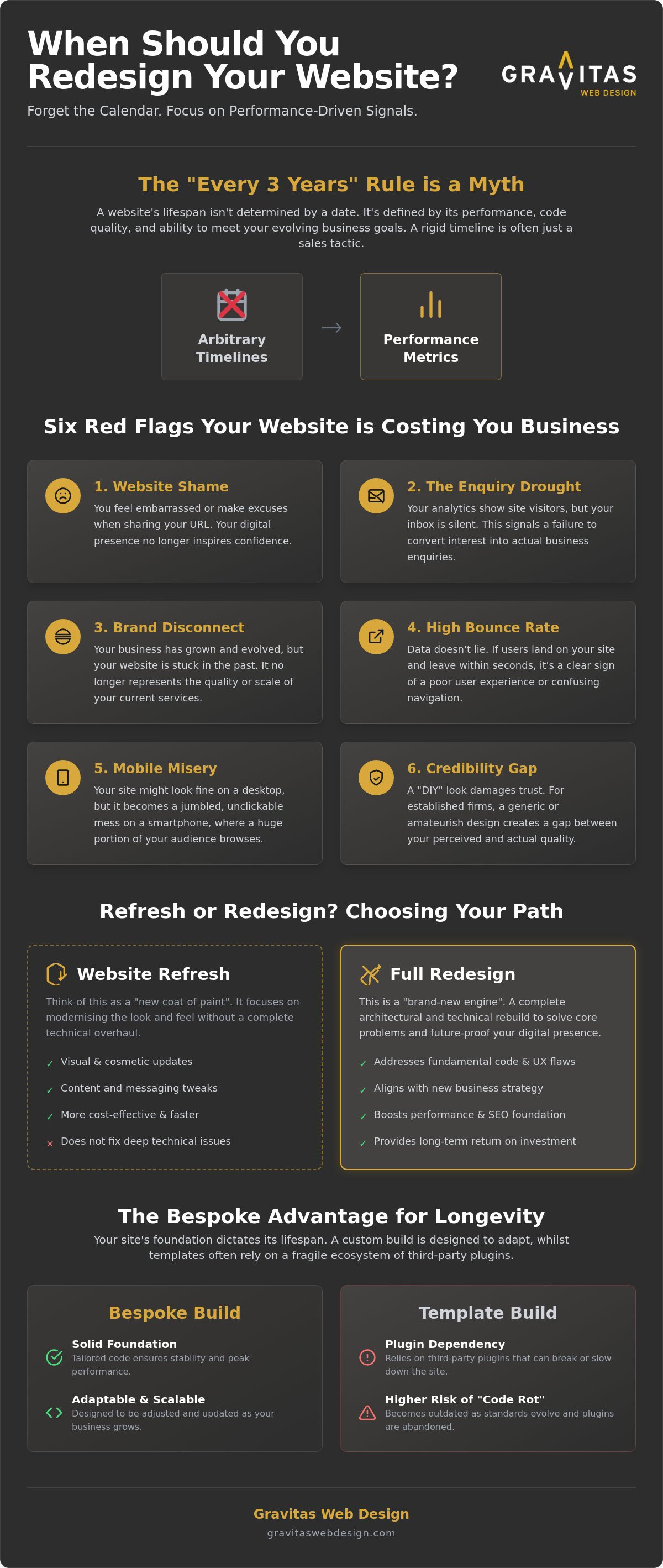
This is where the “bespoke vs template” debate really matters. Off-the-shelf templates are often held together by dozens of third-party plugins. It’s a recipe for what we call technical debt. Every time a plugin breaks or stops being supported, your site takes a hit. A bespoke build, however, is like a well-tailored suit. It’s designed to be adjusted. When you invest in a solid foundation, you can often perform incremental updates and refreshes rather than a total demolition. This approach naturally extends the answer to how often should a business redesign its website, often pushing that “must-do” date back by several years whilst keeping your professional pride intact.
Six Red Flags That Your Website is Quietly Driving Customers Away
Imagine you’re at a networking event. You’ve just hit it off with a brilliant prospect. They ask for your card, or worse, your URL. Do you feel a surge of pride, or do you find yourself apologising before they’ve even opened their mobile browser? This “website shame” is the first and most visceral red flag. If you’re embarrassed to show your digital home, your customers will feel that lack of confidence too. It’s often the most honest answer to how often should a business redesign its website; if you’ve outgrown the “skin” you’re in, it’s time for a change.
Then there’s the “Enquiry Drought”. It’s a baffling scenario where your analytics show plenty of visitors, but your inbox is as quiet as a library on a Sunday. This usually points to a massive brand disconnect. Perhaps you started as a one-man band but now lead a team of ten. If your business has evolved but your site is stuck in the past, high-end clients will simply bounce because they don’t see the version of you that exists today.
Speaking of bouncing, your data doesn’t lie. A high bounce rate is often a cry for help from your user experience (UX). If users are landing and leaving within seconds, they aren’t finding what they need. Often, this is down to “Mobile Misery”. We’ve all seen those sites that look lovely on a wide monitor but become a jumbled, unclickable mess on a smartphone. If you’re testing your site on a five-year-old laptop but your customers are using the latest iPhone, you’re missing the reality of their behaviour.
The Professional Credibility Gap
First impressions happen in less than a second. In that tiny window, a visitor decides if you’re a legitimate professional or a hobbyist. A “DIY” look might have served you well in the early days, but for established firms, it’s a silent killer. This is exactly why bespoke web design for Birmingham businesses has become the gold standard. It ensures your site reflects the actual quality of your service, rather than a generic template that thousands of others are using.
Technical Performance and Google’s Patience
Speed is the new currency. If your site takes more than a few seconds to load, you’ve likely lost that impatient London-based lead before they’ve even seen your logo. Broken links and “404” errors are the digital equivalent of a shopfront with a “Closed” sign hanging crookedly in the window. Worse still, an old site is a magnet for security vulnerabilities. It’s the technical reality behind the question of how often should a business redesign its website; sometimes, the “engine” simply can’t keep up with modern demands.
If any of these flags feel uncomfortably familiar, it might be worth exploring how a fresh approach could help you feel proud of your work again.
Redesign vs Refresh: Choosing the Most Cost-Effective Path
Think of your website like a classic British terrace house. Sometimes, it just needs a fresh coat of paint and some new curtains to feel like home again. Other times, the damp is so deep and the wiring so dodgy that you’ve got to gut the place to the studs. When people ask how often should a business redesign its website, they’re often terrified of the price tag attached to a total demolition. But here is a secret: you don’t always need to start from scratch.
To decide which path to take, you need to audit the “bones” of your site. If your current platform is fast, secure, and easy for you to update, but just looks a bit 2015, you’re in “refresh” territory. However, if you’re fighting against a restrictive system that won’t let you add the features you need, or if the underlying code is so tangled that making one change breaks three other things, you’re looking at a full redesign. It’s about distinguishing between a cosmetic issue and a structural failure.
When a Refresh is Enough
A refresh is your best friend when your business goals haven’t changed, but your style has. If you’ve had a minor brand tweak, you can often revitalise the whole feel of the site just by updating the imagery, colours, and fonts. It’s also the perfect time to look at your Copywriting. Rewriting your headlines to better reflect your current favourite services can do wonders for your conversion rates without touching a single line of complex code. You’re essentially polishing the glass rather than replacing the entire window.
When a Full Redesign is Mandatory
There are moments when a “tweak” is like putting a plaster on a broken leg. If you are currently feeling the squeeze of a restrictive template (like Wix or Squarespace) and your business is ready to scale, you’ve hit a technical ceiling. Knowing when to move from a template to a bespoke website is crucial for your long-term growth.
A full redesign becomes mandatory when you need to:
- Restructure your entire navigation to suit how customers actually behave.
- Integrate complex new features like e-commerce or advanced booking systems.
- Fix a foundation that is fundamentally slow or unsecure.
The beauty of Bespoke Web Design, particularly on a platform like WordPress, is that it’s built to be flexible. When we build from the ground up with a clean, custom foundation, it actually changes the answer to how often should a business redesign its website. Because the “bones” are solid, you can keep the engine running smoothly with regular Website Maintenance & Hosting, allowing for easier, cheaper refreshes for years to come. You avoid the “total overhaul” cycle because your site was built to evolve, not expire.
The Strategic Cost of Doing Nothing: ROI and Future-Proofing
Choosing to “wait another year” isn’t a neutral decision. It is a financial one. When business owners ask how often should a business redesign its website, they’re usually looking at the cost of the project itself. What they often miss is the “leaked revenue” draining out of their current, non-converting site every single day. If your digital presence is clunky, you aren’t just missing out on new leads; you’re actively paying a premium for the ones you do get.
Think about your Search Engine Optimisation (SEO) and PPC efforts. If you are driving traffic to a site that feels like a relic, your cost-per-lead sky-rockets. Google and other platforms notice when users land on your page and immediately flee. They’ll punish you with lower quality scores and higher ad costs. An outdated site is essentially a “tax” on your marketing budget. Conversely, a site that actually works acts like an extra member of your sales team, doing the heavy lifting and answering objections before you’ve even picked up the phone.
Maintenance as a Lifespan Extender
You wouldn’t buy a brand-new car and then never change the oil, would you? The same logic applies here. Regular upkeep is the single best way to delay a total overhaul. By investing in WordPress maintenance services Lichfield, you can keep the engine purring and security tight. This proactive approach prevents the “emergency redesign” that usually happens after a total site failure or a nasty security breach. It turns a potential crisis into a manageable monthly line item, pushing that big redesign date back by several years.
Investing in Bespoke for Better ROI
While templates might seem like a bargain, they often carry a hidden cost in lost conversions. Choosing bespoke web design Birmingham pays for itself because every pixel is aligned with your specific business goals. It allows you to build for scalability from day one. In the UK, a professional redesign can range from a few thousand pounds for a simple site to significantly more for complex builds. The real ROI, however, isn’t in the initial spend; it’s in the higher conversion rates and the future-proofing that comes from owning a site that can grow as you do.
If you’re tired of seeing your marketing budget vanish into a site that doesn’t deliver, it’s time to fix your digital leaks and start growing again.
Navigating Your Redesign: A Stress-Free Framework for Success
So, you’ve decided your site is indeed shouting “early internet” at every visitor. Now what? The question of how often should a business redesign its website is finally settled; the answer is “now”. But don’t panic. You don’t need a degree in computer science to get through this. You just need a plan that doesn’t involve pulling your hair out or speaking in binary. We believe in a straightforward path that gets you from “website shame” to digital pride without the unnecessary hoops.
- Step 1: Define your “Why”. Is this about a fresh look, a desperate need for more leads, or have you hit the technical limits of a cheap template? Knowing your goal prevents “scope creep” from eating your budget.
- Step 2: Audit your content. What stays? What goes? If you have a blog post from years ago about an office move that no longer matters, put it in the bin. Keep the gold, ditch the dross.
- Step 3: Choose your partner. Find a “friendly guide” amongst the jargon-heavy agencies. You need someone who explains how often should a business redesign its website in plain English, not someone who hides behind “synergistic paradigms”.
- Step 4: The Build. This is the heavy lifting. Ensure your partner has a rock-solid plan to protect your SEO rankings. A smooth transition involves careful redirects so you don’t lose the search visibility you’ve worked so hard for.
- Step 5: Launch and Beyond. Launch day is the start line, not the finish. A great site is a living thing that needs regular care to stay at peak performance.
The Content Conundrum
You can have the prettiest site in the UK, but if the words are dull or confusing, nobody is buying. Professional Copywriting is the secret ingredient that most businesses forget. It’s about more than just checking your spelling; it’s about organising your site structure to guide visitors naturally toward an enquiry. If you’re tired of a silent inbox, check out our guide on how to get more enquiries from my website. Your words should do the selling so you don’t have to.
Why a Local Partner Matters
There is a massive benefit to being able to sit down with your designer in Sutton Coldfield or London. UK markets have their own specific quirks and expectations. Cultural nuances in design matter for conversion; what works for a Silicon Valley startup might feel a bit “loud” for an established British firm. By choosing a local partner who prioritises radical transparency, you avoid the industry-standard awkwardness. You get a straight-talking partner who understands your local competition and cares about making you look like the leader in your field.
Stop Guessing and Start Growing Your Digital Presence
We’ve moved past the myth that you need to scrap everything every few years just because an arbitrary calendar says so. The real answer to how often should a business redesign its website lies in your data, your growth, and that sharp feeling of “website shame” we discussed earlier. Your digital presence should be your hardest-working employee, not a source of anxiety that leaks revenue and inflates your cost-per-lead. Whether you’re opting for a light visual refresh or a complete technical overhaul, the focus must stay on your specific business goals.
At Gravitas Web Design, we’ve been founder-led since 2019, offering a transparent and jargon-free process for UK service businesses. We don’t do corporate fluff or technical “smoke and mirrors”; we just build bespoke solutions that help you win trust in less than a second. It’s about creating a digital foundation that grows alongside you, backed by a partner who actually wants to see you feel proud of your work.
Ready to swap website shame for digital pride? Let’s chat about your bespoke redesign.
You’ve done the hard work of building a brilliant business. It’s finally time you had a website that looks like it.
Frequently Asked Questions
How much does a professional website redesign typically cost in the UK?
The cost depends entirely on the scale of your ambition and the complexity of your needs. A simple brochure site is a different beast compared to a high-functioning e-commerce platform with complex integrations. We focus on providing bespoke value rather than a “one size fits all” price tag, ensuring you invest in what actually moves the needle for your business.
Will a redesign hurt my existing Google rankings?
It shouldn’t, provided your partner knows their way around a 301 redirect. A professional redesign actually clears out the digital cobwebs that might be holding your SEO back. By improving speed and user behaviour, you’re more likely to see a ranking boost than a drop. We treat your existing authority with the respect it deserves whilst building a better platform for future growth.
How long does the average website redesign process take from start to finish?
Expect a timeline of roughly eight to twelve weeks for a bespoke build. This gives us enough time to get under the hood of your business, design something beautiful, and test it until it’s perfect. Rushing is for people who like fixing mistakes later; we prefer getting it right the first time so you can feel proud of the result immediately.
Can I redesign my website myself using a template like Wix or Squarespace?
You can, but it’s a bit like building a house on someone else’s land. DIY platforms are fine for a start, but they often lack the “bespoke” power required for scaling. When clients ask how often should a business redesign its website, the answer is often “the moment your DIY template starts feeling like a straitjacket.” Moving to a custom solution is a natural part of growing up as a brand.
What is the difference between a website refresh and a full redesign?
A refresh is a cosmetic tidy-up; a redesign is a structural rebuild. Think of a refresh as new curtains and a rug, whereas a redesign is knocking down a wall to create an open-plan kitchen. If your site functions well but looks a bit “last decade”, a refresh is your most cost-effective friend. If the foundation is crumbling, you need the full overhaul.
Do I need to change my hosting provider when I redesign my website?
You don’t have to, but it’s often a smart move to upgrade. If you’re investing in a high-performance site, putting it on cheap, slow hosting is like putting budget supermarket petrol into a Ferrari. We usually recommend hosting that is specifically optimised for WordPress to keep things snappy and secure, protecting your new investment from day one.
How do I know if my website is “mobile-friendly” enough for standards?
Check your site on a variety of modern handsets and look for “thumb-friendly” navigation. If your text is too small to read without squinting or your buttons require surgical precision to click, you aren’t mobile-friendly. Google now prioritises the mobile version of your site for its rankings, so “good enough” isn’t an option anymore. It has to be seamless.
Should I rewrite all my website content during a redesign?
You should at least audit everything. Your business has likely evolved, and your content needs to reflect who you are today, not who you were three years ago. Professional Copywriting ensures your new site doesn’t just look the part but actually speaks to your customers’ current pains and desires. It’s the difference between a pretty brochure and a high-converting sales tool.