
Web Design Blog
How Much Does a Logo Cost in the UK? The Honest Guide to Branding Budgets
Last Tuesday, a local founder realised their “budget” logo was actually a piece of generic stock art used by three other businesses in the same town. It’s a total gut-punch that leaves you feeling more like a counterfeit than a contender. If you’ve been searching for how much does a logo cost in the UK 2026, you’ve probably noticed the pricing is all over the shop. One platform quotes you the price of a fancy sandwich, whilst a high-end studio wants the equivalent of a small hatchback. It’s confusing, frustrating, and frankly, a bit exhausting.
We get it. There’s a real fear of being ripped off or, worse, looking unprofessional to your best clients. You want a visual identity that makes you feel a surge of pride, not one that makes you want to hide your business cards. This guide is our radically honest attempt to pull back the curtain on branding budgets. We’ll walk you through exactly what different price points deliver, from budget freelancers to bespoke agencies. You’ll gain the clarity needed to choose a partner that aligns with your goals, ensuring you end up with a brand you’re actually excited to show off.
Key Takeaways
- Understand why UK branding prices vary so wildly, from the cost of a daily coffee to the price of a luxury car, and what you actually get for your money.
- Learn how to avoid the “rebrand tax” and why a generic, bargain-bin logo can actually drive your best customers straight to the competition.
- Discover the truth behind how much does a logo cost in the UK 2026 by exploring the invisible strategy work that makes a brand truly successful.
- See why a logo is just the beginning and how a cohesive visual identity secures a far better return on your investment than a standalone graphic.
- Identify how to find a design partner who prioritises radical transparency and honest, human-to-human connection over corporate jargon.
Understanding the Landscape of Logo Design Costs in the UK
Pricing for creative work in Britain is about as predictable as a summer bank holiday. You can find someone to scribble a doodle for the price of a posh coffee, or you can hire a global firm that charges more than a three-bed semi in the Midlands. It’s a massive gap, and it’s enough to give any business owner a bit of a headache. When people ask how much does a logo cost in the UK 2026, they often expect a single, tidy number. The reality is that you aren’t paying for a designer’s time; you are paying for their experience and their ability to understand what a logo is in the context of your specific industry.
Your business stage dictates your investment. A side-hustle startup operating from a kitchen table doesn’t need the same financial commitment as an established firm in Birmingham city centre looking to dominate a new market. The “market rate” is largely a myth because every project carries a different level of risk. If your brand identity fails to connect with your audience, what do you lose? If the answer is “potentially everything”, then a bargain-bin logo is a gamble you probably shouldn’t take.
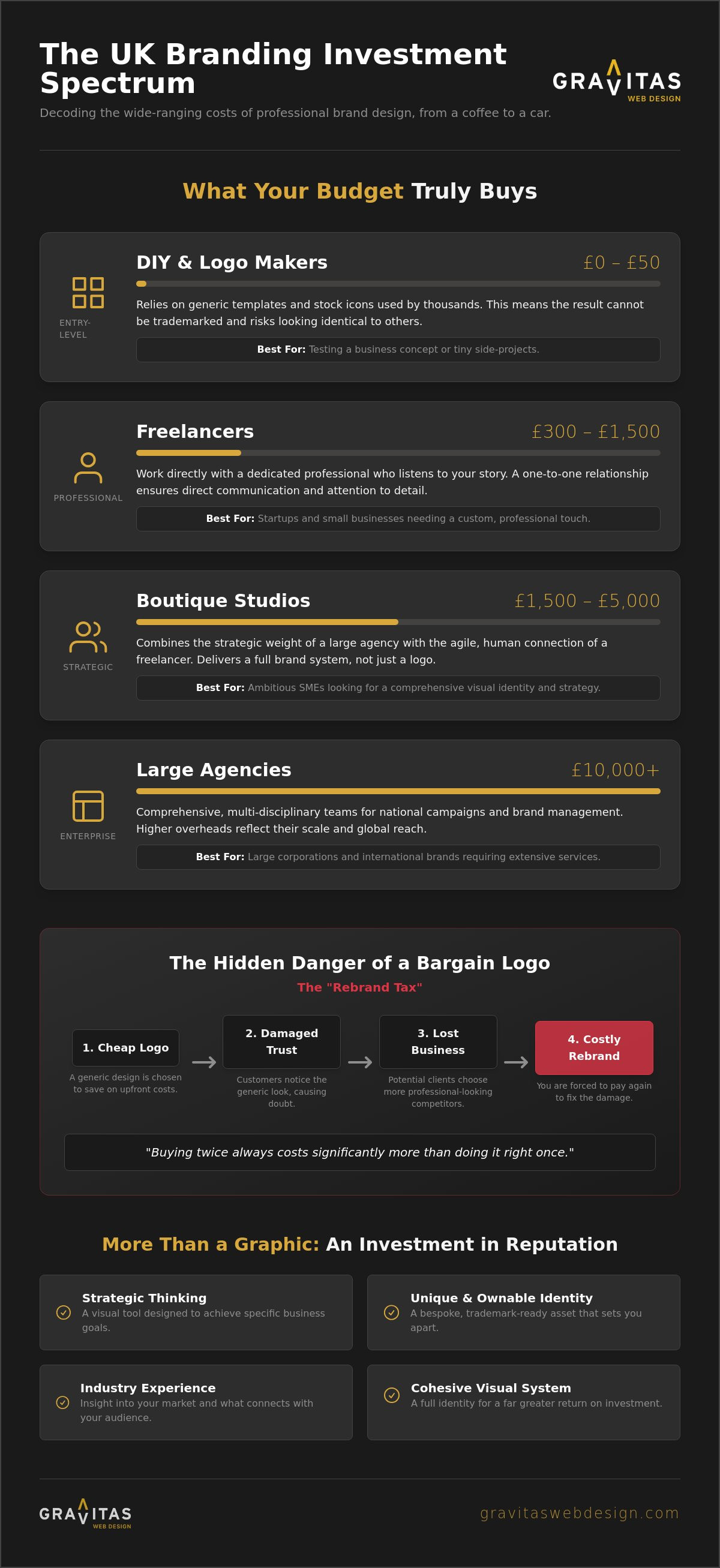
Geography plays a sneaky role too. A firm based in Mayfair has overheads that a studio in Sutton Coldfield simply doesn’t. You’ll often find that boutique studios outside of London offer the same level of strategic punch without the “capital city” surcharge. Below is a quick breakdown of what the UK market generally looks like right now.
| Provider Type | Typical Cost | Best For |
|---|---|---|
| DIY / Logo Makers | £0 – £50 | Testing a concept or tiny side-projects. |
| Freelancers | £300 – £1,500 | Startups and small businesses needing a pro touch. |
| Boutique Studios | £1,500 – £5,000 | SMEs wanting a full identity and strategy. |
| Large Agencies | £10,000+ | Large corporations and international brands. |
The Entry-Level: DIY Tools and Budget Marketplaces
The allure of a logo for the price of a takeaway is strong, but “free” is often the most expensive option you’ll ever choose. Logo generators and template platforms like Canva are brilliant for social media posts, but they rely on icons used by thousands of other people. If you use a generic mark, you can’t trademark it, and you certainly won’t stand out. Crowdsourcing sites often result in designers rushing through dozens of concepts a day just to make a living, which means your business gets zero original thought.
The Professional Middle Ground: Freelancers and Small Studios
This is where most UK businesses find their sweet spot. When you invest between £300 and £1,500, you are usually working with a dedicated professional who actually listens to your story. You get a one-to-one relationship and direct communication, which is vital for getting the details right. Boutique studios, especially those nestled in places like Sutton Coldfield, bridge the gap perfectly. They offer the strategic weight of a big agency but maintain the agile, human-to-human connection that makes the creative process actually enjoyable. It’s about getting a result that makes you feel proud without the corporate stiffness.
Ultimately, when you weigh up how much does a logo cost in the UK 2026, remember that you are buying a tool for your reputation. A well-designed identity works for you whilst you sleep, building trust before you’ve even spoken to a potential client.
The True Cost of Cheap Logos: Why Bargain Branding Can Backfire
Imagine spending fifty quid on a logo and feeling like you’ve bagged the deal of the century. You’ve got a shiny new graphic, and you’ve saved hundreds of pounds. But six months later, you notice a competitor with a suspiciously similar icon, or worse, your best customers start asking if you’ve “gone budget.” This is the “rebrand tax” in action. When you’re crunching the numbers on how much does a logo cost in the UK 2026, it’s easy to get tunnel vision on the upfront price tag. However, buying twice always costs significantly more than doing it right once. You aren’t just paying for a new design later; you’re paying to strip away an old, ineffective identity that has already done damage to your reputation.
There’s a common myth that “any logo is better than no logo.” It’s simply not true. A generic, poorly executed visual identity actively drives potential customers toward your competitors. It’s a psychological trigger. Your visual identity either screams “amateur” or “authority.” If your branding looks like a rushed afterthought, clients will assume your service is too. You want to look like a business that is here to stay, not one that is just testing the waters with a template. If you’re ready to move past the template phase, you might want to chat with us about a professional identity that actually reflects your worth.
The Legal Minefield of Template Logos
Cheap logos from budget marketplaces often rely on stock icons or recycled templates. This is a legal ticking bomb. If your designer used a “free” icon from a public library, you likely don’t own the intellectual property. Someone else could use the exact same mark for a completely different business, and you’d have no legal leg to stand on. Even worse is the nightmare scenario of receiving a cease and desist letter after you’ve already paid for signage, uniforms, and vehicle wraps. The cost of a legal battle or a forced overnight rebrand makes a professional fee look like pocket change.
Technical Failures and the Scalability Test
A logo that looks “okay” on a tiny smartphone screen can fall apart when it’s scaled up. Professional designers work with vector files, which allow your branding to stay crisp whether it’s on a business card or a massive Birmingham billboard. Cheap services often provide flat JPEGs that become blurry and pixelated the moment you try to use them for anything substantial. Poor colour choices are another hidden cost. If your designer doesn’t understand colour profiles for print, you could end up with unreadable signage or expensive print runs that look nothing like the version on your screen. Professionalism is in the details you can’t see until they go wrong.
Breaking Down the Professional Process: What You Actually Pay For
Think of professional branding like an iceberg. What you see on your website or business card is just the tip. About 80% of the work is the heavy lifting that happens beneath the water. When you’re trying to figure out how much does a logo cost in the UK 2026, you’re really paying for the research, the strategy, and the expertise that prevents your brand from sinking. A bespoke project doesn’t start with a sketchbook; it starts with a coffee and a deep dive into your business. We need to know who you are, who your competitors are, and exactly where you want to be in five years. It’s a partnership, not a simple transaction.
A professional logo isn’t just a “pretty picture” to fill a gap on your letterhead. It’s a strategic tool designed to increase your bottom line. If a graphic looks lovely but fails to resonate with your ideal client, it’s a wasted investment. This is why professional logo design London is often viewed as a secret sales weapon for growing firms. It’s about creating an immediate, visceral sense of trust. This process requires feedback loops and revision rounds to polish the concept. These aren’t just minor adjustments; they are the essential steps that turn a good idea into a powerful, profitable identity.
Market Research and Competitor Analysis
Designers don’t just follow their gut; they follow the data. We study your industry to ensure you stand out amongst the noise of your competitors. We analyse the visual behaviour of your target audience, whether they are strolling through Lichfield or commuting in London. What makes them click? What makes them walk away? By identifying “visual gaps” in the market, we can design an identity that exploits those weaknesses in your competition. It ensures you aren’t just another copycat, but the obvious choice for your clients.
Typography, Colour Theory, and Psychology
It’s a hard pill to swallow, but your favourite colour might be a disaster for your business. If you’re a fan of relaxing greens but you’re trying to sell high-energy fitness coaching, there’s a disconnect. Colour theory is deeply rooted in psychology and influences how people feel about your brand before they’ve even read your name. Typography works the same way. A specific font can scream “modern innovator” or whisper “reliable authority.” A professional creates a system that remains consistent across digital screens and physical touchpoints, ensuring your brand never looks out of place.
Logo vs Brand Identity: Why the Difference Impacts Your ROI
Buying a logo without considering your wider brand identity is a bit like buying a designer front door for a house that hasn’t been built yet. It looks lovely, but it doesn’t provide much shelter. When you are digging into how much does a logo cost in the UK 2026, you are often actually looking for the price of a professional reputation. A logo is just one ingredient; your brand identity is the whole recipe. It includes your typography, your colour palette, your photography style, and even your tone of voice. When these elements work together, they create a “vibe” that tells customers you are the real deal before they’ve even read your first paragraph.
A great logo on a terrible, clunky website is a wasted investment. It creates a “trust gap” where your visual promise doesn’t match the user experience. If you want to know how to get more enquiries from my website, the answer usually lies in consistency. When your branding is cohesive, every marketing effort becomes easier and cheaper. You aren’t constantly reinventing the wheel; you are simply applying a proven system that already works. This consistency builds the kind of professional gravity that pulls clients toward you rather than your competitors.
Consistency Across Your Digital Presence
Your brand needs to feel the same whether a client is scrolling through your LinkedIn profile, browsing your website, or holding your business card. This is where brand guidelines come in. Think of them as the rulebook for your visual identity. They ensure your colours are always the right shade and your fonts never look like an accidental mess. As you scale, you need a flexible system that grows with you, not just a static image file that breaks the moment you try to use it on a new platform.
When to Move from a Simple Logo to a Full Brand
There comes a point in every successful business where “startup mode” branding starts to feel a bit tight. If you find yourself making excuses for your visuals or feeling a twinge of embarrassment when sending a link to a high-end lead, it’s time to level up. Transitioning to a full, bespoke identity marks your arrival as an established authority in your field. If you’re wondering when to move from a template to a bespoke website, the answer is usually “yesterday.” Your digital presence should be your hardest-working employee, not a hurdle you have to jump over.
Ready to stop blending in and start standing out with an identity you’re actually proud of? Let’s build something brilliant together.
Investing in Your Reputation: The Gravitas Approach to Branding
We don’t believe in stuffy boardroom presentations or hiding behind a wall of corporate jargon. When you work with us, you’re working with people who actually care about your success. It’s a human-to-human thing. We know that the question of how much does a logo cost in the UK 2026 is often tied to a bigger anxiety; will this investment actually help my business grow? We prioritise radical transparency because we’ve seen too many business owners get burned by vague quotes and hidden fees. Our approach is built on honesty, ensuring you know exactly what’s happening at every stage of the creative journey.
Branding isn’t an island. A beautiful logo is only as strong as the platform it sits on. That’s why we integrate our branding work seamlessly with bespoke web design. We want your customer’s journey to feel effortless, from the first time they see your mark to the moment they click “get in touch.” The Gravitas promise is simple; no hoops to jump through, no industry-standard awkwardness, just results you can be genuinely proud of. We want you to feel that surge of professional confidence every time you hand over a business card or share your website link.
A Transparent Process Built on Trust
Our process starts with a “get to know you” session that feels more like a chat over coffee than a formal interrogation. We dive deep into your story to ensure the final design feels like “you,” not some generic version of your industry. Feedback isn’t something we shy away from; it’s the fuel that makes the final result perfect. We aren’t interested in one-off transactions. We focus on long-term partnerships where we can help your brand evolve as your business reaches new heights. You’re never just a project number to us.
Ready to Elevate Your Business Identity?
Starting the conversation about your new look is the easiest part of your week. We offer an end-to-end solution that goes far beyond just pretty pictures. By combining your new visual identity with strategic SEO and professional copywriting, we ensure your business is found by the right people and says the right things when they arrive. It’s time to stop being your industry’s best kept secret. You’ve worked hard to build a great business; let’s make sure your branding reflects that hard work. When you’re ready to move from “making do” to “making an impact,” we’re here to lead the way.
Ready to Stop Blending In?
You’ve seen that the answer to how much does a logo cost in the UK 2026 isn’t just a single figure on a spreadsheet. It’s about the value of your reputation and avoiding that dreaded “rebrand tax” by doing it properly the first time. Whether you’re a startup in London or an established firm in Birmingham, your visual identity should work as hard as you do. A professional design process turns a simple graphic into a strategic asset that actually drives enquiries and builds trust.
At Gravitas, we strip away the industry-standard awkwardness with transparent, jargon-free pricing. We offer an end-to-end service that bridges the gap between beautiful branding and bespoke web development. There are no hoops or corporate stiffness here. We are just a dedicated partner focused on your growth. Let’s build a brand you’re actually proud of; contact Gravitas Web Design today. Your business is far too good to remain a “best kept secret.” Let’s give it the authority it deserves.
Frequently Asked Questions
Is it worth paying for a logo when I am just starting out?
It depends on your long-term goals, but generally, yes. Starting with a professional look prevents you from being your industry’s best kept secret from day one. If you look like a hobbyist, potential clients will treat you like one. Investing early means you don’t have to pay the “rebrand tax” later when your business takes off and you need to look like a credible authority.
How long does the professional logo design process typically take in the UK?
A bespoke project typically takes between two and six weeks from start to finish. This isn’t just about drawing; it includes the “Iceberg Effect” of research, strategy, and feedback loops. A rushed job usually leads to a generic result that you’ll want to change within months. Taking the time to get the strategy right ensures your visual identity is a long-term business tool.
Will I own the full copyright to my logo once it is finished?
You should always own the full intellectual property once the final invoice is settled. Reputable UK designers will include a transfer of copyright in their contract as standard. This is a massive risk with budget template sites where you might only be “licensing” a generic icon that hundreds of others are using. Always check the terms to ensure you aren’t walking into a legal minefield.
What file formats should I expect to receive from a professional designer?
You should receive a full suite of files including vector formats like SVG, AI, or EPS for high-quality printing. You’ll also need raster files like PNG and JPEG for digital use. A professional package should include different colour variations; full colour, black, and white; to ensure your brand works across every background. If you only get a single JPEG, you’ve been short-changed.
Can a new logo really help me get more enquiries?
It certainly can, especially when integrated with a bespoke website. People buy from businesses they trust, and a professional identity closes the gap between your actual expertise and a potential client’s first impression. When you’re researching how much does a logo cost in the UK 2026, remember that a high-quality mark acts as a silent salesperson, making every marketing effort more effective and professional.
What is the difference between a logo and a brand identity?
Think of your logo as the primary mark of your business, whilst a brand identity is the complete visual system. An identity includes your colour palette, typography, tone of voice, and photography style. Whilst a logo is a single graphic, the identity ensures that everything from your LinkedIn profile to your business cards feels consistent and organised. It’s the difference between an ingredient and the whole recipe.
Do I need a separate logo for my social media profiles?
You don’t need a different logo, but you definitely need variations that fit square or circular profile slots. A professional designer will provide a simplified “stacked” or icon-only version of your mark. This ensures your branding stays legible on a tiny smartphone screen. Using your full, horizontal logo in a tiny circle usually results in a messy, unreadable blob that looks amateur.
Should I choose a local UK designer or an overseas freelancer?
Choosing a local UK designer often leads to a smoother, human-to-human experience. They understand the cultural nuances and consumer behaviour of your specific market, whether that’s in Birmingham or London. Whilst overseas freelancers might be cheaper, you often lose out on the strategic depth and direct communication needed for a bespoke result. Plus, being in the same time zone makes feedback sessions easier to organise.