
Web Design Blog
Why Is My Website Not Converting Visitors? The Candid Guide to Fixing Ghost Traffic
Imagine the scene: you’ve spent months obsessing over your rankings, your traffic numbers are finally climbing, and yet your inbox remains as quiet as a library on a Sunday morning. It’s a bit of a kick in the teeth, isn’t it? You are likely pulling your hair out wondering why is my website not converting visitors when everything seems “fine” on the surface. We know that feeling of digital embarrassment all too well; that cringey moment when you have to send a prospect to a site that feels a bit clunky. It’s like your online presence is wearing a tatty tracksuit whilst you’re trying to sell a premium, bespoke service.
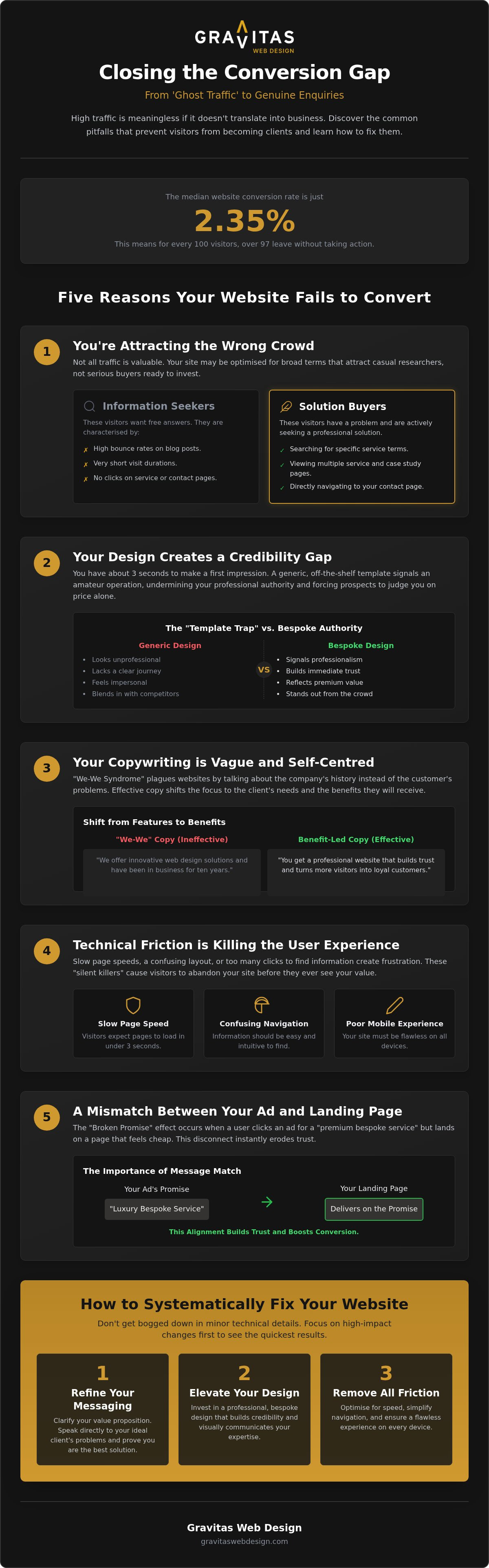
We agree that “ghost traffic” is a soul-crushing waste of potential, especially when the median conversion rate is just 2.35 per cent. This guide is your candid roadmap to closing that credibility gap. You will discover exactly why your visitors are ghosting you and learn the steps to transform your site into a lead-generation powerhouse that actually reflects your expert status. We are going to strip away the jargon to diagnose your conversion problem and provide a clear, friction-free path to turning casual browsers into serious enquiries.
Key Takeaways
- Identify the critical difference between “information seekers” and “solution buyers” to stop chasing empty hits and start attracting genuine enquiries.
- Understand why relying on generic templates creates a credibility gap and how bespoke design signals the professional authority your business deserves.
- Master the shift from “We-We Syndrome” to benefit-led copywriting that speaks directly to your customer’s needs instead of just your own company history.
- Pinpoint the technical friction and speed delays that explain why is my website not converting visitors even when your traffic numbers seem healthy.
- Learn how to prioritise your website fixes by focusing on high-ROI messaging changes rather than getting bogged down in minor technical jargon.
The Frustration of ‘Ghost Traffic’: Why High Hits Don’t Always Equal High Enquiries
Ever opened your analytics and felt a brief rush of pride at a climbing graph, only to check your inbox and find… nothing? Just a few spam emails and a newsletter you definitely don’t remember signing up for. We call this “Ghost Traffic”. It is that maddening phenomenon where your site looks busy on paper, but your phone remains stubbornly silent. You are likely left scratching your head, wondering why is my website not converting visitors when the “numbers” suggest you are doing everything right.
It is a bit like trying to fill a bucket with a massive hole in the bottom. You can turn the tap (your SEO or ads) on as high as you like, but if the bucket is leaky, you are just making a mess on the floor. This “leaky bucket” syndrome does more than just waste your marketing budget; it creates a genuine sense of digital anxiety. It is hard to feel like a top-tier professional in London or Birmingham when your website makes you feel like an amateur. To stop the leak, you need a systematic process of increasing the percentage of visitors who actually take action.
Are You Attracting Researchers or Buyers?
Not all traffic is created equal, and this is often where the disconnect begins. Your site might be ranking for broad, generic keywords that attract “Information Seekers”—people who want a free answer or a quick tip. Whilst it’s great for your ego to see hits on a blog post about “what is branding”, those visitors aren’t necessarily “Solution Buyers” ready to hire a firm. If you are a business in Sutton Coldfield or Lichfield, ranking for “bespoke web design” is infinitely more valuable than ranking for “how to make a logo for free”. Generic terms bring a crowd; specific, high-intent terms bring the clients. You can spot this low-intent traffic in your data by looking for:
- High bounce rates on your most popular “advice” pages.
- Very short session durations (people find their answer and bolt).
- A total lack of clicks on your “Contact” or “Service” pages.
The Mismatch Between Your Ads and Your Landing Page
Then there is the “Broken Promise” effect. Imagine clicking an ad that promises a “luxury, bespoke service” only to land on a page that looks like a cluttered, outdated template. The trust evaporates in milliseconds. If the visual “vibe” or the tone of voice shifts between your social media and your homepage, visitors feel an instinctive sense of friction. Message Match is the alignment between an ad’s promise and a page’s content. When this alignment is off, you aren’t just losing a lead; you’re paying for the privilege of confusing a potential client. Ensuring your landing page delivers exactly what your marketing promised is the first step to turning that ghost traffic into a warm enquiry.
The Credibility Gap: Why Your Professional Image Might Be Quietly Costing You Clients
You have exactly three seconds to prove you aren’t a “cowboy” operation. That’s it. In the time it takes to take a single breath, a visitor has already subconsciously decided if you are a serious player or just someone with a laptop and a dream. If you are constantly wondering why is my website not converting visitors, the answer might be staring you in the face. It’s often a case of your digital suit simply not fitting your professional stature.
The “Template Trap” is a silent killer for firms in Birmingham and London trying to stand out in a crowded market. Off-the-shelf designs feel impersonal because they are designed to fit everyone, which means they truly fit no one. They lack the soul, the “gravitas”, and the specific authority that bespoke design provides. When you look exactly like your cheapest competitor, you force prospects to judge you on price alone rather than the premium value you actually deliver. Credibility isn’t just about pretty pictures; it is about the ease of the journey. By slashing the number of steps a user takes to find what they need, you demonstrate a professional respect for their time that builds immediate trust.
Design Cues That Signal Trust and Authority
High-end web design relies on “breathing room” or white space to let your message land. Cluttered sites scream desperation, whilst clean, intentional layouts signal confidence. Your visual identity needs to be rock solid across every touchpoint. This is why professional logo design in London is so critical; it acts as a shorthand for your entire brand’s reliability. Avoid the temptation of generic stock images of people shaking hands in glass offices. Real, high-quality photography of your actual team or your local Birmingham premises creates a human-to-human connection that a polished template can never replicate.
Social Proof: More Than Just a Few Stars
Most businesses slap a few five-star reviews at the bottom of a page and call it a day. To bridge the credibility gap, you need to go deeper. Detailed, local case studies that name-drop London districts or Birmingham landmarks prove you are an active, trusted member of the community. Displaying the logos of professional bodies or industry awards acts as a digital “seal of approval”. It tells the visitor that other experts have already vetted you, so they don’t have to take a gamble. If you want to see how your current site measures up against these professional standards, it might be time for a bespoke web design consultation to identify where your image is leaking leads.
Words That Work: How Vague Copywriting Is Killing Your Conversion Rate
Ever been stuck at a dinner party with someone who only talks about themselves? “We’ve been established for twenty years. We pride ourselves on our core values. We, we, we.” It’s exhausting, isn’t it? Many business websites suffer from this exact “We-We Syndrome”. If you are currently staring at your analytics and wondering why is my website not converting visitors, it’s highly likely your copy is acting as a digital sedative rather than a sales tool. Your visitors don’t actually care about your history; they care about their own problems and whether you can fix them.
The fastest way to lose a modern audience is to hide behind a wall of “Corporate-Speak”. Phrases like “leveraging synergistic solutions” or “delivering excellence” are essentially invisible; they are so overused that the human brain just skips right over them. To truly connect, you need to swap features for benefits. If you are targeting a customer in Lichfield, they don’t just want a “responsive website” (a feature). They want a “site that works perfectly whilst they are out on a job site” (a benefit). You have to answer the “So What?” for every single claim you make. Good copy is a core part of the user experience; in fact, according to Forbes, research suggests that a superior user experience can boost conversion rates by as much as 400 per cent.
Speaking Your Customer’s Language (Whilst Avoiding Jargon)
Your website should feel like a mirror. When a prospect lands on your page, they should see their own internal monologue reflected back at them. Use the exact words they use when they are stressed out at 10:00 PM looking for a solution. This human-to-human connection is what separates a sterile brochure from a lead-generation machine. This is exactly why professional copywriting is the bridge between a casual browser and a committed lead. It identifies the invisible barriers and objections your customers are secretly thinking but not saying, and it dismantles them before they can click away.
The Missing Call to Action (CTA)
Sometimes the problem is remarkably simple: you haven’t told them what to do next. A vague “Contact Us” button is often the weakest link in your chain. It’s a big, scary commitment for someone who has only just met you. Instead, try creating low-friction “Micro-Conversions”. Think “Download our Pricing Guide” or “Book a 15-minute Discovery Call”. These feel much safer. Placement matters too; don’t make people hunt for a way to hire you. Scatter your CTAs naturally throughout the page, ensuring there is always a clear “next step” visible as they scroll. If you make them work to find your contact details, they simply won’t bother.
Technical Friction: The Silent Killers of User Experience and Performance
Imagine walking up to a high-end shop in Mayfair, reaching for the handle, and finding the door is stuck. You tug again. Nothing. You would walk away in seconds, wouldn’t you? Technical friction is the digital equivalent of that jammed door. You might be losing sleep over why is my website not converting visitors, but the answer could be as simple as a site that is just too clunky to use. If your pages take more than a heartbeat to load, you are already behind. In fact, even a tiny 1-second delay in page response can result in a 7 per cent reduction in conversions. In the fast-paced world of London business, nobody has time to wait for a spinning loading icon.
Broken links and 404 errors are another silent killer. They signal to your visitor that you have stopped paying attention to the details. If your digital “shop floor” is messy, prospects will assume your service is too. Then there is the nightmare of poor navigation. If a potential client has to play detective just to find your pricing or service list, they will simply find a competitor who makes it easier. According to Google research, a 1-second improvement in mobile load time can increase conversions by up to 20 per cent, proving that speed is not just a luxury; it is a fundamental sales requirement.
The Mobile Experience for Busy Professionals
Most of your clients are likely checking your site whilst on the move. Is your site a joy to use on a phone, or is it a total chore? Mobile traffic now accounts for roughly 65 per cent of all website traffic, yet mobile conversion rates are often 42 per cent lower than desktop. This is usually down to poor “thumb-friendly” design. If your buttons are too small to click or your forms require 12 fields of data entry on a tiny screen, you are practically begging people to leave. Stop relying on desktop simulators; pick up an actual smartphone and try to book your own service. If it feels frustrating for you, it is a disaster for your leads.
Performance and Security as Trust Builders
Nothing kills a conversion faster than a “Not Secure” warning flashing in a browser bar. It is the digital version of a “Beware of the Dog” sign on a business premises. Security isn’t just a technical box to tick; it is a foundational part of your professional image. This is where consistent WordPress maintenance becomes your best friend. It is not just about security patches; it is about keeping the engine tuned so your site remains fast whilst your competitors’ sites start to lag under the weight of unoptimised plugins. Premium hosting acts as the high-speed rail for your content, ensuring a smooth journey from the first click to the final enquiry. If your technical performance is currently holding you back, it is time to get your site back on track with a professional audit.
Turning the Tide: How to Systematically Fix Your Website’s Conversion Issues
By now, you likely have a pretty good idea of why is my website not converting visitors. It is rarely just one thing; it is usually a combination of that credibility gap, vague messaging, and those annoying technical gremlins we have already unmasked. But knowing the problem is only half the battle. Now comes the part where we actually roll up our sleeves and turn your digital “ghost town” into a bustling lead-generation powerhouse. This isn’t about giving your site a superficial facelift; it is about a fundamental shift in how your business exists online.
The first step is to stop the guesswork. Look at your data with fresh, slightly cynical eyes. We often find that business owners are too close to their own work to see the obvious friction points. Prioritise your fixes based on impact. Whilst it’s tempting to spend three days arguing over the exact shade of blue for your header, your messaging and user journey will almost always provide a better return on investment. Bespoke design allows for a unique “conversion architecture” that templates cannot match, ensuring every pixel serves a specific purpose in your sales process.
Conducting a Conversion-Focused Content Audit
Start by identifying your “Top Exit Pages” in your analytics. If people are consistently bailing on your “Services” page, that is a massive red flag that your value proposition isn’t landing. We love using heatmapping tools to see where your Sutton Coldfield or London visitors are actually clicking, or more importantly, where they are getting stuck. Review your site against the credibility checklist: do you have real photos? Are your case studies detailed? If your site still feels like a generic online brochure, it’s time to evolve it into a tool that actually closes deals.
The Case for Bespoke Web Design
Many developers take a “one-and-done” approach, handing over the keys and disappearing into the night. This is why a professional partnership is so much more valuable than a simple transaction. Choosing bespoke web design is an investment in your business’s future, not just a cost to be minimised. It allows you to tailor the entire user journey to your specific sales cycle, guiding prospects from that first curious click to a confirmed enquiry with zero friction. When your website finally reflects your actual professional status, you won’t just see more enquiries; you will feel a genuine sense of pride every time you send a link to a high-value prospect.
Stop Ghosting Your Growth and Start Converting
You have unmasked the “ghosts” in your analytics and seen how a clunky mobile experience or vague “corporate-speak” acts as a digital repellent. Bridging the credibility gap requires more than just a fresh coat of paint; it requires a strategic alignment of design, copy, and technical performance. By now, you should have a much clearer picture of why is my website not converting visitors and, more importantly, the exact steps needed to fix it.
Our expert UK-based team in Birmingham and London specialises in creating bespoke designs tailored for high-end service firms. We ditch the tired templates and the technical jargon in favour of a transparent, human-to-human process that actually delivers results. You’ve worked too hard to build your professional reputation to let an outdated website hold you back. It is time to transform your digital presence into the lead-generation powerhouse your business deserves.
Book your bespoke website conversion audit with Gravitas today and let’s turn those silent visitors into your next big win. You deserve a website that reflects your true professional status.
Frequently Asked Questions
What is a good conversion rate for a service-based business website?
A healthy conversion rate for professional services typically sits around 6.1 per cent. However, the top 10 per cent of websites often convert at 11.45 per cent or higher. If your current rate is well below the 5 per cent mark, it’s a clear sign that your messaging or user experience needs a rethink to better align with your audience’s expectations and professional standards.
Can I fix my conversion rate without a full website redesign?
Yes, you can often make significant gains by tweaking your copywriting and fixing technical friction points. Improving your site speed or rewriting your headlines to focus on customer benefits rather than company features can work wonders. However, if your current site is built on a clunky, outdated template, a bespoke redesign might be the only way to truly bridge that credibility gap and secure high-value enquiries.
How do I know if my website traffic is ‘low quality’?
Low-quality traffic is usually identified by high bounce rates and very short session durations on your most important pages. If people are landing on your blog posts but never clicking through to your service pages, you’re likely attracting “Information Seekers” rather than “Solution Buyers”. This mismatch is a primary reason why is my website not converting visitors who seem interested but never actually get in touch.
Why is my bounce rate so high on my homepage?
A high homepage bounce rate usually stems from a “Broken Promise” or a confusing layout. If your marketing promises a premium service but your site looks amateur or takes too long to load, visitors will bail instantly. You have about three seconds to prove your authority; if your homepage doesn’t immediately answer what you do and who you do it for, people will find a competitor who does.
Does my website’s loading speed really affect how many enquiries I get?
Speed is a massive factor in lead generation; even a 1-second delay can drop conversions by 7 per cent. Busy professionals in London or Birmingham won’t hang around for a slow site to load. Improving your mobile speed by just one second can increase your conversion rate by up to 20 per cent, making technical performance one of the most effective ways to stop losing potential clients.
What are the most common conversion killers on professional websites?
The biggest culprits are vague “Corporate-Speak”, a lack of clear calls to action, and “We-We Syndrome”. When you talk too much about yourself and not enough about your client’s problems, they lose interest. Other silent killers include “Not Secure” browser warnings, hidden contact details, and generic stock photography that makes your firm look like an impersonal template rather than a bespoke service provider.
How often should I update my website’s copy and design?
You should review your copy every few months to ensure it still mirrors your customers’ internal monologue. Design trends and technical standards move quickly, so a full refresh is usually wise every two to three years. Regular maintenance is also essential to prevent broken links and security issues from quietly sabotaging your reputation. Keeping your site fresh ensures it always reflects your actual professional status.
Will improving my SEO help increase my conversion rate?
SEO brings people to the door, but it’s your website’s job to let them in. Whilst better SEO increases your traffic, it won’t fix the underlying reasons why is my website not converting visitors once they arrive. However, focusing on high-intent, service-specific keywords rather than generic terms ensures the traffic you do get is far more likely to turn into a genuine enquiry for your business.