
Web Design Blog
The Human Connection: Exploring the Real Impact of Branding on Customer Loyalty
Why do customers keep flocking to that cheaper, slightly mediocre competitor down the road when your work is clearly superior? It feels a bit like shouting into a void, doesn’t it? You have likely spent years perfecting your craft, yet you are still battling high churn rates and feeling invisible in an overcrowded market. It is genuinely frustrating to watch potential clients overlook your brilliance simply because your digital presence does not quite reflect your professional standards.
We can all agree that being the best-kept secret in your industry is a one-way ticket to burnout. This is where understanding the true impact of branding on customer loyalty changes the game entirely. We are going to show you how strategic branding moves your business beyond forgettable, one-off sales to create a tribe of loyal superfans. You will learn how to build a brand that acts as “digital gravity,” allowing you to command premium prices whilst your favourite customers start doing the marketing for you. It is time to stop being a vendor and start being a brand people actually care about.
Key Takeaways
- Learn why branding is a “gut feeling” rather than just a colour palette, and why shifting to relational branding turns one-off buyers into lifelong fans.
- Understand the real impact of branding on customer loyalty by leveraging the “Halo Effect” to ensure your professional expertise is immediately obvious.
- Discover how bespoke web design and a human-centric brand voice build the kind of visual credibility that generic templates simply cannot replicate.
- Identify if your current digital presence is a “leaky bucket” for trust and learn how to audit your brand to stop losing potential superfans.
Beyond the Logo: Why Customer Loyalty is the New Business Currency
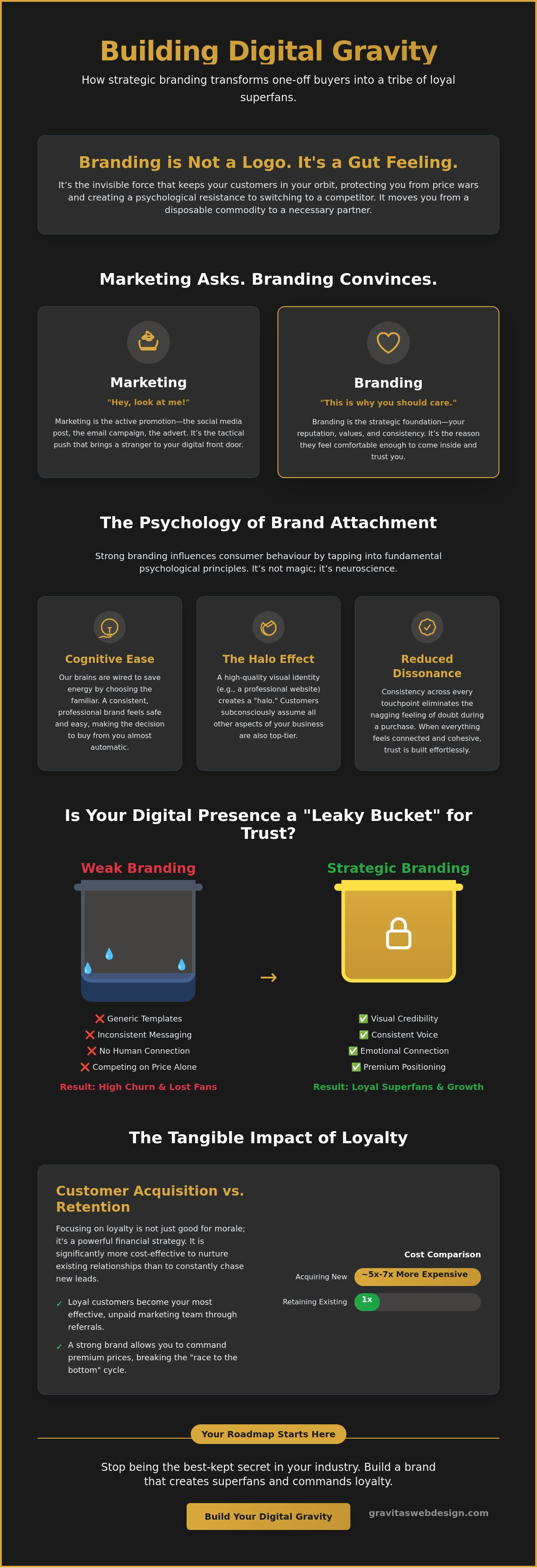
Branding isn’t just a shiny logo or a specific hex code for your favourite shade of blue. It’s actually the gut feeling a customer has when they hear your name. Think of it as your reputation on steroids. We’ve seen too many businesses focus solely on transactional sales, those one-off buys that keep the lights on but don’t build a future, rather than focusing on relational branding that creates lifelong fans. The real impact of branding on customer loyalty is that it builds what we call Digital Gravity. It’s that invisible force that keeps your customers tethered to your orbit, even when the market gets noisy or a cheaper competitor pops up with a flashy advert.
If you’re competing on price alone, you’re already in a race to the bottom. It’s a exhausting cycle where the only winner is the one with the smallest profit margin. There will always be someone willing to do the job cheaper, but there shouldn’t be anyone who can do it with your specific flair. A strong brand protects you from this trap by moving your business from being a disposable commodity to being a necessary partner. When you have a clear identity, you stop being a line item on a spreadsheet and start being a name people trust.
The Difference Between Marketing and Branding
Marketing is essentially the ask. It’s the social post or the email that says, “Hey, look at me!” Branding, on the other hand, is the reason they actually say yes. Whilst marketing might bring a stranger to your front door, your branding is what makes them feel comfortable enough to come in and stay for tea. A faceless business feels cold and corporate; it’s hard to be loyal to a ghost. In a world that craves authenticity, showing the human side of your work is your greatest competitive advantage because people buy from people they like.
Why Loyalty Matters More Than Ever
Let’s talk numbers without the boring spreadsheet. It’s common knowledge amongst growth experts that the cost of acquiring a new customer is significantly higher than keeping an existing one. A loyal customer base isn’t just a safety net; it’s your most effective, unpaid marketing team. They refer you automatically because they trust your consistency. Brand loyalty is the psychological resistance to switching to a competitor even when they offer a lower price. When you truly understand the impact of branding on customer loyalty, you stop chasing every single lead and start nurturing a community that genuinely wants you to succeed.
The Psychology of Attachment: How Branding Influences Consumer Behaviour
Ever wondered why you reach for the same brand of tea every time you’re in the supermarket? It’s not just habit; it’s your brain trying to save energy. This fundamental human behaviour is at the heart of the impact of branding on customer loyalty. Our brains are hardwired to seek ‘Cognitive Ease.’ If a business looks familiar, polished, and consistent, it feels safe. When you present a professional image, you’re essentially giving your customer’s brain a rest, making the decision to buy from you much easier than choosing a competitor they don’t recognise.
This leads us to the ‘Halo Effect.’ It’s a psychological bias where our overall impression of a person or brand influences how we feel about their specific traits. If you invest in professional logo design in London, people don’t just see a pretty icon. They subconsciously assume your customer service, your technical skills, and your reliability are also top-tier. You’re using visual shorthand to communicate quality before you’ve even said a word.
Templates can’t do this. They lack the emotional resonance needed to build a real human-to-human connection. Whilst templates might be cheap and quick, they lack the soul your business deserves. Research into the impact of brand authenticity suggests that customers are far more likely to stick around when they feel a genuine bond. Consistent branding also reduces ‘Cognitive Dissonance,’ that nagging feeling of doubt during a purchase. When every touchpoint feels the same, the fear of the unknown vanishes.
The Power of Recognition and Familiarity
Consistency creates a memory shortcut. When you use the same colours and typography across your website and social media, you’re training people to recognise you instantly. This is the ‘Mere Exposure Effect’ in action: the more often people see you, the more they tend to like you. Think of your brand like a friend. If your friend turned up one day as a corporate lawyer and the next as a bohemian surfer, you’d be a bit concerned, wouldn’t you? Inconsistent branding does the same thing to your audience; it makes you seem unreliable.
Trust as a Non-Negotiable Foundation
People buy from people they trust. Branding is the visual evidence of that trust. If your website looks like a ‘budget’ DIY project, you’re sending a signal that you might not care about the finer details of your work either. Why should a client trust you with their hard-earned money if you haven’t invested in your own presence? When you master the impact of branding on customer loyalty, you’re not just selling a service; you’re selling certainty. Building brand equity through a clear mission and shared values is the final piece of the puzzle. If you’re ready to move away from the ‘budget’ look, you can always book a discovery call to see how we can help.
The Loyalty Loop: Four Pillars of an Irresistible Brand Identity
Creating a brand that people actually stick with isn’t about luck or having a massive marketing budget. It’s about building a solid structure that supports that “gut feeling” we talked about earlier. To truly harness the impact of branding on customer loyalty, you need to move beyond the surface level. Think of these four pillars as the foundation of your business house. If one is shaky, the whole thing might just come toppling down when a competitor offers a 10% discount.
The first pillar is Visual Credibility. Your website is often the first “handshake” a potential client has with your business. If you are using a generic, clunky template, you are essentially turning up to a black-tie event in a tracksuit. Investing in bespoke web design in Birmingham ensures your digital presence reflects your unique value rather than looking like everyone else’s. When you look the part, customers assume you can do the part.
Next, you need a Consistent Voice. Whether you are based in London or Sutton Coldfield, your copy needs to sound like a human, not a corporate robot. People connect with personalities, not polish. This pairs perfectly with Shared Values. Customers today are savvy; they remain loyal to brands that stand for something beyond just making a profit. Finally, there is the Customer Experience (CX). Every single touchpoint, from the tiny favicon in the browser tab to the very bottom of your footer, must scream quality and care.
Consistency is the Secret Sauce
We often see the danger of “Brand Fragmentation.” This happens when your LinkedIn profile looks like a buttoned-up lawyer, but your website feels like a chaotic art gallery. This inconsistency breeds doubt. Organising your brand guidelines ensures your team and your customers always know what to expect. Often, a rebranding strategy for small business is less about changing who you are and more about finding that lost consistency to restore your professional pride.
Storytelling: Your Competitive Edge
Facts tell, but stories sell. More importantly, stories keep people coming back for more. The secret is to position your customer as the hero of the story, whilst you act as the guide. Whether you are crafting a narrative for local audiences in Lichfield or a global market in London, your story should resonate with their specific pains and desires. When a customer sees themselves in your brand’s journey, they stop being a buyer and start being a part of your tribe.
Measuring the Impact: How to Tell if Your Branding is Actually Working
How do you actually know if your brand is doing the heavy lifting or just sitting there looking pretty? It is easy to get caught up in vanity metrics like followers or likes, but the real impact of branding on customer loyalty shows up in your bank balance and your peace of mind. You are looking for proof that you have moved from being a replaceable vendor to a non-negotiable partner. If you are not seeing these shifts in your data, it might be time to audit your professional presence and see where the disconnect lies.
The ultimate proof is Customer Lifetime Value (CLV). This isn’t just a fancy acronym; it is the total amount of money a customer spends with you over the entire relationship. If they keep coming back for more, your branding is working. It means they trust you enough to skip the research phase and come straight to the source. Then there are referral rates. When your customers become your unpaid sales force, referring friends and colleagues without being asked, you have achieved brand advocacy. Finally, look at your price elasticity. A strong brand allows you to raise your prices to reflect your true value without losing your tribe. If they are only with you for the bargain, they aren’t loyal; they are just thrifty.
The “Would They Miss You?” Test
Be honest: if your business vanished tomorrow, would your customers genuinely miss you, or would they just find another supplier in five minutes? This is the difference between being a commodity and a community staple. You can check the pulse of your brand health by looking at social media engagement. Are people actually talking to you, or are you just shouting into the void? True brand advocacy means your audience feels a sense of ownership over your success, providing long-term stability that no marketing campaign can buy.
Tracking Digital Sentiment
Your reviews and testimonials act as a mirror for your brand identity. Pay close attention to the specific words people use to describe you. Do they mention your “professionalism” and “personality,” or just your “price”? Even “boring” businesses, like insurance or plumbing, can inspire fanatical loyalty through a brand that feels human and reliable. It is about the emotional residue you leave behind after a transaction is finished. True loyalty is measured by the total absence of a search for alternatives.
Turning Strangers into Superfans: Your Roadmap to a Loyal Community
You have seen the data. You know that the impact of branding on customer loyalty isn’t just a collection of buzzwords; it is the actual engine behind your business’s long-term survival. But how do you stop being a face in the crowd and start being the brand your customers wouldn’t dream of leaving? It starts by closing the gap between the high-quality work you do and the way the world currently perceives you. If you are just starting out, the smartest move is a startup branding package in London that sets your foundation correctly from day one. Don’t build on sand.
The Gravitas Web Design approach is built on a simple truth: we prefer human-to-human design over corporate fluff. We want to help you audit your current presence to see if your website is a “leaky bucket” for customer trust. You might be brilliant at what you do, but if your digital home feels outdated or clunky, you are losing loyalty before the first conversation even begins. The impact of branding on customer loyalty is most visible when your visual identity finally matches your professional pride.
Don’t Let a Bad Website Kill Your Brand
Poor UX design actively erodes the loyalty you have worked so hard to build. If a customer struggles to navigate your site or find the information they need, they don’t feel valued. They feel ignored. This is why corporate identity design in London needs to feel expensive but approachable. Remember, “good enough” is usually the enemy of “unforgettable.” If you want superfans, you cannot settle for a template that looks like everyone else’s.
Your Next Steps to Brand Brilliance
It is time to take action. Start with a candid brand audit. Look in the digital mirror and ask yourself if your website actually represents the quality of your work. Once you have identified the gaps, focus on one pillar of the loyalty loop at a time. Maybe you need to refine your visual credibility or perhaps your brand voice needs a bit more soul. Whatever the first step is, do not wait for a “perfect” time to begin. Your future superfans are already out there looking for you. Stop being the best-kept secret and start building a brand that lasts.
Ready to Trade Transactional Sales for Lifelong Superfans?
We have explored how a professional identity acts as digital gravity, keeping your clients close even when competitors try to lure them away with lower prices. From the psychological power of the Halo Effect to the four pillars of the Loyalty Loop, it is clear that the impact of branding on customer loyalty is the difference between a business that survives and one that thrives. You don’t have to be a faceless corporation to command respect; you just need a brand that finally matches the quality of your work.
At Gravitas Web Design, we specialise in expert branding for professional services across Birmingham, Lichfield, and London. Our approach is built on radical transparency. We will tell you exactly what you need to succeed without trying to sell you expensive fluff you don’t actually require. It is about creating that human-to-human connection that cuts through the noise and builds genuine trust.
Your expertise deserves a digital presence that makes you feel proud. It is time to stop being the best-kept secret in your industry and start building a legacy that lasts.
Frequently Asked Questions
Does branding really affect customer loyalty for small businesses?
Yes, branding is actually more critical for small businesses because it is your reputation’s digital suit. It moves you from being a faceless, replaceable option to becoming a recognisable and trusted partner. When people feel they genuinely know your business, they are far less likely to shop around for a cheaper alternative. This is the core impact of branding on customer loyalty: it creates a psychological barrier against your competitors.
How long does it take for branding to impact customer retention?
You will see a shift in perception almost instantly, but true loyalty takes a bit of time to bake. Most professional services notice a change in the quality of their leads and client retention within three to six months of a brand refresh. It is a long-term play that relies on building a track record of consistency across every digital touchpoint until you become the default choice.
Is a professional logo enough to build brand loyalty?
A logo is a great start, but it is only the tip of the iceberg. Think of a logo as the face of your business; it is how people recognise you in a crowd. However, your personality, values, and the way you treat people are why they actually stay. Loyalty is built on the substance and the human connection that sits behind the visual symbol.
Can I build customer loyalty with a template-based website?
It is possible, but you are essentially playing on “hard mode.” Templates often look like hundreds of other sites, which makes your business feel generic and easily replaceable. To truly master the impact of branding on customer loyalty, you need a bespoke presence that reflects your specific value. A custom site shows you have invested in your own excellence, which encourages clients to do the same.
What is the most important factor in brand loyalty?
Trust is the non-negotiable foundation of every loyal relationship. If a customer doesn’t trust that you will deliver exactly what you promised, no amount of pretty colours or clever copy will save the relationship. Consistency in your message, your visuals, and your actual work is what cements that trust over time. When you are consistent, you become a safe bet for your clients.
How much should a small business spend on branding to see an impact?
Instead of looking for a fixed price, think of branding as an investment in your business’s future stability. You should spend enough to ensure your digital presence doesn’t look like a “budget” DIY project that scares away premium clients. The goal is to create a professional identity that lasts for years, rather than a cheap fix that needs replacing every six months.
Does rebranding risk losing my existing loyal customers?
Done correctly, rebranding actually strengthens your bond with existing customers rather than alienating them. It shows your “tribe” that you are growing, evolving, and investing in your own excellence. As long as your core values and the quality of your work remain the same, your loyal clients will usually be your biggest cheerleaders during the transition. It gives them a fresh reason to talk about you.
How do I know if my brand voice is resonating with my audience?
Pay close attention to the way your clients talk back to you in emails, social media comments, and reviews. If they are using the same language or tone you use in your copy, your brand voice is hitting the mark. When your audience begins to mirror your communication style, it is a clear sign that you have moved beyond a transaction and created a genuine connection.